Table of Contents:
- Best Event Apps of 2026 at a Glance
- Feature Comparison Matrix
- Why Your Event App Matters More Than Ever in 2026
- What to Look For in an Event App
- Top 5 Event App Platforms of 2026
- Best Mobile Event Apps vs Best Enterprise Event Apps
- Choosing an Event App by Event Type
- Choosing an Event App by Attendee Size
- The 2026 Features That Actually Move the Needle
- How Amego Powers Enterprise Conferences
- Quick Tips to Get More Out of Any Event App
- Event App FAQ
The best event apps in 2026 combine mobile-first attendee experiences with personalized agendas, networking, real-time updates, engagement tools, sponsor features, and analytics. The right platform depends on your event type, audience size, integrations, and how much customization you need.
Event people know a bad app faster than anyone. It freezes during registration. It doesn't reflect the schedule change you made at 11pm. It shows attendees a networking tab nobody set up. And when something breaks at 8am on day one, the support ticket goes nowhere.
2026 has given the market a lot of options, and they're built for different jobs. This guide is the category overview: what the best event apps do, who each one fits, and where to go deeper. Amego's mobile event app is included, and we say so up front, since this guide is published on the Amego blog.
Looking for something more specific? Compare vendors in the best event apps for conferences and corporate events, learn how to choose an event app for a conference, plan a large conference app search, or use the enterprise event app buyer's guide.
Best Event Apps of 2026 at a Glance
Feature Comparison Matrix
The at-a-glance table above shows positioning. This matrix compares the specifics enterprise buyers evaluate: white-label depth, AI personalization, security certifications, native networking, sponsor ROI tooling, and starting price. Each row reflects what the vendors publish on their own websites and third-party review sites like G2 as of October 2026.
Pricing matters here. Most vendors require a sales call before quoting; Amego publishes plans on the pricing page. For enterprise programs above 1,500 attendees, every platform in this list quotes custom, so your evaluation should include a scoped quote based on actual registration numbers, SSO, and sponsor count rather than list pricing alone.
Why Your Event App Matters More Than Ever in 2026
There was a time when the event app was a nice-to-have. A digital version of the printed program, maybe with push notifications. That era ended a few years ago.
Today, the app is where attendees navigate the venue, book 1:1 meetings, collect session resources, find their cohort, and get real-time updates when something changes. For organizers, it's where engagement gets measured, sponsor ROI gets demonstrated, and post-event data gets harvested. For sponsors and exhibitors, it's often the difference between walking away with 200 qualified leads and walking away with a stack of business cards nobody will follow up on.
A bad event app doesn't just create friction. It signals to every attendee that the experience wasn't thought through. A good one disappears into the background, because it does exactly what's needed, exactly when it's needed. That's the standard worth holding these platforms to.
What to Look For in an Event App
The gap between adequate and excellent comes down to a few things.
Speed of updates. Real-time content changes matter. Room changes happen. Speakers cancel. Sessions get moved. The apps that win are the ones where an organizer can update a session location at 7am and every attendee's phone reflects it before they finish their coffee.
Offline reliability. Whether it's a festival with overloaded cell towers or a convention center with spotty Wi-Fi, the app has to work when connectivity doesn't. Apps that require a live connection at the moment someone needs directions to a breakout room are apps that get complained about on LinkedIn.
Networking that actually gets used. Most apps have a people tab. Almost nobody uses it. The difference is friction. If setting up a meeting takes six taps and a profile nobody pre-filled, it doesn't happen. The apps that drive real connections are the ones that reduce friction at every step. Our comparison of conference networking apps breaks down which platforms get this right.
Data that means something. Session attendance, push notification open rates, exhibitor booth scans, networking connections made. These numbers matter to organizers and sponsors. An app that doesn't surface them isn't a data asset. It's a black box.
Integrations that hold. Enterprise conferences run on registration platforms, event management systems, and CRM tools. An app that requires a manual CSV export the night before isn't enterprise-grade. It's a liability.
If you’re evaluating platforms specifically for a conference, our guide to choosing the right event app for your conference walks through the features and decision criteria to consider.
Top 5 Event App Platforms of 2026
1. Amego
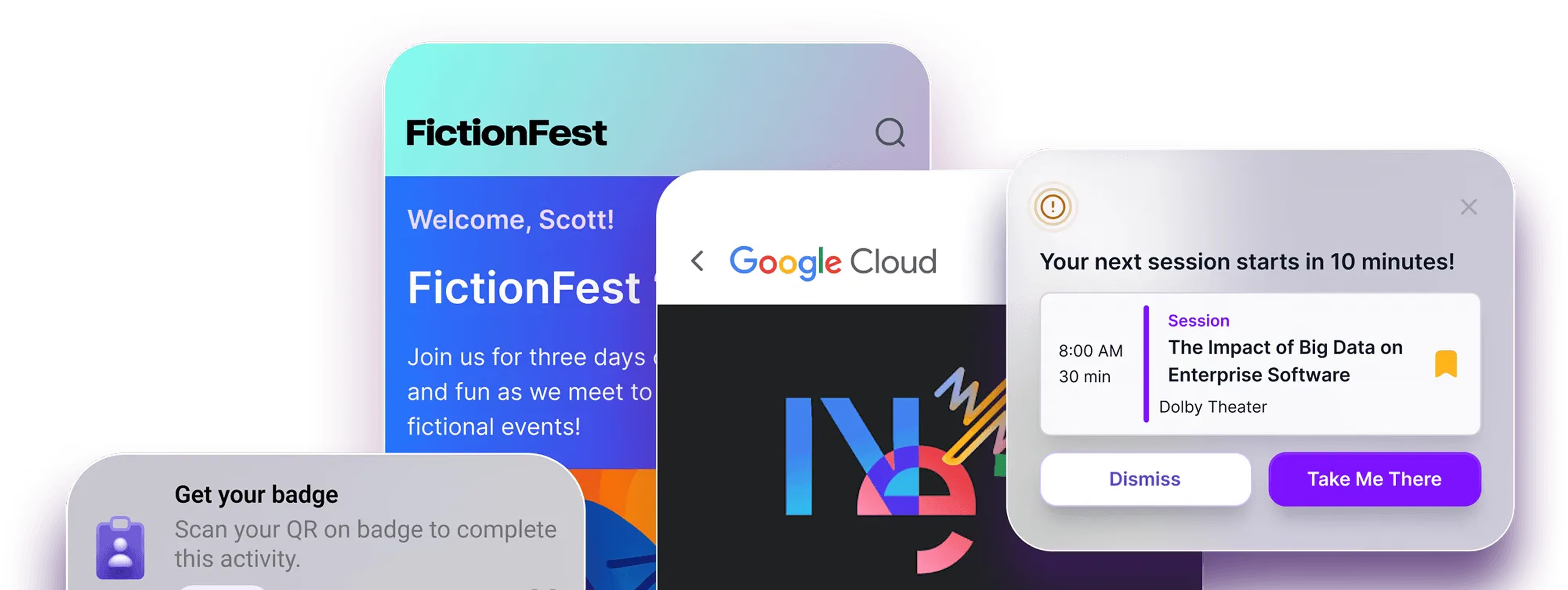
Amego is built for large-scale, professional events where brand, attendee experience, and sponsor ROI all have to work at the same time. The Amego Classic mobile app is fully white-labeled, Amego Admin lets organizers push real-time content changes without a developer, and Sidekick (Amego's AI event companion) personalizes the agenda for each attendee. Teams at Atlassian, Cloudflare, Google Cloud Next, ServiceNow, Nutanix, Docusign, and Palo Alto Networks use Amego. Amego is SOC 2 Type II audited and aligned with GDPR requirements. On G2, it was named a Leader in the Mobile Event Apps Grid in the Summer 2026 report.
Best for: Enterprise and corporate events.
2. Cvent Attendee Hub
Cvent Attendee Hub is a module inside the broader Cvent event management ecosystem. Its strongest use case is teams already running registration, sourcing, and lead retrieval through Cvent, where the Attendee Hub connects to everything else without a custom data pipeline. Teams outside the Cvent ecosystem may find it more than they need. See our Cvent Attendee Hub alternatives guide for a G2-based comparison.
Best for: Existing Cvent customers.
3. Whova
Whova has one of the most active community boards in the space and strong profile-based matchmaking, which makes it a common pick for academic conferences and professional associations. Teams that need deep brand customization or enterprise features like AI personalization may want to compare options. Our Whova alternatives guide covers how reviewers on G2 rate the two.
Best for: Associations and community events.
4. Bizzabo
Bizzabo is known for its marketing and CRM integrations, and its Klik SmartBadge adds a networking layer for brand-forward events. It is typically evaluated by marketing teams that want to connect event engagement to pipeline.
Best for: B2B marketing events.
5. EventMobi
EventMobi covers a broad set of event app tools with a flexible builder that mid-market teams tend to find fast to configure. Teams running large, heavily branded enterprise programs may want to compare it against enterprise-focused options. See EventMobi alternatives for details.
Best for: Mid-market events.
Best Mobile Event Apps vs Best Enterprise Event Apps
Teams searching for the best mobile event apps and the best enterprise event apps are usually solving related but different problems. A mobile event app is any attendee-facing phone app for an event. An enterprise event app is a mobile app engineered for the security, scale, integration, and brand requirements large organizations are accountable to.
What a best-in-class mobile event app includes
Native iOS and Android with offline mode. Personalized agenda with session bookmarking. Real-time push notifications with segmentation. In-app networking with 1:1 meeting booking. Exhibitor directory with lead scanning. Session Q&A, polls, and live surveys. Branded home screens, colors, and icons. Any of the five platforms above meet this baseline. The differentiator is depth: how much the app can adapt to your brand, your workflows, and your audience without a professional-services engagement.
What a best-in-class enterprise event app adds
Single sign-on and SCIM provisioning. SOC 2 Type II and GDPR documentation available on request. Role-based access controls across the admin platform. Audit logs. Private attendee directories gated by registration tier. Native integration with registration (Swoogo, Cvent, RainFocus), MAP and CRM systems (Marketo, HubSpot, Salesforce), and SSO providers (Okta, Entra ID). Scalability tested at 10,000+ concurrent users without degrading push delivery or search response. Dedicated customer success and real-time event-day support. A full white-label build, not a container with a logo swap.
Of the platforms in this guide, Amego and Cvent most consistently meet the enterprise criteria out of the box. Bizzabo meets most of them for marketing-driven programs. Whova and EventMobi are stronger fits for mid-market, association, and community events where the enterprise control plane is less critical than ease of setup.
Choosing an Event App by Event Type
The right event app depends as much on the shape of the event as on the platform itself. Here is how to think about the fit by event type.
Conferences and corporate events
Running a professional conference or corporate event? See our full comparison of the best event apps for conferences and corporate events. For enterprise conferences with dense multi-track agendas, sponsor programs, and brand requirements, Amego is built for that use case, and Cvent Attendee Hub is a natural alternative for teams already inside the Cvent ecosystem. If you're vetting an enterprise event app for a large, multi-track conference, start with scalability, security, and integrations.
Associations and member events
Annual meetings, chapter events, and member conferences need an app that less tech-forward attendees can pick up in seconds, community features that keep members talking after the event, and sponsor tools that support non-dues revenue. Our breakdown of the best event apps for associations compares six platforms side by side.
Festivals and consumer events
Music festivals, food expos, arts fairs, and fan conventions have different requirements than professional conferences. The audience is broader, connectivity is worse, and people are there for the experience rather than the pipeline. Lineup personalization synced to streaming services, offline functionality that caches everything before the gates open, cashless in-app payments, and group coordination features do the heavy lifting. Gamification, badge scans, and challenge check-ins keep floor traffic moving and give sponsors a measurable ROI story.
Trade shows and conventions
Trade shows and B2B conventions live and die by lead capture. The tools that matter are exhibitor lead scanning with qualification fields sponsors control, an in-app exhibitor directory with booth locations and promoted placements, and networking that surfaces the buyer or partner an attendee actually needs to meet. Amego's lead scanning and sponsor tools are built around these use cases; specialized matchmaking platforms like Grip and b2match are common companions for hosted-buyer programs.
Internal events
Sales kickoffs, company all-hands, executive summits, and internal offsites need a secure branded environment more than a public-facing brand experience. Look for SSO, role-based access, private attendee directories, and content controls that fit your internal comms and legal requirements. Amego's solutions for internal event teams cover SKOs, offsites, and corporate kickoffs.
Choosing an Event App by Attendee Size
Attendee size changes what matters most. The feature list stays similar; the operational requirements and risk profile change a lot.
500 to 1,000 attendees
Single track or lightly multi-track. One admin can manage most of the content. The priorities are a fast setup, a clean attendee experience, and a networking tool that gets used. Price-published tiers like Amego Base ($2,499/yr) or Elevate ($4,999/yr) usually fit this range. White-label depth matters less than configuration speed. EventMobi and the Amego Base plan are common picks here.
1,000 to 5,000 attendees
Multi-track with dedicated breakout and sponsor areas. One or two admins and a professional-services onboarding or in-house champion. The priorities shift to integrations with registration, segmentation for push notifications, sponsor reporting, and a stable native app with offline mode. Amego, Bizzabo, and Cvent Attendee Hub are the typical shortlist. Enterprise security review is usually required.
5,000 to 10,000 attendees
Deep multi-track programs with concurrent keynote and breakout sessions, full sponsor programs, and a brand team involved. Full white-label is now a brand requirement rather than a nice-to-have. SSO, SCIM, and SOC 2 Type II documentation are typically a precondition for buying. Amego and Cvent Attendee Hub are the realistic enterprise picks. For a sense of what this looks like in practice, Atlassian runs 20+ global events on one Amego instance, managed by a single team, and reported 10x more survey responses after moving to Amego. See the Atlassian success story.
10,000+ attendees
Flagship enterprise programs like Google Cloud Next or Palo Alto Networks' Ignite. The app has to perform under peak load during keynote push bursts, support dozens of sponsor configurations, integrate with multiple registration and CRM systems, and give the brand team the control to make the app look and feel like a shipped product. This is Amego's core customer profile. Cvent Attendee Hub competes at this size for teams fully standardized on Cvent.
The 2026 Features That Actually Move the Needle
The platforms leading in 2026 have moved past the "does it have a schedule?" question. Here's where the real differentiation sits.
AI that does something specific. The apps that have added AI as a feature feel like AI added to an app. Amego built Sidekick as the attendee experience itself, a layer that personalizes and guides rather than just answers. When an attendee opens the app between sessions at a 10,000-person conference and Sidekick shows them two sessions they didn't know about and one exhibitor booth that matches what they told the registration form they were looking for, that's AI earning its keep. Not "AI-powered." Doing something.
Real-time push notifications with audience targeting. The difference between a push notification strategy and a push notification blast is segmentation. Amego lets organizers target by attendee type, session track, registration tier, or any attribute in the system. A general attendee and a VIP sponsor shouldn't be getting the same message at 9am.
Gamification with real sponsor ROI. Quest challenges built around sponsor booth visits give exhibitors a measurable ROI story that goes beyond "your logo was in the app," which makes renewal conversations easier.
Integrations that sync, not just import. Amego's integration layer connects with registration platforms like Swoogo, Cvent, and others so that session data, attendee attributes, and registration records stay current throughout the event cycle.
An engagement suite that keeps working mid-event. Live Q&A, polls, surveys, in-app news feeds. These features keep attendees participating rather than passively watching. Organizers manage all of it from Amego Admin in real time.
How Amego Powers Enterprise Conferences
Amego is built for professional events where the app is part of the brand and the stakes are high. Here is how the platform covers what enterprise teams ask for.
The Amego Classic mobile app is fully white-labeled: your colors, fonts, icons, and home screens carry through the whole experience as a native iOS and Android app. Atlassian calls Amego its "Goldilocks solution," agile enough for the team to move fast. Atlassian runs 20+ global events on one app, managed by a single team, and saw 10x more survey responses than at previous events. Read the Atlassian success story.
Amego Admin is where organizers manage sessions, speakers, sponsors, attendees, push notifications, and gamification challenges without a developer, and updates reach attendee devices while the event is live.
Sidekick is Amego's agentic AI layer, built into the attendee experience. It builds personalized schedules, matches attendees with people, sessions, and sponsors, helps with wayfinding, and sends just-in-time nudges during the event. Enterprise customers can connect their own LLM deployment for data privacy and control.
Quest is Amego's gamification system. Sponsor-specific challenges, attendee challenges, and internal team challenges can run side by side, which gives exhibitors a way to drive booth traffic and measure it.
Networking includes 1:1 meeting booking, attendee chat, and connection tools that use registration data, so profiles aren't empty. Lead scanning for sponsors includes qualification fields that exhibitors define, with exports they can act on right away.
On security, Amego is SOC 2 Type II audited and aligned with GDPR requirements, and its approach is documented on the security and compliance page. SSO is available as an add-on.
On proof, Cloudflare reported 98% adoption for its sales kickoff and a 4.65+ average session rating after moving to Amego. See the Cloudflare story. On G2, Amego was named a Leader in the Mobile Event Apps Grid and a High Performer in Event Management Platforms, with 100% scores for Quality of Support and Ease of Doing Business With.
Quick Tips to Get More Out of Any Event App
A few habits make a real difference regardless of which platform your event is running.
Set up early. Download and complete your profile at least 48 hours before you arrive. The networking tools, session bookmarking, and personalized recommendations all work better when the profile is complete before you walk in the door. Attendees who set up early have more to work with when they arrive.
Plan push notifications in advance. Last-minute blasts feel chaotic to attendees and undercut the experience the rest of the event is trying to create. A pre-built notification schedule, session reminders, sponsor activations, Quest milestones, feels like a service.
Give sponsors the tools, not just the logo. An app that gives exhibitors a branded profile, a lead scanning tool, and qualified data exports changes the post-event conversation. Sponsors that see ROI come back. Sponsors that get a logo listing don't.
Use the data. Session attendance rates, networking connections, push open rates, Quest completion by track. This data shapes next year's program and gives the event team something concrete to bring to leadership.
If you're planning a conference above 500 attendees and want to see what the platform looks like in practice, Amego offers a full demo that covers the attendee app, Amego Admin, Sidekick, Quest, sponsor tools, and lead scanning in about 30 minutes. It's worth the time before you sign anything.
The events that matter most deserve an app that was built for them. Not one that was built for someone else and adapted.
Explore more: event networking, event gamification with Quest, and what enterprise event organizers actually need from an event app.
Event App FAQ
What is the best event app in 2026?
The best event app depends on your event type, audience size, integrations, and how much customization you need. Amego suits enterprise and corporate events, Whova is common for associations, Cvent Attendee Hub fits teams already using Cvent, and Bizzabo and EventMobi serve B2B marketing and mid-market events.
What is the best mobile event app?
The best mobile event app is one with native iOS and Android, offline mode, personalized agenda, 1:1 meeting booking, segmented push notifications, exhibitor directory, and real-time admin updates. For enterprise programs, Amego and Cvent Attendee Hub lead the mobile event app category. For mid-market and community events, Whova and EventMobi are strong picks.
What is the best enterprise event app?
An enterprise event app has to meet security, scale, integration, and brand standards: SOC 2 Type II, SSO and SCIM, integrations with registration and CRM, and a fully white-labeled native app that can carry a flagship brand. Amego is purpose-built for enterprise event programs and is used by Atlassian, Cloudflare, Google Cloud Next, Palo Alto Networks, Nutanix, and ServiceNow. Cvent Attendee Hub is a common alternative for teams already standardized on Cvent.
What is the best event app for conferences?
For conferences, look for a personalized agenda, networking, real-time notifications, sponsor tools, and integrations with registration. For large or enterprise conferences, add full branding control, security documentation, and AI personalization. Amego is built for that use case.
What is a white-label event app?
A white-label event app is a mobile event app that carries your organization's brand instead of the vendor's. The strongest white-label offerings publish a native iOS and Android app to the stores under your name, with your colors, fonts, icons, and home screens throughout. Amego's Classic app is fully white-labeled. Branded containers that live inside a vendor-named parent app are a weaker form of white-label and are usually what competitors mean when they say "custom branding."
What security features should enterprise event apps provide?
Enterprise event apps should offer SOC 2 Type II, GDPR alignment, SSO (SAML and OIDC), SCIM provisioning, role-based access, audit logs, and encryption at rest and in transit. Private attendee directories gated by registration tier, data-residency options, and a signed MSA that covers DPA requirements are standard requests. Amego publishes its approach on the security and compliance page.
How much does an event app cost?
Costs vary by features, attendee volume, and branding. Amego's published plans start at $2,499 per year (Base, 500 attendees included) and $4,999 per year (Elevate, 750 attendees included), with Enterprise quoted for larger programs. Most other vendors in this guide do not publish pricing and quote after a scoping call.
What features matter most in an event app?
Speed of content updates, offline reliability, networking people actually use, useful data, and integrations that sync with registration and CRM. AI features matter when they do something specific, like recommending sessions or nudging attendees at the right time.
Is there an AI event app?
Yes. An AI event app adds an assistant that personalizes the agenda, recommends sessions and people, and sends timely nudges. Amego's Sidekick is an example. Our guide to what an AI-powered event app is explains the category.
Related guides: best event apps for associations, best event apps for trade shows, best white-label event apps, and event app ROI.

Sign up for our newsletter
Get insights delivered to your email.