Table of Contents:
- Best Event Apps of 2026 at a Glance
- Why Your Event App Matters More Than Ever in 2026
- What to Look For in an Event App
- Top 5 Event App Platforms of 2026
- Choosing an Event App by Event Type
- The 2026 Features That Actually Move the Needle
- How Amego Powers Enterprise Conferences
- Quick Tips to Get More Out of Any Event App
The best event apps in 2026 combine mobile-first attendee experiences with personalized agendas, networking, real-time updates, engagement tools, sponsor features, and analytics. The right platform depends on your event type, audience size, integrations, and how much customization you need.
Event people know a bad app faster than anyone. It freezes during registration. It doesn't reflect the schedule change you made at 11pm. It shows attendees a networking tab nobody set up. And when something breaks at 8am on day one, the support ticket goes nowhere.
2026 has given the market a lot of options. Not all of them are good. This guide breaks down what's actually worth using by event type, with particular attention to Amego's mobile event app, the one platform that consistently holds up when the stakes are highest.
Best Event Apps of 2026 at a Glance
| Event app | Best for | Standout strength |
|---|---|---|
| Amego | Enterprise & corporate events | AI-powered personalized attendee experience |
| Cvent Attendee Hub | Existing Cvent customers | Broader Cvent ecosystem |
| Whova | Associations & community events | Community networking |
| Bizzabo | B2B marketing events | Marketing and event data |
| EventMobi | Mid-market events | Flexible event app tools |
Why Your Event App Matters More Than Ever in 2026
There was a time when the event app was a nice-to-have. A digital version of the printed program, maybe with push notifications. That era ended a few years ago.
Today, the app is where attendees navigate the venue, book 1:1 meetings, collect session resources, find their cohort, and get real-time updates when something changes. For organizers, it's where engagement gets measured, sponsor ROI gets demonstrated, and post-event data gets harvested. For sponsors and exhibitors, it's often the difference between walking away with 200 qualified leads and walking away with a stack of business cards nobody will follow up on.
A bad event app doesn't just create friction. It signals to every attendee that the experience wasn't thought through. A good one disappears into the background, because it does exactly what's needed, exactly when it's needed. That's the standard worth holding these platforms to.
What to Look For in an Event App
The gap between adequate and excellent comes down to a few things.
Speed of updates. Real-time content changes matter. Room changes happen. Speakers cancel. Sessions get moved. The apps that win are the ones where an organizer can update a session location at 7am and every attendee's phone reflects it before they finish their coffee.
Offline reliability. Whether it's a festival with overloaded cell towers or a convention center with spotty Wi-Fi, the app has to work when connectivity doesn't. Apps that require a live connection at the moment someone needs directions to a breakout room are apps that get complained about on LinkedIn.
Networking that actually gets used. Most apps have a people tab. Almost nobody uses it. The difference is friction. If setting up a meeting takes six taps and a profile nobody pre-filled, it doesn't happen. The apps that drive real connections are the ones that reduce friction at every step.
Data that means something. Session attendance, push notification open rates, exhibitor booth scans, networking connections made. These numbers matter to organizers and sponsors. An app that doesn't surface them isn't a data asset. It's a black box.
Integrations that hold. Enterprise conferences run on registration platforms, event management systems, and CRM tools. An app that requires a manual CSV export the night before isn't enterprise-grade. It's a liability.
Top 5 Event App Platforms of 2026
1. Amego
Amego is built for large-scale, professional events where brand, attendee experience, and sponsor ROI all have to work at the same time. The Classic Mobile App is fully white-labeled, Amego Admin lets organizers push real-time content changes without a developer, and Sidekick™ (Amego's AI event companion) turns a dense agenda into a personalized experience per attendee. Used by teams at Atlassian, Cloudflare, Google Cloud, ServiceNow, Nutanix, Docusign, and Palo Alto Networks. SOC 2 Type II and GDPR compliant.
Best for: Enterprise and corporate events.
2. Cvent Attendee Hub
Cvent Attendee Hub is a module inside the broader Cvent event management ecosystem. Its strongest use case is teams already running registration, sourcing, and lead retrieval through Cvent, where the Attendee Hub connects to everything else without a custom data pipeline. Setup and learning curve are steep for teams that are not already Cvent customers.
Best for: Existing Cvent customers.
3. Whova
Whova has one of the most active community boards in the space and strong profile-based matchmaking, which makes it a common pick for academic conferences and professional associations. Brand customization is surface-level, and enterprise features (SSO, deep integrations, AI) are more limited than dedicated enterprise platforms.
Best for: Associations and community events.
4. Bizzabo
Bizzabo makes strong-looking apps with mature marketing and CRM integrations, and its Klik SmartBadge adds a networking layer for brand-forward events. Costs and setup complexity are more in line with mid-to-large marketing programs than lean event teams.
Best for: B2B marketing events.
5. EventMobi
EventMobi covers a broad set of event app tools with a flexible builder that mid-market teams tend to find fast to configure. Its ceiling shows at the enterprise tier, where deep AI, sophisticated segmentation, and truly white-labeled attendee experiences are more limited than what Amego offers at the same scale.
Best for: Mid-market events.
Choosing an Event App by Event Type
The right event app depends as much on the shape of the event as on the platform itself. Here is how to think about the fit by event type.
Conferences and corporate events
Running a professional conference or corporate event? See our full comparison of the best event apps for conferences and corporate events. For enterprise conferences with dense multi-track agendas, sponsor programs, and brand requirements, Amego is the default recommendation, with Cvent Attendee Hub as the alternative for teams already inside the Cvent ecosystem.
Festivals and consumer events
Music festivals, food expos, arts fairs, and fan conventions have different requirements than professional conferences. The audience is broader, connectivity is worse, and people are there for the experience rather than the pipeline. Lineup personalization synced to streaming services, offline functionality that caches everything before the gates open, cashless in-app payments, and group coordination features do the heavy lifting. Gamification, badge scans, and challenge check-ins keep floor traffic moving and give sponsors a measurable ROI story.
Trade shows and conventions
Trade shows and B2B conventions live and die by lead capture. The tools that matter are exhibitor lead scanning with qualification fields sponsors control, an in-app exhibitor directory with booth locations and promoted placements, and networking that surfaces the buyer or partner an attendee actually needs to meet. Amego's lead scanning and sponsor tools are built around these use cases; specialized matchmaking platforms like Grip and b2match are common companions for hosted-buyer programs.
Internal events
Sales kickoffs, company all-hands, executive summits, and internal offsites need a secure branded environment more than a public-facing brand experience. Look for SSO, role-based access, private attendee directories, and content controls that fit your internal comms and legal requirements. Amego's solutions for internal event teams cover SKOs, offsites, and corporate kickoffs.
The 2026 Features That Actually Move the Needle
The platforms leading in 2026 have moved past the "does it have a schedule?" question. Here's where the real differentiation sits.
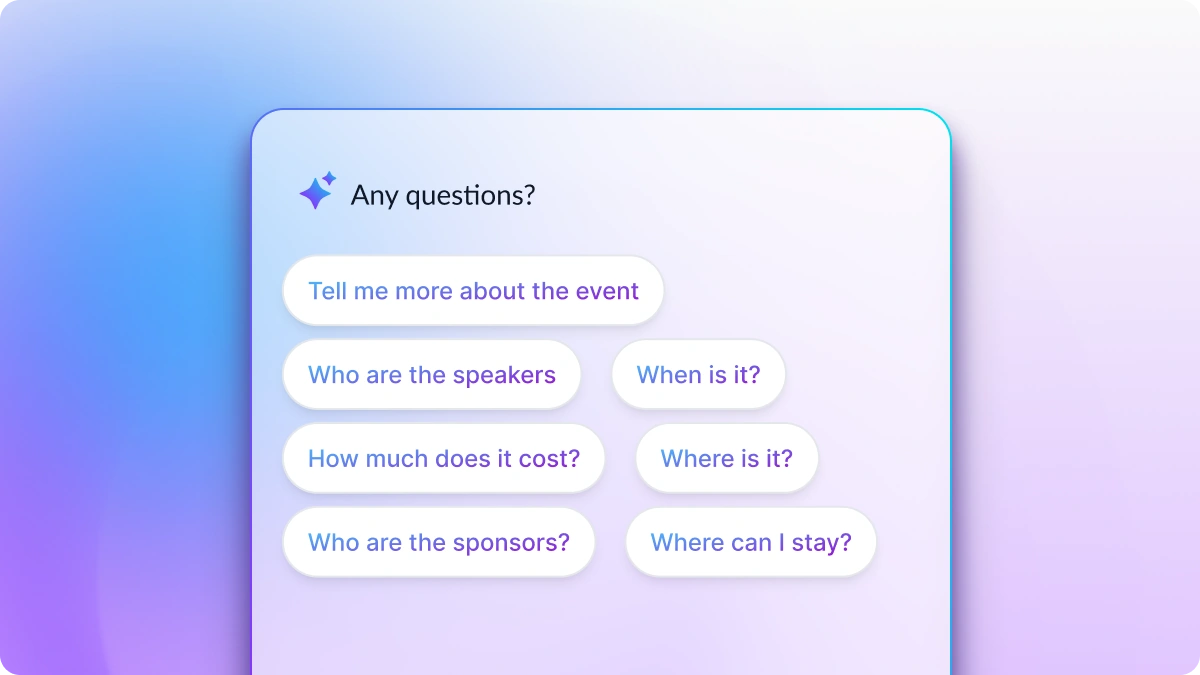
AI that does something specific. The apps that have added AI as a feature feel like AI added to an app. Amego built Sidekick™ as the attendee experience itself, a layer that personalizes and guides rather than just answers. When an attendee opens the app between sessions at a 10,000-person conference and Sidekick shows them two sessions they didn't know about and one exhibitor booth that matches what they told the registration form they were looking for, that's AI earning its keep. Not "AI-powered." Doing something.
Real-time push notifications with audience targeting. The difference between a push notification strategy and a push notification blast is segmentation. Amego lets organizers target by attendee type, session track, registration tier, or any attribute in the system. A general attendee and a VIP sponsor shouldn't be getting the same message at 9am.
Gamification with real sponsor ROI. Quest challenges built around sponsor booth visits create something most event apps can't: a measurable ROI story for exhibitors that goes beyond "your logo was in the app." That conversation changes renewals.
Integrations that sync, not just import. Amego's integration layer connects with registration platforms like Swoogo, Cvent, and others so that session data, attendee attributes, and registration records stay current throughout the event cycle.
An engagement suite that keeps working mid-event. Live Q&A, polls, surveys, in-app news feeds. These features keep attendees participating rather than passively watching. Organizers manage all of it from Amego Admin in real time.
How Amego Powers Enterprise Conferences
Amego was founded in 2021 by Scott Owens, an event industry veteran who spent years frustrated with legacy event apps that weren't built for the complexity of enterprise-scale conferences. The founding thesis wasn't "let's make a better app." It was: event professionals deserve a tool built by people who understand what showtime actually looks like.
That context matters. Every decision in Amego's architecture reflects it.
The Classic Mobile App is fully white-labeled and fully branded. Not "customizable with your logo." Fully branded, your colors, your fonts, your navigation structure, your event identity throughout. Atlassian called it their "Goldilocks solution." Docusign made it their default event app. Those aren't companies that settle for adequate.
Amego Admin is built for organizers who need to manage large volumes of content without a developer on standby. Sessions, speakers, sponsors, attendees, push notifications, gamification challenges, all configurable in real time, with changes reflected on attendee devices fast. Not at the next sync. Fast.
Sidekick™ is Amego's AI companion, and it's worth understanding what that actually means in practice. It's not a chatbot window. Sidekick surfaces personalized session recommendations based on attendee behavior, flags exhibitors worth visiting before the floor closes, and gives attendees just-in-time nudges when something relevant is starting. The Atlassian team didn't describe Sidekick as "AI-powered." They described it as feeling like a well-briefed personal assistant who knew the conference better than they did.
Quest is Amego's gamification system, and it's one of the most underappreciated engagement levers in the platform. Events that run Quest see higher sponsor booth traffic, stronger session attendance rates, and more networking activity. Quest supports multiple tracks, so sponsor-specific challenges, attendee challenges, and internal team challenges can all run in parallel.
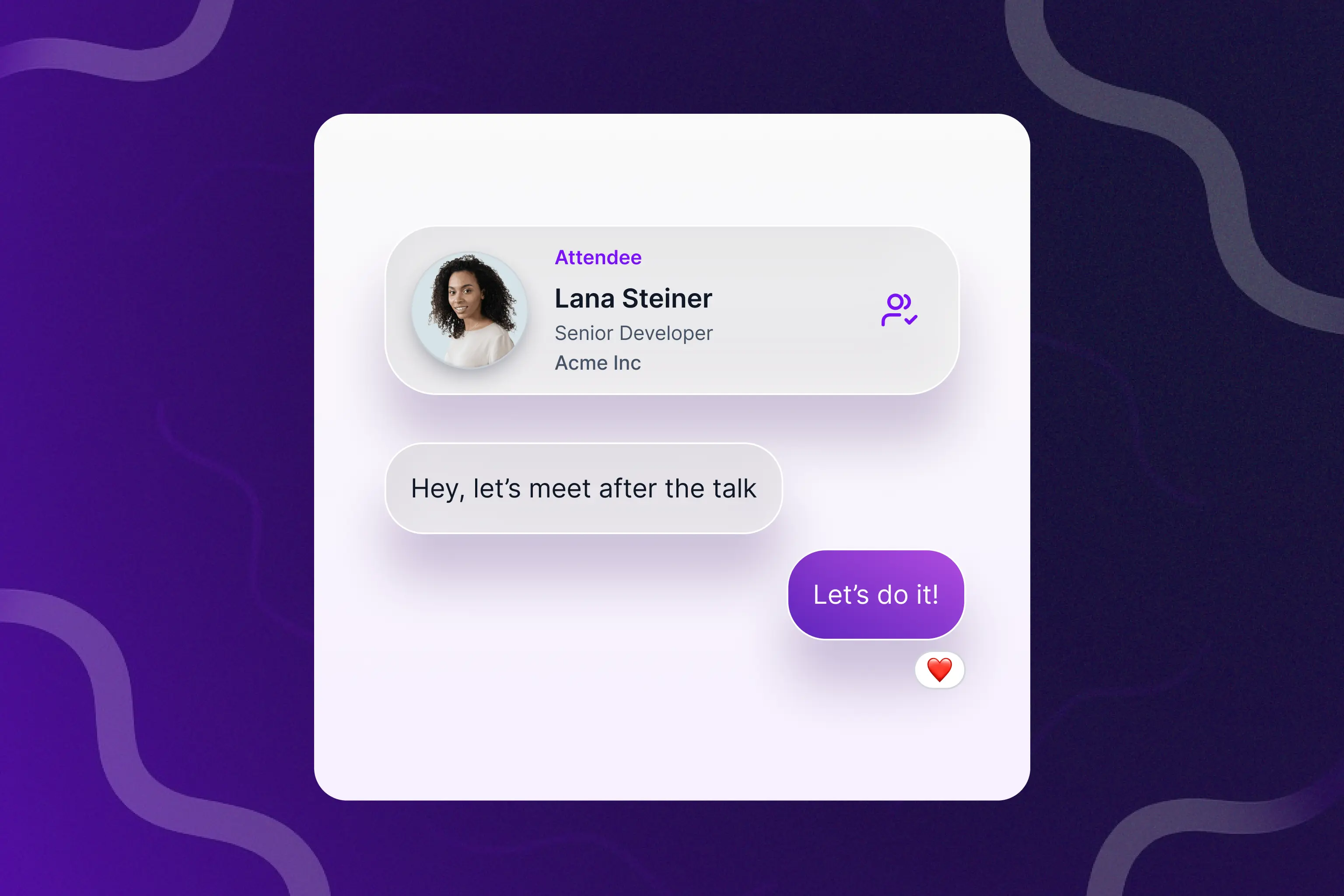
Networking in Amego includes 1:1 meeting booking, attendee chat, and connection tools that work directly from registration data, so profiles aren't empty, and the friction of setting up a meeting is real instead of theoretical. Lead scanning for sponsors includes qualification fields that exhibitors define themselves, with clean data exports they can action immediately.
On security: Amego is SOC 2 Type II and GDPR compliant. For enterprise IT and procurement teams, that's not a nice-to-have. It's the reason the procurement process ends.
On recognition: Amego has been named Best Support and High Performer on G2. That's not marketing. That's event teams leaving reviews after showtime.
Quick Tips to Get More Out of Any Event App
A few habits make a real difference regardless of which platform your event is running.
Set up early. Download and complete your profile at least 48 hours before you arrive. The networking tools, session bookmarking, and personalized recommendations all work better when the profile is complete before you walk in the door. Attendees who set up early make more connections. The data consistently shows it.
Plan push notifications in advance. Last-minute blasts feel chaotic to attendees and undercut the experience the rest of the event is trying to create. A pre-built notification schedule, session reminders, sponsor activations, Quest milestones, feels like a service.
Give sponsors the tools, not just the logo. An app that gives exhibitors a branded profile, a lead scanning tool, and qualified data exports changes the post-event conversation. Sponsors that see ROI come back. Sponsors that get a logo listing don't.
Use the data. Session attendance rates, networking connections, push open rates, Quest completion by track. This data shapes next year's program and gives the event team something concrete to bring to leadership.
If you're planning a conference above 500 attendees and want to see what the platform looks like in practice, Amego offers a full demo that covers the attendee app, Amego Admin, Sidekick™, Quest, sponsor tools, and lead scanning in about 30 minutes. It's worth the time before you sign anything.
The events that matter most deserve an app that was built for them. Not one that was built for someone else and adapted.
Explore more: event networking, event gamification with Quest, and what enterprise event organizers actually need from an event app.

Sign up for our newsletter
Get insights delivered to your email.