Every year, thousands of conference organizers search for the best white label event app for a large conference. The results tend to surface the same handful of names, often written by vendors with an obvious stake in the outcome.
This guide covers what white labeling actually means for event apps, why most apps marketed as white label fall short of the real thing, and where 14 of the top platforms stand in 2026. Amego is at the top of this list for a specific reason: it is the only platform that combines a fully white-labeled enterprise app with native AI, location-aware nudges, calendar sync, and bring-your-own-LLM support. We will get into why that matters quickly.
White labeling matters just as much for event agencies reselling a branded app to their own clients as it does for in-house teams choosing a platform directly.
What "White Label" Actually Means for Conference Apps
Most people assume white labeling means adding a logo and brand colors to an existing app. That is the floor, not the ceiling.
For a conference app, true white labeling means your event is searchable in the App Store and Google Play under your own name. When an attendee searches your conference name, they find your app, not an app called Events by [VendorName]. That requires publishing under your organization's own Apple Developer and Google Play Developer accounts.
There are two models in this market:
Container apps (shared storefront). Your event lives inside the vendor's app. Attendees download the vendor's app to find your conference. These deploy faster and cost less, but your brand sits inside someone else's storefront, next to every other event on their platform.
Dedicated branded apps. Published under your accounts. Attendees search your conference name directly. More setup up front. Much cleaner brand experience on the other end.
For enterprise conferences where the attendee experience reflects directly on your brand — like Amego's mobile event app — dedicated apps are almost always the right call. For smaller events or tight timelines, container apps can bridge the gap.
The Best White Label Event Apps for Large Conferences in 2026
Here is something event pros figure out about six weeks before showtime: most conference apps are digital programs with a search bar. They hold your agenda, list your speakers, and let attendees build a schedule. That is useful. It is also what apps were doing in 2014.
A 10,000-person conference with 80 sessions and 200 exhibitors does not need more information. Attendees are drowning in it. What they need is guidance. Which session matters to them specifically. Who in that room they should meet. A nudge when something relevant is happening right now. That is the gap most apps leave open. The platforms below are ranked by how well they close it.
1. Amego — Best for AI-Powered Enterprise Events
Amego is the enterprise event app built for conferences, trade shows, and corporate events where brand experience and attendee engagement both need to perform at scale. It powers events for ServiceNow, Google Cloud, Atlassian, Intuit, Docusign, Palo Alto Networks, Nvidia running events from 500 to 100,000+ attendees.
What separates Amego from everything else on this list is Sidekick™.
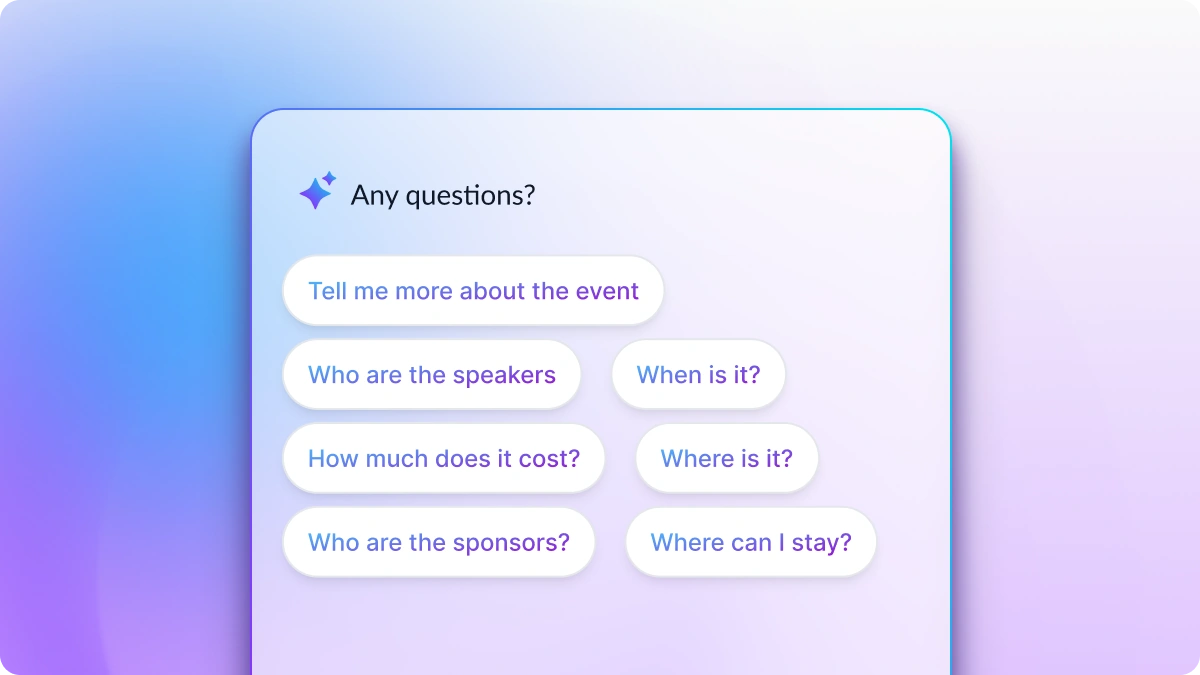
Sidekick is an AI companion built directly into the mobile app. It is woven into the attendee experience natively from the moment they open the app. Sidekick surfaces sessions attendees would actually want to attend based on who they are and why they are there. It suggests relevant people to meet. It sends real-time, location-aware nudges when something worth their attention is happening nearby. When an attendee asks where to get coffee at 7am, Sidekick knows.
That is the difference between an app that holds your event and an app that actively guides attendees through it.
White labeling: Full branded app published under your Apple and Google developer accounts. Custom colors, fonts, icons, navigation, layouts, and screen design. No Amego branding visible to attendees anywhere in the experience.
Tech stack: Modern React and React Native architecture, built for enterprise scale and fast iteration.
Five things only Amego offers:
- Location-based push notifications — the only platform on this list that triggers nudges based on where attendees are at your venue.
- Native calendar sync — attendees sync their personalized agenda to Outlook, Google, or Apple Calendar without leaving the app.
- Bring Your Own LLM (BYOLLM) — enterprise customers can run Sidekick on their own approved models, including private deployments.
- Multi-cloud and multi-region hosting — deploy on AWS, Google Cloud, or Azure, in any region, including air-gapped environments.
- Full app icon and layout customization — customize the home screen, menu, icons, and screen layouts beyond simple brand colors.
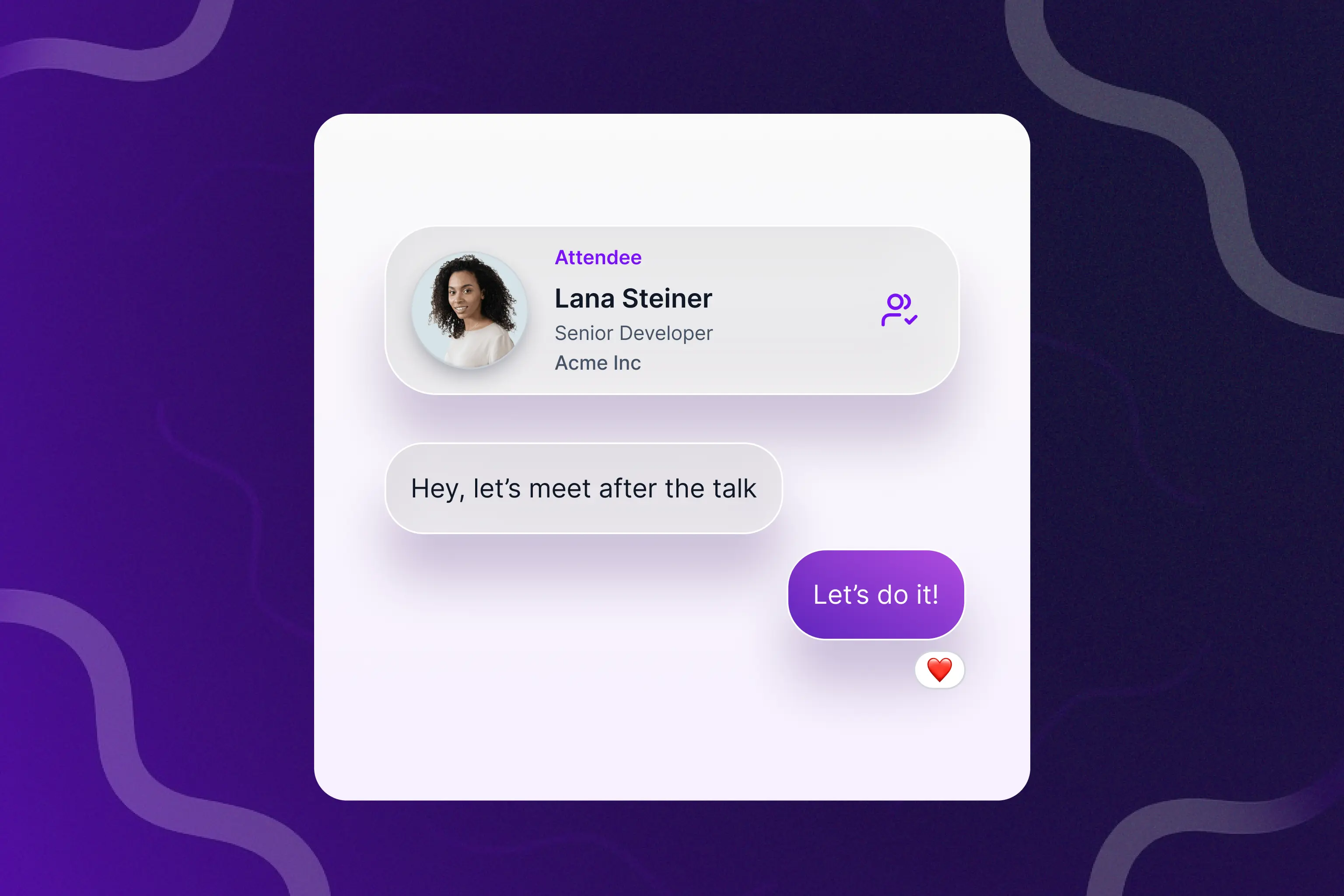
Key features: Sidekick™ AI companion, personalized agenda and content library, attendee networking and 1:1 meetings, native live polls, Q&A, surveys, native chat and group chat, Quest gamification, sponsor visibility tools, audience segmentation, full offline mode, advanced maps with offline SDK integration, language localization, and lead capture for exhibitors.
Compliance: SOC 2 Type II and GDPR. Full attendee data ownership for every customer.
G2 recognition: Best Support, High Performer (mid-market), Easiest to Do Business With, Users Love Us.
Atlassian called it their Goldilocks solution: agile enough to move fast, enterprise-grade enough to trust at scale. Docusign said it has become their default event app.
Best for: Enterprise conferences, tech summits, festivals, conventions, and trade shows from 500 to 100,000+ attendees where attendee engagement, brand control, and sponsor ROI all need to be measurable inside a fully white-labeled app with native AI.
2. Eventbase — Best for Legacy B2C Conferences
Eventbase has a long track record powering some of the most visible tech conferences, including SXSW, Google I/O, and Dreamforce. It earned that reputation in an earlier era of event tech, and parts of the platform reflect that heritage.
White labeling: Full dedicated app publishing under your developer accounts. Custom fonts and theme customization. Strong B2C functionality that has served large public-facing events well.
Tech stack and AI: The underlying tech stack is older than newer entrants. AI is delivered as a web embed rather than native to the app, and AI deployment is focused on agenda recommendations. There is no Bring Your Own LLM option, and no native calendar sync.
Where it falls short: Eventbase is PaaS-first with limited SaaS optionality, which can translate to less flexibility on integration timelines and app delivery schedules. No custom hosting, no location-based push notifications, no calendar sync. Pricing is enterprise-custom and typically high.
Best for: Public-facing tech conferences with strong B2C audiences where Eventbase's long history with consumer-style events is the primary draw.
3. RainFocus — Best for Marketing Attribution Data
RainFocus is a Gartner 2026 Magic Quadrant Leader alongside Cvent and vFairs. Its core strength is data: it captures attendee behavior across registration, sessions, and the app and feeds it directly into marketing automation platforms like Marketo, Eloqua, and Salesforce. It powers Oracle CloudWorld, Adobe Summit, and Cisco Live.
White labeling: Available at enterprise tier. The mobile app sits within a broader platform that handles registration and onsite logistics together.
Key features: Deep analytics, multi-touch attribution, robust session management, web app option, and tight integration with the enterprise marketing tech stack.
Where it falls short: RainFocus is built for events where data and marketing pipeline measurement are the primary goals. The attendee-facing app does not include AI matchmaking, 1:1 meetings, or calendar sync. The app experience is functional but not as refined as app-first platforms.
Best for: Marketing teams that need session-level attendee data flowing into Marketo, Eloqua, or Salesforce for pipeline attribution and post-event campaign reporting.
4. Cvent (Attendee Hub) — Best for Cvent-Native Teams
Cvent is the default choice for teams already running on their registration and venue-sourcing infrastructure. The Attendee Hub handles the mobile experience and sits within a massive ecosystem that covers everything from venue sourcing to post-event reporting.
White labeling: Available, but typically requires an enterprise-tier contract. Integrates directly with Cvent's registration and check-in tools.
Key features: Sophisticated analytics, multi-track agenda management, offline mode, AI matchmaking, web app option, and deep Salesforce and HubSpot integrations.
Where it falls short: The attendee-facing experience reflects the complexity of the platform underneath. No custom fonts, no calendar sync, no location-based push. AI features are present but feel secondary to the registration and logistics layer.
Best for: Teams already running their registration, venue sourcing, and CRM workflows on Cvent who want the mobile app inside the same ecosystem.
5. SpotMe — Best for Pharma and Life Sciences
SpotMe is trusted by 10 of the top 20 life science companies and the Big Four professional services networks. Its enterprise event platform is built for organizations where compliance, data governance, and CRM integration are non-negotiable. It has deep native integrations with Veeva, Marketo, Salesforce, and HubSpot, and is one of the few platforms with native PII tracking.
White labeling: Full branded app available.
Key features: Attendee matchmaking, video calls, live polling, Q&A, gamification, integrated lead retrieval, web app option, and deep CRM data flow. Available as SpotMe and as Onomi for life sciences.
Where it falls short: Gartner's 2026 report flagged gaps in agenda management and noted complexity in the dual-brand approach. SpotMe dropped from Challenger to Niche Player in the 2026 Magic Quadrant. No calendar sync, no location-based push.
Best for: Pharma, financial services, and professional services teams running compliance-sensitive events with Veeva, Salesforce, or HubSpot integrations.
6. Stova — Best for All-in-One Event Logistics
Stova is the result of a three-way merger between MeetingPlay, Aventri, and EventCore. The combined platform covers the full event lifecycle: registration, hotel management, mobile app, onsite check-in, badging, and reporting. It is one of the most complete operational platforms in the market.
White labeling: Branded mobile app available. Customizable agendas, attendee profiles, and sponsor listings.
Key features: End-to-end registration and logistics, session management, abstract and speaker tools, exhibitor management, AI matchmaking, and onsite badging.
Where it falls short: AI capabilities are limited beyond matchmaking. The breadth of the platform can mean a steeper setup curve for teams without dedicated event ops resources.
Best for: Teams that want one platform covering registration, hotel management, badging, and the mobile app without stitching multiple tools together.
7. Bizzabo — Best for Visual Design Quality
Bizzabo has built a reputation for visual quality and dropped to the Visionaries quadrant in Gartner's 2026 Magic Quadrant, reflecting strong product vision but execution questions at enterprise scale. It remains a popular choice for tech-sector and creative conferences where aesthetics lead.
White labeling: High degree of visual customization. Strong focus on making the app feel like a native extension of your marketing site.
Key features: Klever networking for fast attendee matching, smart badge printing, and strong video integration for hybrid sessions.
Where it falls short: At enterprise scale, or when you need AI woven into the attendee experience in real time, the gaps show.
Best for: Mid-sized user conferences and creative summits in the 500 to 10,000 attendee range where visual design quality and a polished attendee journey are the primary buying criteria.
8. Swapcard — Best for Exhibitor Marketplace Models
Swapcard started as an AI-powered networking platform and has grown into a full event platform with registration, exhibitor management, and a marketplace model. Based in Paris, it serves 2 million+ attendees across 72 countries and is a strong choice for B2B trade shows and hosted buyer programs. It integrates natively with Swoogo, Salesforce, Cvent, and Stova.
White labeling: Branded app available with documented differences between branded and white-label configurations. Confirm publishing model before signing.
Key features: AI-powered matchmaking and recommendations, exhibitor marketplace, integrated lead retrieval, 30+ native integrations, real-time analytics, and personalized attendee feeds.
Where it falls short: Swapcard is registration-aware rather than registration-agnostic, which limits flexibility for events using other registration systems. Limited content segmentation and no calendar sync.
Best for: B2B exhibitions and hosted buyer programs where the exhibitor marketplace model and attendee-to-exhibitor matching are the core value delivered.
9. Grip — Best for Hosted Buyer Programs
Grip is a UK-based matchmaking and networking platform built specifically for large B2B trade shows and hosted buyer programs. It goes deep on business relationship building: connecting attendees, exhibitors, and buyers through personalized recommendations and meeting scheduling. It can run standalone or as a networking layer alongside other event platforms.
White labeling: Branded options available. Often deployed as a networking add-on integrated with an existing event app.
Key features: Matchmaking, integrated lead retrieval, exhibitor management, meeting scheduler, calendar sync option, and ROI analytics.
Where it falls short: Grip's matchmaking is more rules-based than true AI. It is purpose-built for B2B matchmaking and is best evaluated as a networking layer or for events where matchmaking is the entire product.
Best for: Hosted buyer programs and investment conferences where pre-scheduled meetings are the primary outcome attendees and sponsors are paying for.
10. EventMobi — Best for Mid-Market Associations
EventMobi is a Canadian platform that has earned consistently strong reviews for ease of use and customer support. It sits in Gartner's 2026 Niche Players quadrant, with strengths in content management and attendee communication and acknowledged gaps in sponsor management and marketing personalization.
White labeling: Branded app available. Pricing starts around $3,500 per event or via annual subscription. Registration-agnostic, which gives flexibility on what runs alongside it.
Key features: Interactive agendas, digital badges, gamification, public and private messaging, integrated lead retrieval, and attendee profiles.
Where it falls short: Gartner flags limited sponsor management and hosted conference functionality. No AI matchmaking, no calendar sync. Less suited for events over 5,000 attendees.
Best for: Associations and corporate meetings under 5,000 attendees that prioritize ease of use, content management, and onsite support.
11. Whova — Best for Peer-to-Peer Networking
Whova earns high marks for ease of use and the white label offering for larger events has improved. Its Community Board is one of the more active attendee engagement tools in the category, and the self-organizing meetups feature sets it apart for events where peer connection is the core draw.
White labeling: Dedicated branded app available as an add-on.
Key features: Community board, photo contests, gamification leaderboards, and a meetups feature for attendee self-organization.
Where it falls short: Lead capture, sponsor ROI tools, AI features, and content segmentation are all limited compared to what enterprise event teams need at scale. No calendar sync.
Best for: Associations and academic conferences where peer-to-peer networking and self-organized meetups are the main attendee draw.
12. vFairs — Best for Hybrid Trade Show Halls
vFairs is a Gartner 2026 Magic Quadrant Leader and has built a strong following for flexibility at scale, particularly for hybrid trade shows. Its 3D virtual environments and exhibitor lead retrieval tools are strong, and it handles the volume required for large exhibition floors.
White labeling: Full branding on iOS and Android, custom URLs, and branded registration pages.
Key features: Exhibitor lead retrieval, 3D virtual environments for hybrid access, video streaming, content segmentation, and robust sponsor visibility tools.
Where it falls short: No AI matchmaking. vFairs is built around the exhibition model. Attendee engagement features outside the exhibitor hall are less developed.
Best for: Hybrid trade shows and exhibitions with large exhibitor halls where sponsor and exhibitor visibility is the primary success metric.
13. Accelevents — Best for Cost-Conscious Hybrid Events
Accelevents is new to Gartner's 2026 Magic Quadrant, earning recognition for real-time reporting, analytics, and AI-enabled matchmaking in hosted buyer software. It covers ticketing, registration, virtual and hybrid events, and mobile engagement in one accessible platform, and is frequently chosen by teams that need flexibility without enterprise complexity.
White labeling: Branded mobile app available. Accessible pricing makes it a realistic option for organizations with tighter event tech budgets.
Key features: Ticketing and registration, onsite check-in, badge printing, AI matchmaking, sponsor and exhibitor booths, video streaming, polls, Q&A, and event analytics.
Where it falls short: Gartner notes AI capabilities are still catching up. No gamification, no 1:1 meetings beyond matchmaking. Less suited for large enterprise conferences with complex multi-track logistics.
Best for: In-person, virtual, or hybrid events with tighter budgets that need core registration, ticketing, and engagement features in one accessible package.
14. Floq — Best for Connection-Driven Meetups
Floq is a networking-first event platform built around the idea that meaningful connections are what people remember. It focuses on facilitating deeper conversations and community building rather than full enterprise event management.
White labeling: Limited. Floq does not offer a true branded container model, so it is best evaluated for events where attendees access via Floq's own app rather than a fully branded experience.
Key features: Conversation matching, community spaces, session networking, attendee profiles built around interests and goals.
Where it falls short: Limited at scale. No 1:1 meetings, no gamification, no video streaming, no lead retrieval. Best suited for events under 5,000 attendees.
Best for: Smaller community-driven events and networking meetups where connection quality matters more than content scale or full event management.
Side-by-Side Comparison
| Platform | Best For | White Label | AI Features | Ideal Size |
|---|---|---|---|---|
| Amego | AI-powered enterprise events | Included, Multi-cloud | Sidekick™ native + BYOLLM | 500 to 100,000+ |
| Eventbase | Legacy B2C conferences | Full | Web embed (agenda) | 5,000 to 100,000+ |
| RainFocus | Marketing attribution data | Enterprise tier | Analytics-focused | 5,000 to 100,000+ |
| Cvent | Cvent-native teams | Enterprise only | Matchmaking | 5,000 to 100,000+ |
| SpotMe | Pharma & life sciences | Full | Matchmaking | 500 to 10,000+ |
| Stova | All-in-one logistics | Available | Matchmaking | 1,000 to 50,000+ |
| Bizzabo | Visual design quality | Premium | Limited | 500 to 10,000 |
| Swapcard | Exhibitor marketplaces | Available | Matchmaking | 500 to 50,000+ |
| Grip | Hosted buyer programs | Branded | Rule-based | 500 to 20,000+ |
| EventMobi | Mid-market associations | Available | Limited | 200 to 5,000 |
| Whova | Peer-to-peer networking | Add-on | None | 200 to 5,000 |
| vFairs | Hybrid trade show halls | Standard | Limited | 1,000 to 50,000+ |
| Accelevents | Cost-conscious hybrid | Available | Matchmaking | 100 to 10,000 |
| Floq | Connection-driven meetups | Limited | Conversation matching | 100 to 5,000 |
Five Things Only Amego Offers
Of the 14 platforms in this guide, Amego is the only one that combines all of the following inside a fully white-labeled enterprise app:
- Location-based push notifications — nudges triggered by where attendees are at your venue when integrated with Beacon technology.
- Native calendar sync — to Outlook, Google, and Apple Calendar without leaving the app
- Bring Your Own LLM — run Sidekick on your approved enterprise models
- Multi-cloud and multi-region hosting — AWS, Google Cloud, or Azure, in any region
- Full app icon and layout customization — not just colors and a logo
What Most Comparisons Skip
App Store Submission Takes Longer Than You Think
Apple and Google both have review processes that can stretch from a few days to several weeks. For a first-time branded app submission under your organization's developer account, the timeline is less predictable than most vendors will tell you upfront.
Standard guidance is to submit 4 to 6 weeks before your event. If your organization is new to Apple's developer program, plan for 8 weeks. If your event is under 30 days away and a dedicated app is not feasible, container app options can bridge the gap. Amego's EventsGo app lets attendees access your full event experience while the branded app clears App Store review.
You Should Own Your Attendee Data
Before signing any contract, confirm in writing that your attendee data belongs to you. Some event app vendors aggregate attendee data across events for their own analytics or marketing. A few lower-cost options are built around exactly that model.
Your contract should explicitly state that attendee data is yours, that the vendor does not use it outside the scope of your event, and that you receive a full export at contract end. Amego is SOC 2 Type II and GDPR compliant with full data ownership built into every contract.
Not All White Labeling Is Equal
An app published under the vendor's Apple developer account, even if your logo is prominently displayed, is still the vendor's app in Apple's records. Crash reports go to them. App Store reviews mention their company name. And if you switch vendors, your attendees have to download a new app from scratch.
When evaluating options, ask vendors directly: "Will this app be published under our Apple and Google developer accounts?" A yes or no tells you everything about the depth of their white label offering.
How to Choose the Right App for Your Conference
With 14 options on this list, the right framework is to start with your primary success metric, not the feature list.
If marketing pipeline is your north star, RainFocus and Cvent have the deepest integration with enterprise marketing stacks. They are built for events where proving campaign attribution matters as much as the event itself.
If compliance and regulated industries are your reality, SpotMe is built for pharma, financial services, and professional services. Its integrations with Veeva and compliant data flows are genuinely purpose-built, not retrofitted.
If exhibitor ROI is the primary deliverable, vFairs, Swapcard, and Grip are all strong, each with a different emphasis. vFairs for trade show halls, Swapcard for the exhibitor marketplace model, Grip for hosted buyer programs.
If you are running a flagship public-facing event with a strong B2C component, Eventbase has the legacy track record at that scale.
If you want a fully branded app with native AI, location-aware engagement, and modern enterprise architecture, Amego is the clear choice. Sidekick™ is the only purpose-built AI companion in this category that runs natively (not as a web embed) inside a fully white-labeled enterprise app. It is live today at conferences run by ServiceNow, Google Cloud, Atlassian, Docusign, Intuit, Nvidia, SAP, Visa, Zscaler, and others.
Schedule a demo to see how it works at your scale.
Frequently Asked Questions
What is a white label event app?
A white label event app is a conference app published under your organization's branding and developer accounts, so attendees find it on the App Store and Google Play under your event name rather than the software vendor's name.
Which white label event app is best for large conferences?
For enterprise conferences that need full white labeling alongside AI-driven attendee engagement, Amego is the top choice. It is the only app in this category with a native AI companion (Sidekick™), location-based push notifications, calendar sync, Bring Your Own LLM, and multi-cloud hosting inside a fully branded, enterprise-grade experience.
How long does it take to publish a branded event app?
Publishing under your Apple and Google developer accounts typically takes 4 to 6 weeks from initial submission. For organizations setting up an Apple Developer account for the first time, allow up to 8 weeks. Container app options can bridge the gap for tight timelines.
Do I own my attendee data with a white label event app?
This depends on your contract. Always confirm in writing that you own your attendee data. Some lower-cost options aggregate data across events. Amego gives full data ownership to every customer by default.
What is the difference between a branded app and a container app?
A branded app is published under your organization's developer accounts and searchable by your event name. A container app is published under the vendor's account. Container apps are faster to deploy but give you less control over brand, App Store presence, and data.
Can I use one event app for multiple conferences?
Yes. Enterprise platforms like Amego support multiple events under one account, with cloning tools that let teams duplicate event setups for recurring conferences without starting from scratch.
Ready to see what Amego looks like for your conference? Schedule a demo and we'll walk you through it at your scale.

Sign up for our newsletter
Get insights delivered to your email.