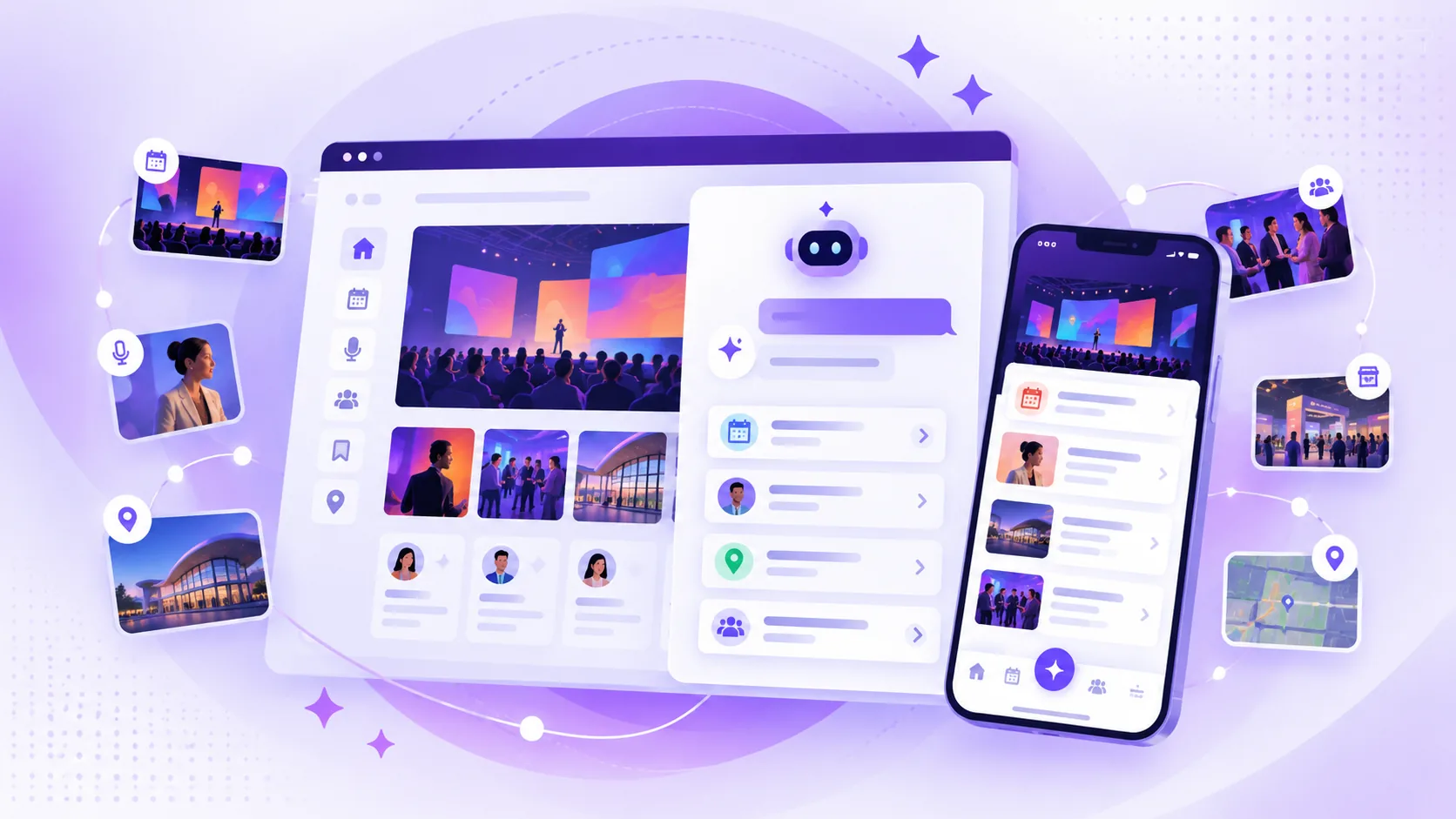

Most event apps get opened on day one, checked occasionally on day two, and forgotten by day three. Attendees download it because they were told to. They use it once to find the session room. Then they go back to their phone’s native calendar.
That’s not a content problem. It’s a platform problem.
The event app platforms that actually work — the ones attendees open ten times a day — are built differently. They surface the right session at the right moment. They make it easy to connect with the right person. They give sponsors real visibility instead of a logo buried in a menu. And they let organizers push content changes in real time instead of scrambling to send a mass email when Room 4B moves to the main hall.
This guide covers the six platforms worth considering in 2026. It’s written from Amego’s perspective — we’re one of them — so we’ll be direct about where we lead and honest about where the others earn their place.
What Is a Custom Event App?
A custom event app is a mobile event experience that can be configured around an event’s branding, content, navigation, agenda, attendee experience, integrations, and engagement goals. Depending on the platform, customization can range from colors and logos to fully branded app-store listings, custom navigation, personalized content, workflows, and integrations.
What Can Be Customized in an Event App?
| Area | Examples |
|---|---|
| Branding | Colors, fonts, logos |
| Navigation | Menu structure, tabs |
| Home experience | Cards, featured content |
| Agenda | Tracks, filters, personal schedules |
| Engagement | Polls, surveys, gamification |
| Networking | Profiles, recommendations |
| Integrations | Registration, CRM, maps |
| AI | Recommendations, attendee guidance |
The failure mode is almost always the same. The app looks fine in the demo. It has an agenda, a speaker list, a map. The organizer approves it, sends the download link to attendees, and assumes the hard part is done.
Then the event starts. A keynote gets moved. A session fills up. A sponsor wants to know how many people viewed their profile. The organizer needs to push an update and realizes it takes 20 minutes and a support ticket. Attendees stop checking the app because it stopped being accurate. And by day two, most of the team is texting updates manually.
The damage is real. Sponsors don’t renew. Attendees rate the experience lower than the content deserves. And the organizer spends the post-event week apologizing instead of sharing data.
The right platform solves this before it starts.
At the feature level, the gap between platforms isn’t as wide as vendors claim. Most of them have an agenda, push notifications, polls, and a sponsor section. The real differences show up under pressure.
Real-time content management. Can you push a session change in 90 seconds or 20 minutes? At a 5,000-person conference, that gap is the difference between a smooth pivot and a hallway full of confused attendees.
Branding depth. White-label means different things to different platforms. Some let you change the logo and primary color. Others let you control every screen, every navigation item, every home screen module. Attendees notice the difference, even if they can’t articulate it.
AI that’s actually useful. A lot of platforms have added AI features in 2025 and 2026. Most of them amount to a chatbot that returns search results. The ones worth paying attention to surface recommendations proactively, understand natural language questions, and reduce the cognitive load of navigating a complex multi-day event.
Sponsor ROI that’s measurable. Sponsors are increasingly asking for data, not just placement. If your app can’t tell a sponsor how many attendees viewed their profile, watched their video, or scanned a lead at a booth, that’s a renewal conversation you’ll lose.
Networking that people use. Attendee directories are not networking tools. Networking tools match people based on shared interests, make it easy to request a meeting, and make the follow-up frictionless. Most platforms have a directory. Fewer have real networking infrastructure.
Here’s how the six most reliable platforms stack up — what each one does well, where it hits a ceiling, and which type of event it’s actually designed for.
Amego: Best for Enterprise Events and AI Attendee Experience
Amego is built specifically for large-scale enterprise events where everything has to work — the brand, the experience, the sponsor ROI, and the real-time logistics. It powers apps for Cisco Live, NVIDIA GTC, Salesforce Dreamforce, ServiceNow Knowledge, and events at that tier. That’s not a coincidence. Those events have requirements that eliminate most platforms before the demo ends.
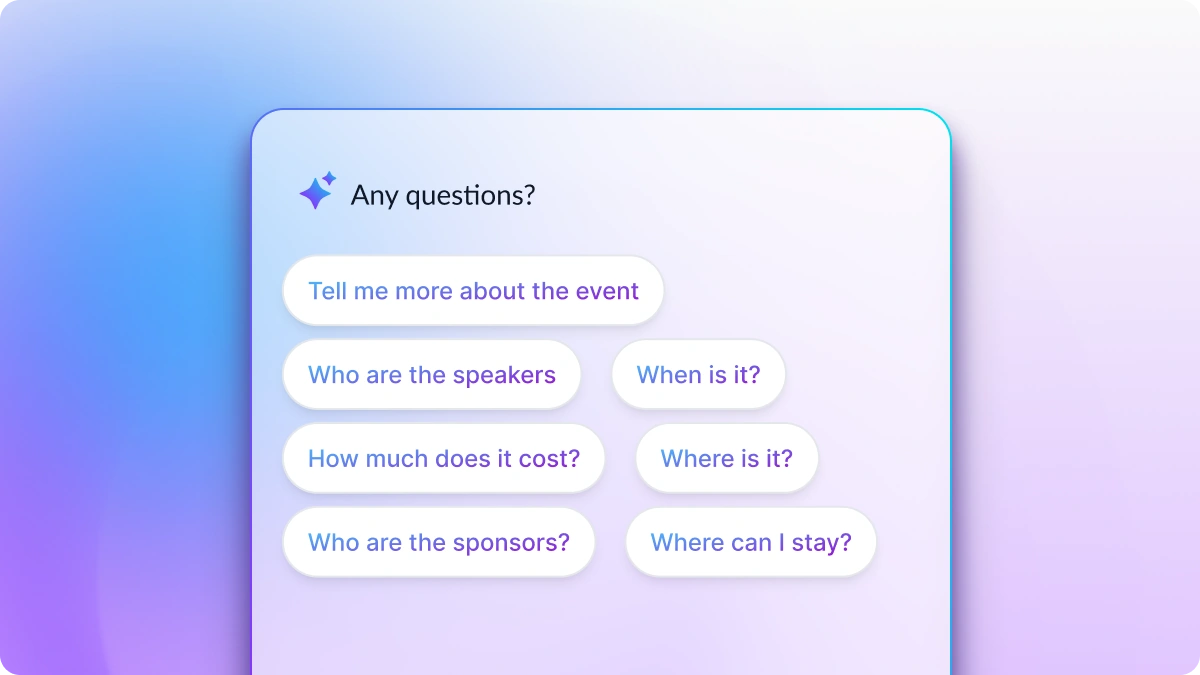
The feature that genuinely separates Amego from the field is Sidekick, the built-in AI event companion. Sidekick isn’t a search bar dressed up with a chatbot interface. It surfaces personalized session recommendations based on an attendee’s profile and behavior. It answers natural language questions about the schedule, the venue, and the agenda. It proactively reminds attendees about sessions they’ve saved and helps them make decisions in the moment. Attendees at Amego-powered events use it. That’s the part most AI features don’t manage.
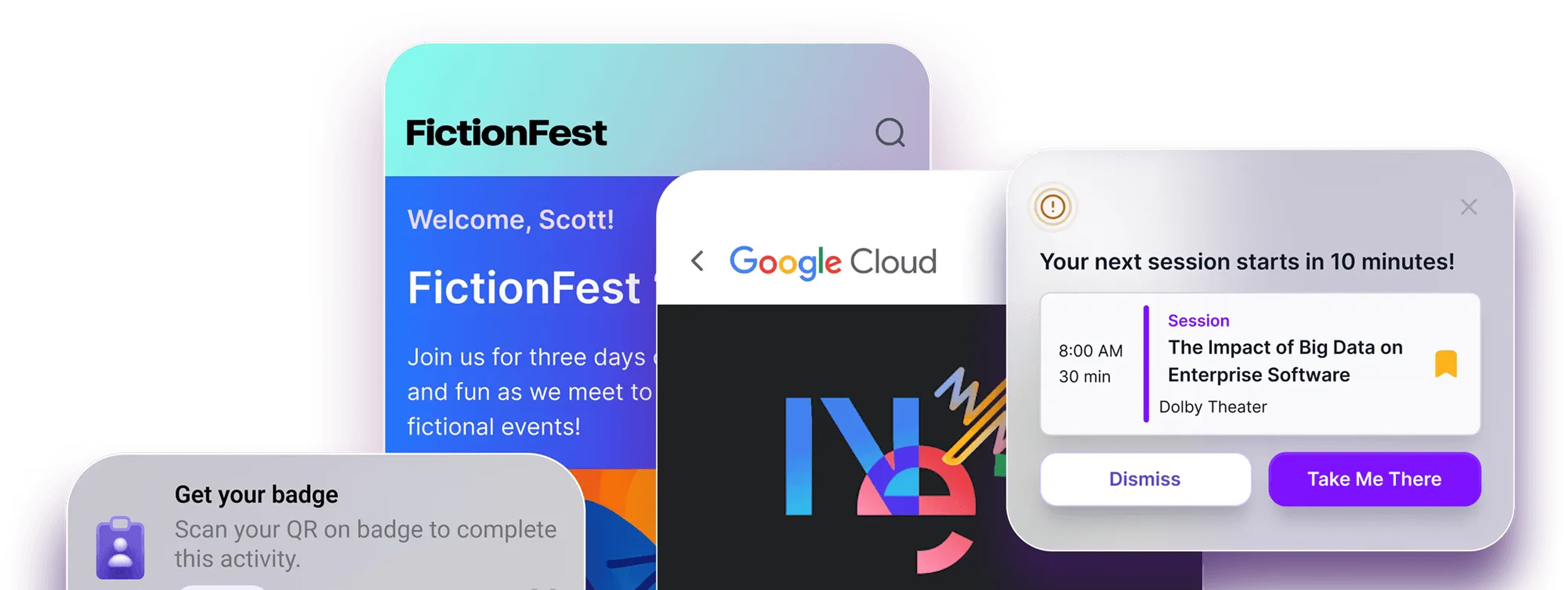
On the customization side, Amego gives organizers full control. Custom screens, navigation menus, home screen layouts, background images, fonts, and color schemes — all of it maps to the event brand, not to Amego’s. The result is an app that looks like it was built for the event, not licensed from a vendor. Content updates push live in real time. No re-publish cycle. No support ticket. A schedule change at 8am is visible to all 40,000 attendees at 8:01am.
The engagement toolkit is deep: live polls, Q&A, surveys, an in-app news feed, push notifications, and Quest — a gamification system that drives leaderboard-based challenges and keeps attendees moving through the event. Networking includes 1:1 meeting booking, attendee chat, and connection tools that go beyond a directory. For sponsors and exhibitors, Lead scanning handles onsite lead scanning with a purpose-built device that doesn’t require attendees to download a separate app.
Amego also ships EventsGo, a shared app environment for testing your event build before it goes live — which matters a lot when the stakes are high and you don’t want the first real test to happen in front of 10,000 people.
Best for: Large enterprise conferences, multi-day events with complex session tracks, organizations where brand consistency and sponsor ROI are non-negotiable.
The honest answer for enterprise events: If you’re running the kind of event where a bad app experience makes the front page of the internal post-mortem, Amego is where most teams end up. The AI layer, real-time content management, and deep customization solve the problems that send enterprise organizers back to the drawing board with other platforms.
Whova: Best for Networking and Community
Whova is the platform most commonly cited when attendee networking is the primary goal. The Community Board keeps conversations active before, during, and after the event. SmartProfiles surface connection recommendations based on shared background and interests. For academic conferences and professional associations where peer networking is the whole point, it works well.
The ceiling is customization. Whova apps carry a recognizable visual fingerprint that doesn’t fully disappear when you apply your branding. For events where the app needs to feel like an extension of the event brand — not a licensed tool — that’s a consistent complaint. The AI features are limited compared to what dedicated enterprise platforms offer in 2026.
Best for: Academic conferences and professional associations where networking depth matters more than brand depth.
Worth knowing: If your event outgrows the community-first use case, or if sponsors start asking for more visibility, Whova hits its limits quickly.
Cvent Attendee Hub: Best for Large-Scale Enterprise
Cvent’s advantage is integration, not the app itself. If you’re running registration, check-in, and lead retrieval through Cvent already, the Attendee Hub connects to all of it without a custom data pipeline. For teams already embedded in the Cvent ecosystem, that integration value is real.
The tradeoffs are well-documented. The setup process is long. The learning curve is steep. The product assumes you have a dedicated event technology team, and it shows. Teams that aren’t already Cvent customers tend to find the implementation runway longer than expected.
Best for: Large corporate events already running inside the Cvent ecosystem where integration matters more than time-to-launch.
Worth knowing: The app experience itself is functional but not distinctive. Attendees who’ve used multiple event apps will notice.
Bizzabo: Best for Brand Experience
Bizzabo makes genuinely good-looking apps. The design quality is high, the marketing integrations are sophisticated, and the Klik SmartBadge — wearable tech that lets attendees connect by tapping badges — is a useful networking differentiator for brand-forward events.
The friction is cost and complexity. Bizzabo is priced for organizations with a dedicated events team and a budget that reflects it. Teams that come in expecting a polished-but-simple platform sometimes find the implementation more involved than anticipated.
Best for: Tech conferences and product launches where visual brand experience is a primary requirement and the budget supports it.
Worth knowing: For events that need both deep customization and genuine AI features, Bizzabo’s current offering lags behind what Amego delivers at the same tier.
Eventee: Best for Quick Setup
Eventee is the right choice when speed matters more than depth. The drag-and-drop builder is fast. The attendee-facing agenda is clean and easy to navigate. A functional app for a workshop or internal retreat can be live in a few hours.
It doesn’t scale. Eventee doesn’t offer the networking infrastructure, gamification, sponsor management, or AI features that enterprise events need. It’s a tool for a specific job — small-to-mid-size events with lean teams — and it does that job well.
Best for: Workshops, internal offsites, and smaller seminars where simplicity and speed outweigh feature depth.
Webex Events: Best for Hybrid
Webex Events (formerly Socio, now owned by Cisco) was built for hybrid. If a significant share of your audience is remote and the in-person and virtual experiences need to feel connected, this platform handles that integration more cohesively than most.
For fully in-person events, it’s a harder sell. The hybrid features don’t add value when everyone’s in the room, and the app experience doesn’t stand out against more focused competitors. Enterprise IT teams tend to be comfortable with it on security grounds, which is a real factor in certain organizations.
Best for: Hybrid conferences where virtual and in-person audiences need a unified experience.
| Platform | Best For | White-Label Depth | Built-in AI | Real-Time Updates | Enterprise Scale |
|---|---|---|---|---|---|
| Amego | Enterprise + AI Experience | Full | Yes, Sidekick | Yes | Yes |
| Whova | Networking-first events | Partial | No | Limited | Moderate |
| Cvent | Existing Cvent ecosystem | Moderate | Limited | Yes | Yes |
| Bizzabo | Brand-forward events | High | Limited | Yes | Moderate |
| Eventee | Small / quick-launch events | Basic | No | Yes | No |
| Webex Events | Hybrid events | Moderate | No | Yes | Moderate |
How We Evaluated These Platforms
Amego is one of the platforms in this list, so it is worth being explicit about how the comparison was assembled. Each platform was assessed against the same criteria that matter for professional events: customization depth (branding, navigation, home, agenda, engagement, networking, integrations, AI), attendee experience quality, integration ecosystem, enterprise readiness (SSO, security, scale), and pricing model transparency. Where a competitor leads for a specific use case, that is called out in the platform section, not softened. Where Amego leads, the platform section says so and links to first-party evidence.
Last reviewed: September 2026.
For most enterprise event teams, the evaluation ends at a short list of two: Amego and Cvent, if you’re already inside the Cvent ecosystem. For teams that aren’t, it’s usually Amego by the end of the demo. And if you already are, but need an app that delivers on brand, customization, ease of use, and a support partner that feels like part of your team, Amego offers deep integrations with your existing EMS.
The reason comes back to what happens on day two and day three of your event — not day one. On day one, attendees are motivated and curious. By day three, they’re tired and selective. The app needs to earn its place in the pocket every time they pull it out. That requires real-time accuracy, useful AI, and a brand experience that feels like it belongs to the event. Most platforms get one or two of those right. Amego is built to deliver all three.
If networking is your only priority and brand doesn’t matter, Whova is a good choice. If your event is small and your timeline is short, Eventee gets you live fast. If hybrid is the core use case, Webex Events has the infrastructure.
But if you’re running the kind of event where 10,000 people are depending on the app to navigate three days of programming, and sponsors are expecting ROI data at the end of it, Amego is where you start.
See why Amego is consistently ranked a leader for enterprise events on G2.

Sign up for our newsletter
Get insights delivered to your email.