

Table of Contents:
- What Is a Conference Networking App?
- Why Traditional Event Networking Falls Short
- How Conference Networking Apps Improve Attendee Connections
- Key Features of a Strong Conference Networking App
- How AI Is Changing Event Networking
- What to Look for in a Conference Networking App
- Why Networking Is the Real Measure of Event Success
- Conference Networking App FAQs
Networking is one of the main reasons people register for conferences in the first place.
It's also the part most attendees walk away disappointed with.
Walking into a 5,000-person ballroom hoping to find the right people in three days is overwhelming. Most attendees leave with a stack of business cards from people they will never email, and miss the connections that actually mattered. A good conference networking app closes that gap.
It turns networking from a guessing game into something intentional, personalized, and worth showing up for.
What Is a Conference Networking App?
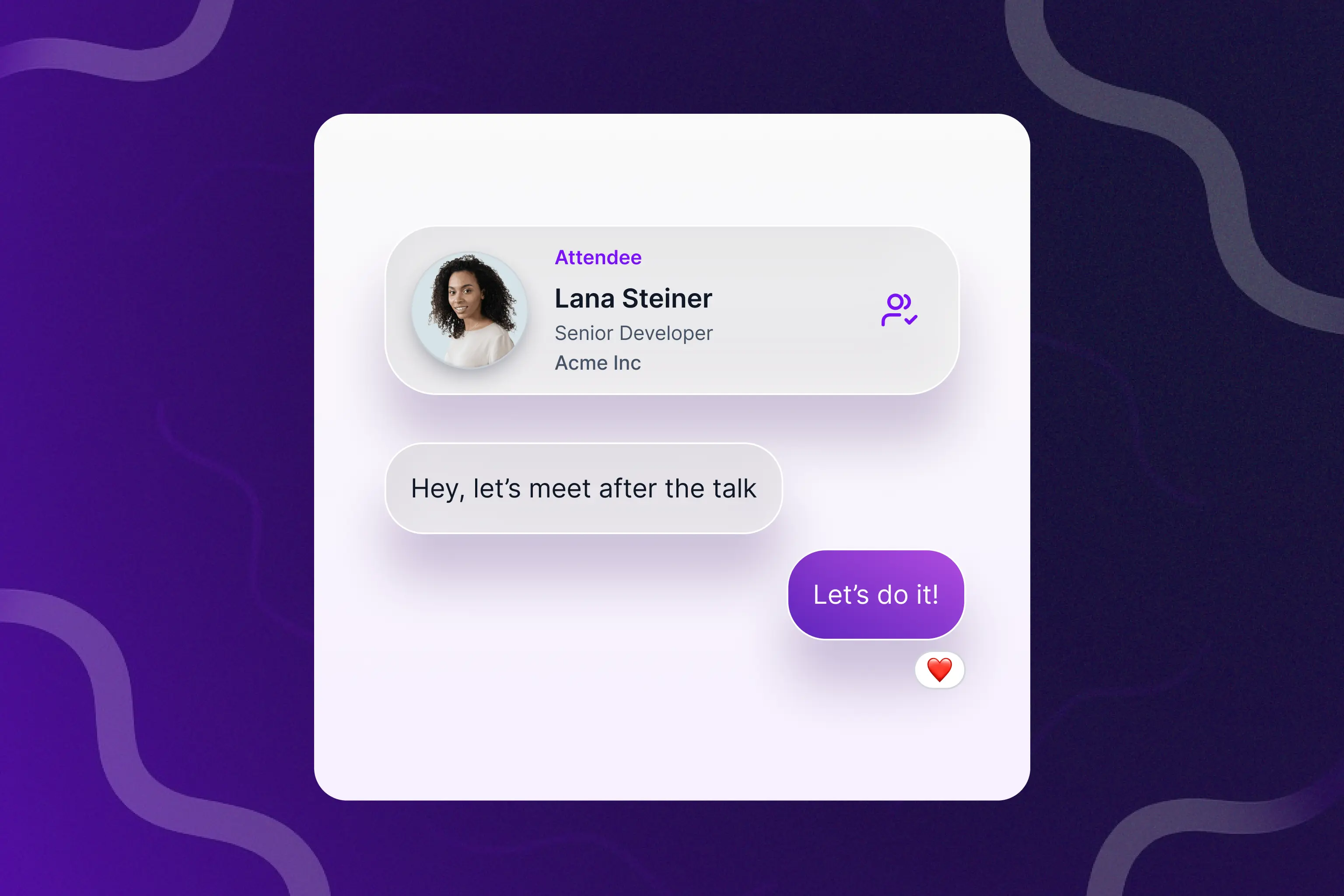
A conference networking app is a mobile or web tool that helps attendees discover, connect, and meet other people at an event. It is typically built into the broader event app and includes attendee profiles, smart search and filters, direct messaging, and meeting scheduling.
The point isn't to digitize a printed attendee list. It's to make sure that out of thousands of people in the room, attendees actually find the handful that matter to them.
Why Traditional Event Networking Falls Short
Most networking at large events still depends on chance.
A coffee line. A seat next to someone in a breakout. A name badge spotted across the lobby. These moments are great when they happen, but they don't scale.
Without the right tools, networking is:
- Unstructured. Attendees don't know who's even at the event.
- Time-constrained. Three days isn't enough to meet thousands of people.
- Low-signal. Random encounters don't surface the right matches.
Most attendees walk away with a few good conversations and a feeling that they missed the ones that would have mattered most.
That's the gap a modern event networking app is built to close.
How Conference Networking Apps Improve Attendee Connections
A strong conference networking app doesn't just connect people. It connects the right people, at the right time, for the right reason.
Here's what that looks like in practice.
Smarter attendee discovery. Instead of scrolling through a flat directory of 8,000 names, attendees can find people by role, company, industry, interests, or session activity. The app should reduce the directory to a shortlist of connections worth making, not multiply the noise.
Personalized recommendations. The best networking experiences are guided. With AI-driven suggestions, attendees see who they should meet based on shared interests, sessions they've attended, and goals they set during onboarding. That's the kind of relevance you can't get from a search bar alone. Amego's Sidekick™ AI companion powers this kind of just-in-time matchmaking inside the app.
Built-in messaging and meeting tools. Once attendees find the right people, they need a frictionless way to actually meet. That means in-app chat, meeting requests, calendar syncing, and confirmation flows that don't require email tag.
Networking that doesn't end at the closing keynote. Real value comes from connections that survive the flight home. A good app keeps conversations and contact records accessible after the event ends, so a hallway conversation in May becomes a working relationship in October.
Key Features of a Strong Conference Networking App
If you're evaluating event apps, focus on what attendees will actually use.
Intelligent attendee matching. Recommendations should be based on profile data and behavior, not random sorting. Amego's "For You" view, for example, surfaces up to 250 recommended attendees ranked by shared sessions, similar interests, and profile signals.
Filters that go deeper than name search. Role, company, industry, and custom attributes (like attendee type or track) make discovery faster.
1:1 meeting scheduling. Browse profiles, send a request, lock the time, sync to a calendar. No back-and-forth email threads.
Flexible chat. Private 1:1 messages, topic-based channels, VIP rooms, and moderated spaces all serve different event formats. The app should let organizers configure what makes sense for theirs.
Digital business cards and badge scanning. A QR scan should save the contact in-app, eliminating paper cards and post-event spreadsheet wrangling.
Gamification. Lower the social temperature with point-based challenges, scavenger hunts, and sponsor discovery tasks. Amego's Quest feature is built around this idea.
Privacy controls. Attendees should decide what's visible, who can message them, and when they're available to meet. Organizers should be able to set the same controls at the event level.
How AI Is Changing Event Networking
For years, event apps positioned a search bar and a directory as "networking." That's not networking. That's a phone book.
AI changes the math. Instead of asking the attendee to know who they should meet, the app figures it out for them. Recommendations factor in the sessions someone has attended, the topics they've engaged with, the goals they shared during onboarding, and the people they've already connected with.
The result is networking that feels personal, not generic. Attendees get a curated list of who to meet next, not a list of every person registered. That distinction is the entire game.
For organizers, AI also means richer attendee insights. You can see which connections were made, which sponsor booths got real engagement, and which sessions drove the most networking activity. That's the data sales and marketing teams have been asking for since the first event app shipped.
What to Look for in a Conference Networking App
Not every "networking feature" delivers what it promises. If you're choosing an event app, pressure-test it on these:
- Real attendee adoption. Pretty UI doesn't matter if attendees won't open the app. Look at adoption rates from real customers, not vendor screenshots.
- Performance at scale. A directory that lags at 500 attendees won't survive 50,000. Ask about infrastructure and recent enterprise deployments.
- Integration with the rest of the event app. Networking shouldn't sit in a sidecar. It should connect to the agenda, sponsors, and gamification in one experience.
- Sponsor and exhibitor support. Lead capture, qualified meeting requests, and ROI reporting matter as much for sponsors as they do for general attendees.
- Configurable controls. Privacy, opt-in, chat policies, and meeting hours need to flex to your event format.
- Support that picks up the phone. When something breaks at 7 a.m. on day one, you don't want a ticket queue. You want an event person on the other end.
Why Networking Is the Real Measure of Event Success
Content gets attendees in the door.
Connections are what keep them coming back.
When people walk away with relationships that turn into business deals, partnerships, or just a smarter circle of peers, the event becomes more than a calendar entry. It becomes the one they tell their team to attend next year.
A good conference networking app is what makes that math work. It guides attendees toward conversations that matter, gives sponsors qualified leads instead of badge scans, and gives organizers proof that their event is doing what it's supposed to do.
Networking shouldn't be left to chance. Pick the right tools, and it won't be.
Schedule a demo to see how Amego helps event teams turn conference networking into measurable connection.
Conference Networking App FAQs
What is a conference networking app?
A conference networking app is a mobile or web tool inside an event app that helps attendees find each other, send messages, schedule meetings, and exchange contact details. The strongest ones use AI to recommend the most relevant connections based on profile data, interests, and session activity.
How do networking apps help attendees connect at events?
They replace random encounters with structured discovery. Attendees see curated recommendations, search by role or interest, request meetings, and message each other directly in the app, so the right conversations actually happen during the event.
What features should I look for in a conference networking app?
Smart attendee matching, advanced filters, 1:1 meeting scheduling, flexible chat, digital badges, gamification, and configurable privacy controls. The app should also integrate cleanly with the rest of the event experience: agenda, sponsors, and notifications.
Do networking apps work for large conferences?
Yes, when they're built for scale. Look for platforms that have run events of 10,000-plus attendees, can handle real-time recommendations, and offer enterprise-grade reliability. Amego, for example, supports events from 500 to 100,000-plus attendees.
How is AI changing conference networking?
AI moves networking from search to suggestion. Instead of asking attendees to scroll through a directory, AI-powered apps recommend who to meet based on shared sessions, interests, goals, and behavior in the app. That's exactly what Sidekick is built to do.

Sign up for our newsletter
Get insights delivered to your email.