
Table of Contents:
- The ROI Conversation Most Event Teams Are Avoiding
- What Event ROI Actually Means
- The Metric Categories That Actually Matter
- Your Event App Is Your ROI Data Engine
- How to Calculate Sponsor ROI
- How to Build the Stakeholder Report
- Event ROI Benchmarks for 2026
- The Mistakes That Undermine Your ROI Story
Every event team knows the feeling. The event was great. Energy was high, sessions were full, the networking happy hour ran 45 minutes over. Leadership asks how it went, and the answer is: "Really well. Great feedback."
That answer doesn't protect your budget. It doesn't justify the investment. And it definitely doesn't win more resources for next year.
The events that earn ongoing organizational support are the ones that come with a story told in data. This guide covers how to build that story — the ROI formula, the metrics that matter, how your event app generates the proof, and how to package it for the people who control the budget.
The ROI Conversation Most Event Teams Are Avoiding
Around 40% of event organizers still report struggling to prove event ROI to leadership. That number has been improving, but it points to a real structural problem in how most event teams approach measurement.
The problem isn't that events don't generate value. In-person events are consistently rated as one of the highest-impact marketing channels available. The problem is that the value is real and the proof is missing.
Two things create that gap. First, measurement is treated as a post-event task rather than a planning decision. By the time the event is over, the data that could have proven ROI was never captured. Second, the tools event teams use aren't built to surface ROI signals. A registration system tells you who showed up. A spreadsheet tracks costs. Neither connects the dots between what happened at your event and what it produced for the business.
This is where the conversation about event app ROI becomes important. Your event app isn't just a schedule and a map. It's a behavioral data layer that sits on top of everything happening at your event. If it's doing its job, it's generating the engagement signal, networking activity, and session data that forms the foundation of a credible ROI case.
If it isn't capturing that data, you're flying blind — and your budget defense is going to rely on vibes.
What Event ROI Actually Means
The basic formula for event ROI is:
ROI (%) = ((Total Value Generated − Total Event Costs) ÷ Total Event Costs) × 100
Simple enough. The complexity is in defining what goes into each side of that equation.
Total event costs should include everything: venue, production, AV, catering, staffing, travel, technology (your event app, registration system, lead scanning tools), agency fees, and the opportunity cost of the team hours that went into producing the event. Most teams undercount costs because they only include direct vendor spend and forget internal labor.
Total value generated is where it gets more nuanced. For B2B events, value typically includes:
- Pipeline created or influenced
- Closed revenue attributable to the event
- Sponsor and exhibitor revenue
- Customer retention signals (renewal conversations, executive engagement)
- First-party attendee data with commercial value
- Cost savings from deals accelerated by in-person relationship-building
Not all of these are easy to reduce to a dollar figure. That's expected. A layered approach works better than chasing a single number. Lead with the financial metrics your finance team will recognize, then support with the behavioral and engagement data that explains why the financial outcomes materialized.
One important note on attribution: B2B sales cycles are long. A VP who attended your conference in March may not become a closed deal until November. Using a 90-day attribution window for most B2B events is a minimum. Enterprise cycles may need 180 days. Teams that pull their ROI report two weeks after an event will consistently undervalue what they produced.
The Metric Categories That Actually Matter
Event success metrics fall into four layers. Each layer tells a different part of the story, and leadership needs to see all four to understand the full picture.
Layer 1: Financial Outcomes
These are the numbers your CFO cares about most. Pipeline generated, closed revenue, sponsor revenue, cost per attendee, and cost per qualified lead. Track every event-influenced opportunity through your CRM with an event tag, and report on it at 30, 90, and 180 days.
For context on cost efficiency: research from CEIR shows the average cost of a face-to-face contact at a trade show runs around $96, compared to over $1,000 for cold outreach to the same person. Events are cost-efficient when measured correctly. Most teams measure them incorrectly.
Layer 2: Engagement Metrics
These are the behavioral signals that predict whether Layer 1 outcomes will be strong. App adoption rate, session attendance by track, poll and Q&A participation, average time spent in the app, and content engagement by session all tell you whether attendees were genuinely engaged or just physically present.
High engagement metrics are a leading indicator of pipeline quality. An attendee who attended six sessions, participated in four polls, scheduled two 1:1 meetings, and opened five sponsor profiles is meaningfully more likely to become a qualified opportunity than one who attended one session and left.
Layer 3: Networking and Connection Metrics
How many 1:1 meetings were scheduled and completed? How many attendee connections were made? Which sponsor meetings converted to follow-up calls? For events where networking is a core value proposition, these numbers are central to the ROI case — not a footnote.
Layer 4: Attendee Satisfaction and Sentiment
Net Promoter Score (NPS) from post-event surveys, session ratings, and open-ended feedback round out the picture. An NPS above 50 is strong for events. Above 70 is exceptional. These numbers don't directly translate to pipeline, but they predict whether your attendees will return and bring colleagues — which does translate to pipeline over time.
Your Event App Is Your ROI Data Engine
Here's what most ROI conversations miss entirely: the quality of your ROI proof is directly tied to the quality of your event app's data capture.
A well-built event app isn't passive. It's generating behavioral data every time an attendee opens a session, responds to a poll, schedules a meeting, scans a badge, or engages with sponsor content. That data is your evidence. Without it, you're working from registration lists and a gut feeling. With it, you have a defensible, specific account of what happened and who was paying attention.
Amego Admin surfaces this data in real time, across the engagement, networking, and content layers of the event. Here's what that looks like in practice across specific feature areas.
App adoption and engagement. The most basic signal — did attendees actually use the app? — tells you whether your communication and onboarding worked. Engagement analytics in Amego Admin show you total logins, daily active users, session engagement rates, and which features drove the most interaction. An event where 80% of attendees actively used the app generates far more usable data than one where 20% downloaded it once.
Session-level data. Which sessions had the highest attendance? Which ones had the most poll participation or Q&A questions? Session-level analytics let you identify what content resonated and build a stronger program next year. They also give you credible evidence that a specific track or topic had genuine draw — useful both for future programming decisions and for sponsors investing in session-specific visibility.
Networking activity. The meetings reporting in Amego Admin tracks scheduled meetings, meeting statuses, and attendee connection data. For a B2B event where relationship-building is the primary objective, this layer is some of the most commercially valuable data you'll produce. "Our attendees scheduled 340 qualified meetings over two days" is a different conversation than "networking was really active."
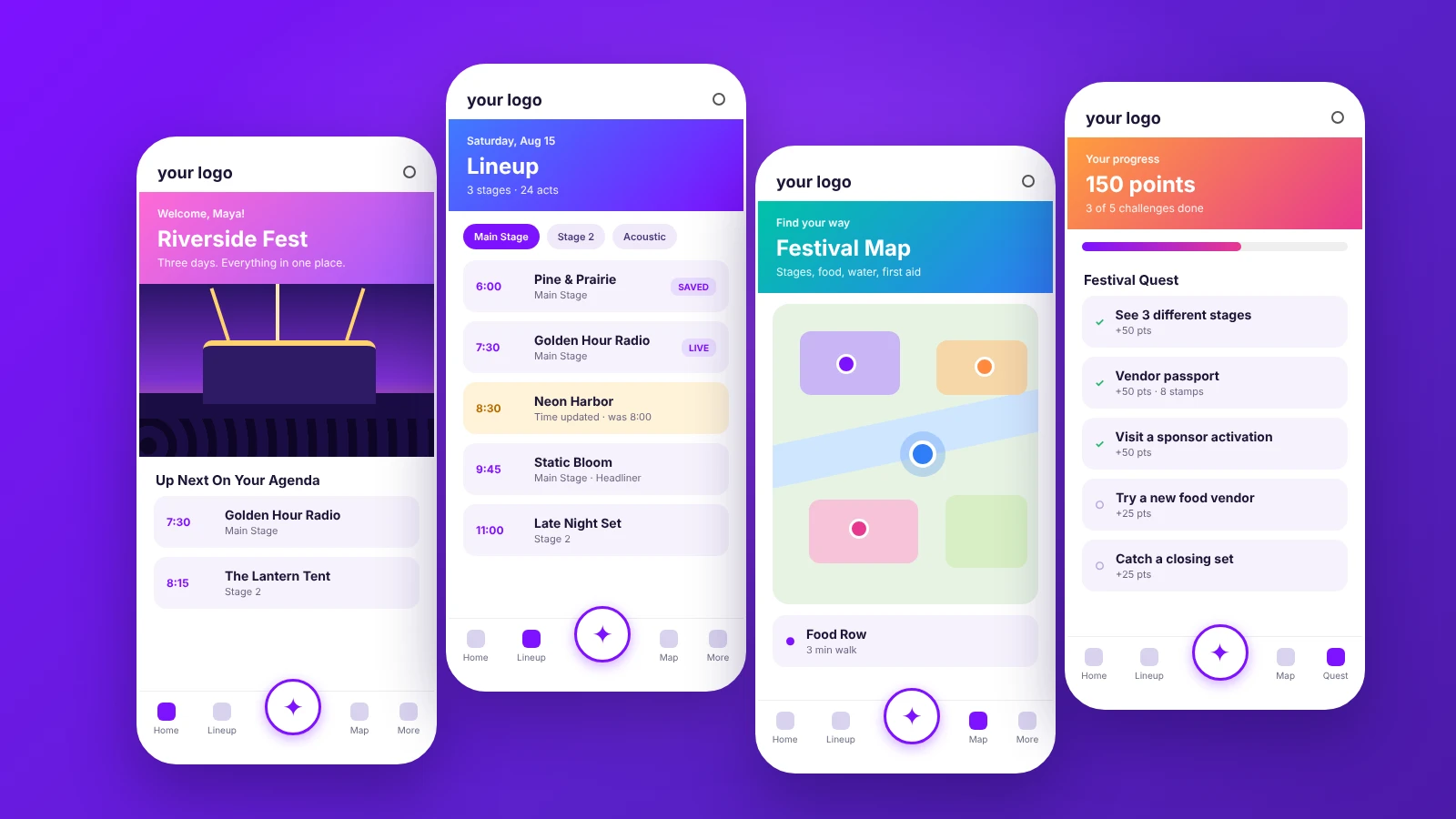
Gamification engagement. If you're using Quest to drive behavior across the event floor — sponsor booth visits, session check-ins, networking activity — the completion data becomes part of your engagement proof. Gamification metrics show that specific behaviors happened at specific rates, which is exactly the kind of structured evidence sponsors and leadership respond to.
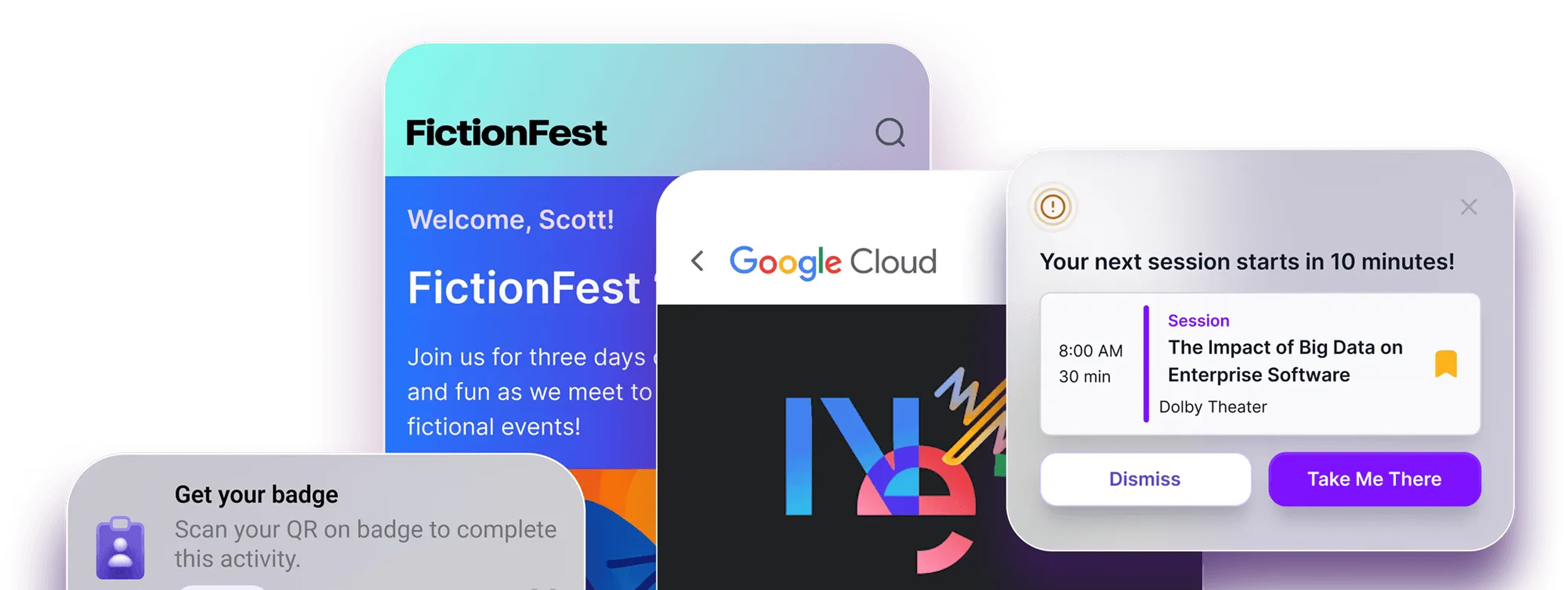
Notification performance. Push notification analytics show open rates, click-throughs, and engagement by segment. For event marketers who rely on notifications to drive attendance at specific sessions or sponsor activations, this is a direct line between communication effort and attendee behavior.
The through-line in all of this: data you don't capture before and during the event cannot be reconstructed afterward. The event app you choose determines what's available to you when it's time to make the ROI case.
How to Calculate Sponsor ROI
Sponsors are increasingly asking for proof before they renew, not just after the event. The teams that win repeat sponsorship revenue are the ones who come to the renewal conversation with specific data rather than general praise.
Sponsor ROI has a few distinct components.
Lead volume and quality. How many badge scans did the exhibitor's team capture? How many of those met the qualification criteria the sponsor defined before the event? Lead Scanning by Amego gives exhibitors a mobile lead scanning tool that captures qualified contacts directly from badge scans, attaches qualification notes and custom survey responses, and exports clean data to their CRM. The difference between 200 badge scans and 200 leads with qualification context, meeting notes, and CRM-ready export is the difference between a sponsor who feels busy and one who can measure pipeline.
Session and content visibility. If sponsors have branded session content, sponsored tracks, or placement in the content library, they want to know how many attendees engaged with it. Session attendance figures, content library views, and in-app sponsor profile clicks all feed into this.
Meeting quality. For sponsors who used the meeting scheduling feature to set up pre-qualified conversations, tracking how many scheduled meetings actually took place — and what happened afterward — gives them a performance metric that goes well beyond booth traffic.
Build a sponsor-specific report that covers these three areas for every exhibitor. Sponsors who receive a clear, data-backed ROI summary after an event renew at higher rates than those who don't. It's not complicated, but it requires the data infrastructure to exist in the first place. Your event app is that infrastructure.
How to Build the Stakeholder Report
Your CFO and your CMO are asking different questions. A single post-event report that tries to serve both audiences often serves neither well. Two versions of the same report, each framed around what that stakeholder actually cares about, is almost always more effective.
The financial stakeholder report (CFO, VP Finance, budget owners) should lead with pipeline generated, cost per attendee, cost per qualified lead, and sponsor revenue. Keep it to one page. Use a table. Include a "measurement window" note that explains why 90-day pipeline numbers are preliminary and 180-day numbers are more accurate for your sales cycle. Add a cost-per-lead comparison against your next most expensive lead channel. Events almost always look favorable in that comparison — but only if you make it explicit.
The marketing and program stakeholder report (CMO, VP Marketing, event team leadership) can go deeper. Include engagement metrics, NPS, session performance, networking activity, app adoption rates, and a qualitative summary of what worked and what didn't. This report is also where you build the case for next year's budget by connecting this year's engagement data to the financial outcomes it enabled.
Both reports should include a "what we'd do differently" section. This is the part that separates teams who are measuring for accountability from teams who are measuring for improvement. Leadership trusts the latter more, because it demonstrates that the data is being used, not just collected.
Event ROI Benchmarks for 2026
Benchmarks vary significantly by event type, industry, and objective. These are reasonable reference points for B2B enterprise events.
Pipeline return. A 3:1 pipeline-to-cost ratio is a common benchmark for B2B events — three dollars of pipeline for every dollar invested in producing the event. High-performing events with strong targeting and pre-event outreach regularly exceed this. Events without structured lead capture or qualification often fall short of it.
App adoption rate. A well-promoted event app should reach 60–80% adoption among registered attendees for an in-person conference. Events that integrate the app into pre-event communications, use it as the primary schedule vehicle, and activate engagement features throughout typically hit the higher end of that range.
Meeting completion rate. Of all 1:1 meetings scheduled through the event app, a completion rate of 70–80% is a reasonable target for events with strong onsite meeting infrastructure and staff support.
NPS. Industry averages for conference NPS typically sit in the 30–50 range. An NPS above 50 indicates a genuinely strong attendee experience. Events that use personalized agendas, active engagement features, and intelligent networking tools consistently score higher because the experience feels tailored rather than generic.
Session engagement. For events using live polls, Q&A, and surveys, participation rates above 30% per session are a strong signal. Sessions with AI-driven recommendations driving attendance typically see higher engagement rates because the attendees in the room chose to be there based on relevant interest signals, not just proximity.
These benchmarks are useful for calibrating expectations and for comparing performance year over year. They're less useful as absolute targets than as conversation starters with leadership about what realistic improvement looks like.
The Mistakes That Undermine Your ROI Story
Even teams that care about measurement make these consistently.
Treating ROI as a post-event task. If you haven't defined your success metrics and built your data capture infrastructure before registration opens, you can't reconstruct that data after the fact. ROI starts in the planning brief, not in the post-event debrief.
Confusing activity metrics with outcomes. Headcount is not ROI. Badge scans are not leads. Session attendance is not business value. These are inputs that create the conditions for outcomes. Report both, but be clear about which is which.
Using too short an attribution window. For enterprise B2B sales cycles, pulling an ROI report 30 days after an event will almost always understate the return. Set 90-day and 180-day checkpoints at the beginning and hold to them when reporting to leadership.
Choosing an event app that doesn't generate reportable data. This is the one that costs teams the most. An event app that shows a schedule and sends push notifications is not generating the engagement, networking, and behavioral data you need to build a credible ROI case. The platform choice is a data strategy decision, whether it's recognized as one or not.
Ignoring sponsor ROI until renewal time. Sponsors who receive proactive ROI data mid-event or immediately post-event are significantly more likely to renew. Waiting until they ask is already too late. Build sponsor reporting into your post-event workflow from the beginning, and make it specific.
The events industry has spent years arguing that in-person events are valuable. That argument is largely won. What's left is the harder work: proving that your specific event delivered specific value to specific people in the organization. The data to make that case exists inside your event. The question is whether your tools are capturing it.
Amego is built for event teams that take this seriously — from the engagement analytics in Amego Admin to the lead capture tools that give sponsors something worth renewing for. If your current stack isn't generating the data you need to prove value, that's worth fixing before the next event, not after it.
Want to see how Amego surfaces event ROI data in real time? Book a demo.

Sign up for our newsletter
Get insights delivered to your email.