
Table of Contents:
- The Most Under-Engineered Part of Most Conferences
- Three Networking Mistakes Organizers Make Consistently
- How to Design Networking, Not Just Enable It
- What Event Networking Technology Actually Needs to Do
- AI Matchmaking: What It Is, What It Isn't, and What It Actually Improves
- B2B Event Networking: Higher Stakes, Different Requirements
- Measuring Networking ROI
- How to Choose the Right Event Networking Platform
Ask any group of conference attendees why they showed up in person instead of watching the livestream, and the answer is almost always the same: to meet people.
Not to see the keynote. Not to collect the tote bag. To meet the right people, have real conversations, and leave with relationships that are worth the cost of the flight and the hotel.
Networking is consistently the top-ranked reason people attend live events. It's also the part of most conferences that gets the least intentional design. Content gets months of curation. Logistics get spreadsheets and site visits. Networking gets a cocktail hour and a hope.
This guide is about closing that gap: what it looks like to design networking intentionally, what an event networking platform actually needs to support it, and how to measure whether it worked.
The Most Under-Engineered Part of Most Conferences
The conference program gets built out session by session. Each speaker is confirmed, the schedule is timed to the minute, and AV is tested twice. Then, under "Tuesday 6–8pm": Networking Reception.
That's not a networking program. That's an open bar with ambient noise.
The disconnect is understandable. Content is easier to design than connection. You can write a session description. You can't write a conversation. But the instinct to leave networking as unstructured downtime produces exactly what you'd expect: a room full of people standing with their colleagues because approaching a stranger is uncomfortable and there's no mechanism to do anything else.
The events that generate the strongest attendee satisfaction scores and the best repeat attendance rates aren't the ones with the best content. They're the ones where attendees made connections they couldn't have made anywhere else. That outcome doesn't happen by accident. It requires the same intentionality as the rest of the program.
Three Networking Mistakes Organizers Make Consistently
Treating networking as a time block rather than a program element. Networking shouldn't live only in the white space between sessions. The best networking experiences are woven through the full event arc, starting before the doors open, running alongside the content program, and extending past the closing session. When networking is a standalone block on the schedule, it's optional. When it's integrated into the event's rhythm, it's unavoidable.
Collecting no data before the event starts. The quality of networking is directly tied to the quality of attendee data. An event that collects only name, title, and company during registration has almost nothing to work with when it comes to making relevant match suggestions. Organizers who add a few targeted profile questions during registration, like areas of interest, goals for the event, and what kind of connections they're looking for, unlock the entire personalization layer. A small investment at registration pays dividends throughout the event.
Conflating activity with outcomes. A hundred people in the networking lounge isn't a networking metric. It's a headcount. The number of meetings scheduled, connections made, messages exchanged, and follow-up conversations booked are metrics. The difference matters because one justifies the cocktail spend and the other justifies the entire event.
How to Design Networking, Not Just Enable It
Designed networking uses attendee data and structure to make the right connections easier to find and less awkward to initiate. Random networking leaves that entirely to chance. For most attendees at most conferences, chance doesn't perform well.
Here's what intentional networking design looks like in practice.
Start before the event. Attendees who are connected to other attendees before the event are significantly more likely to engage when they arrive and more likely to return next year. Pre-event profile access, the ability to message connections in advance, and a structured "who should you meet" recommendation all shift the dynamic. By the time an attendee walks through the door, they should already have a list of people to look for.
Use the agenda as a networking scaffold. People who attend the same session have a built-in conversation starter. Session-linked networking, like small discussion groups after a keynote, roundtables built around a track, or topic-specific meetups, uses shared context to remove the awkwardness of cold introductions. The conversation starts with the session, not with "so, what do you do?"
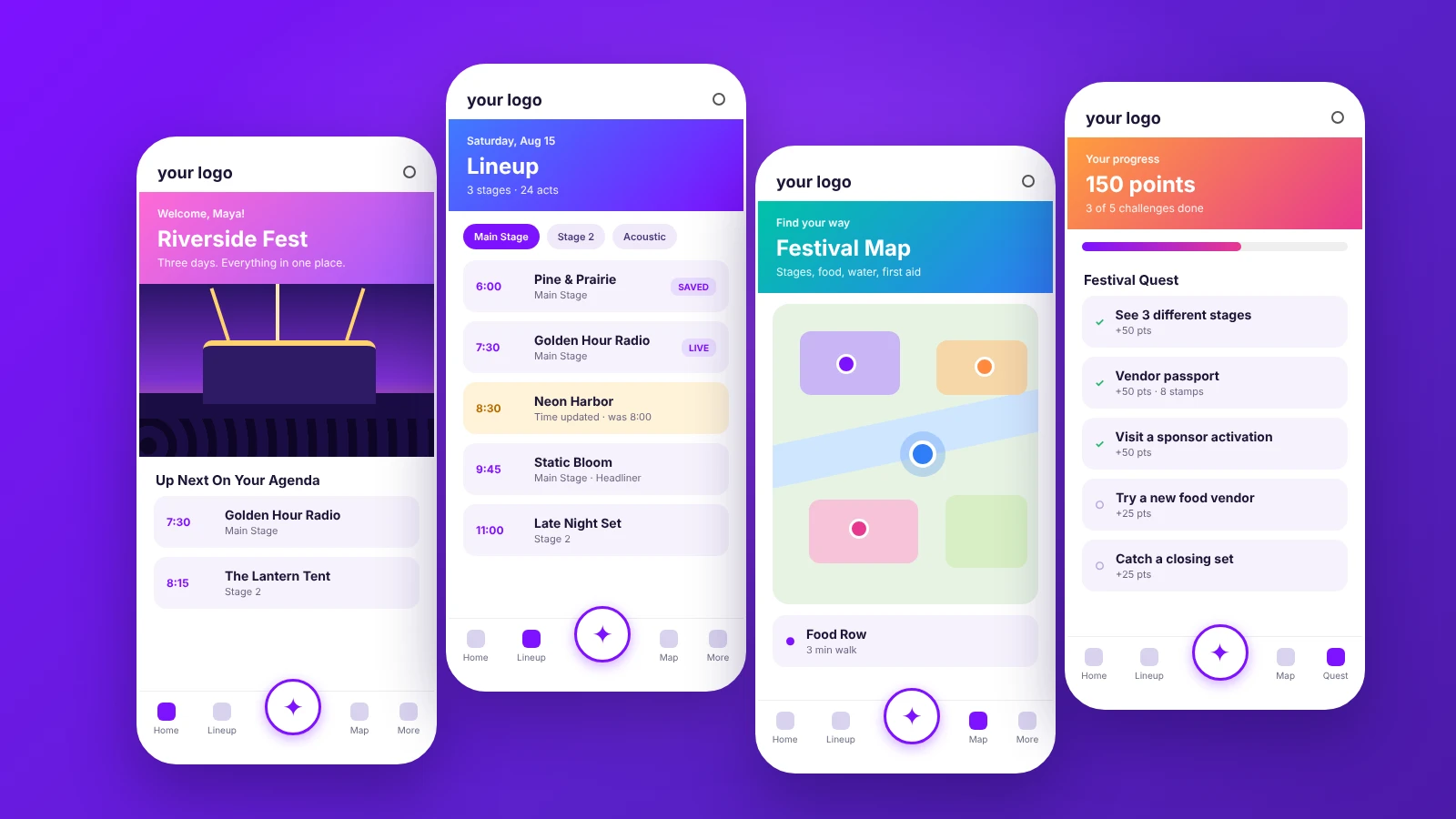
Give attendees a reason to take action. Connection bingo, scavenger hunts, and gamified challenge programs like Quest turn networking behaviors into progress toward a goal. When an attendee can earn points for scanning a new contact, completing a sponsored booth visit, or scheduling a 1:1 meeting, those activities happen at much higher rates than they do when the only incentive is abstract. Attendees who explore more of the event floor also report higher satisfaction. The activity and the connection often come together.
Extend networking past showtime. Most events end and the networking disappears with them. Group chats, post-event message threads, and connection tools that stay active after the closing session keep the energy alive and give attendees a reason to stay engaged with your community until the next event.
What Event Networking Technology Actually Needs to Do
A lot of event apps claim to support networking. Very few are actually designed around it. Here's the functional baseline that a capable event networking platform needs to meet.
Rich, searchable attendee profiles. Name and company aren't enough. Profiles should surface role, interests, stated goals, and session participation. The more signal in the profile, the better the matchmaking and the more useful the directory.
1:1 meeting scheduling. The ability to request, confirm, and manage a meeting through the app removes a significant friction point. Without in-app scheduling, attendees have to exchange emails or LinkedIn messages, find a time, and hope it happens. In-app scheduling closes that loop before the conversation loses momentum.
In-app messaging. Direct messaging between attendees should be native to the app. Sending someone to a third-party platform to follow up breaks the experience and reduces conversion from "interested" to "connected."
Group chats with access controls. Segment-specific group chats, for speakers, sponsors, VIP attendees, or specific session tracks, let organizers create focused communities within the event. Visibility rules ensure the right conversations are happening in the right rooms.
Real-time connection tools. Badge scanning for peer-to-peer connection exchange is the onsite equivalent of a business card swap, without the business cards. Two attendees scan each other, connect in the app, and continue the conversation. Clean and frictionless.
Reporting visibility for organizers. Networking data shouldn't live only on the attendee side. Organizers need visibility into meeting volume, connection rates, and messaging activity through a reporting layer in the CMS. That data is both proof of networking success and input for next year's design. Amego Admin's meeting reporting surfaces scheduled meetings, meeting statuses, and onsite space utilization in real time, giving organizers the signal they need to course-correct during the event, not just after it.
AI Matchmaking: What It Is, What It Isn't, and What It Actually Improves
AI matchmaking is one of the most discussed features in the event networking space right now. It's also one of the most misrepresented.
Here's the honest version.
What AI matchmaking is. At its most useful, AI matchmaking analyzes attendee profiles, stated goals, behavioral signals, and session engagement patterns to surface curated connection suggestions. Instead of presenting a directory of 4,000 attendees and letting each person sort through it, the system surfaces a short, prioritized list of people worth meeting, and explains why.
The why matters. A suggestion that says "You and this person are both attending the Enterprise Security track and have both flagged cloud infrastructure as a focus area" is actionable. A match score with no context is not.
What AI matchmaking isn't. It isn't magic, and it isn't a replacement for well-designed networking experiences. An AI matchmaking feature dropped into an event with no attendee profile data, no 1:1 scheduling infrastructure, and no time blocked for actual meetings will underperform. The technology amplifies what's already there. It can't substitute for the design decisions that create the conditions for connection.
What it actually improves. Events that activate AI matchmaking consistently see higher meeting scheduling rates, more cross-segment connections, and more attendees who report that they "met the right people." The shift from a full directory to a curated shortlist reduces the cognitive load that makes networking feel overwhelming. Attendees don't have to decide who to approach out of thousands. They have three or five suggestions that are actually relevant.
Amego's Sidekick™ applies this intelligence natively inside the event app, not as a separate matching tool but as part of the experience running alongside session recommendations, wayfinding, and real-time engagement. The match suggestions are informed by the same behavioral signals that power personalized agendas, which means they get smarter throughout the event, not just before it starts.
For events that want a dedicated deep-networking layer, Amego also integrates with Braindate, a purpose-built peer learning and connection platform, giving organizers flexibility to layer in specialized tools without disrupting the core app experience.
B2B Event Networking: Higher Stakes, Different Requirements
B2B events are where the gap between casual networking and designed networking has the most direct commercial consequence.
At a B2B conference, networking isn't a perk. It's a primary business objective. Attendees are evaluating vendors, building partnerships, opening conversations with prospects, and deepening relationships with existing accounts. Sponsors are expecting qualified meetings, not random foot traffic. Organizers are measured on whether the event moved pipeline.
That context changes what "good networking" looks like.
Qualification matters more than volume. A sales rep who has 40 badge scans but no context on any of them has a lead list, not a pipeline. A sales rep who has 15 conversations with documented context, qualification notes, and scheduled follow-ups has a pipeline. The networking infrastructure at a B2B event needs to support capture quality, not just capture volume. Amego's lead scanning app gives exhibitor and sponsor teams exactly that: mobile badge scanning with custom qualification surveys and CRM-ready export, so every connection comes with the context to follow up effectively.
Meeting scheduling needs to happen before the floor opens. B2B attendees who arrive with a pre-set meeting schedule extract more value and report higher satisfaction than those who leave scheduling to chance. Pre-event 1:1 scheduling, activated several weeks before the conference, lets buyers and sellers find each other when there's still time to prioritize the conversation in both parties' schedules.
Sponsor meeting ROI needs to be reportable. For sponsors and exhibitors, the question after the event is always the same: was it worth it? Meeting volume, qualification rates, and pipeline generated from event conversations are the data points that answer that question. Organizers who can provide sponsors with specific meeting and engagement reporting, not just booth traffic estimates, have a dramatically easier renewal conversation.
For teams running B2B-specific events, the networking layer is the commercial layer. Designing it with the same rigor applied to content and logistics is what separates events that justify enterprise budgets from ones that are perpetually at risk of being cut.
Measuring Networking ROI
Networking ROI is measurable. Most teams just don't build the measurement infrastructure for it.
Here are the metrics that tell the real story.
Meeting volume and completion rate. How many 1:1 meetings were scheduled through the app? Of those, how many were completed? A completion rate above 70% indicates that the scheduling infrastructure and onsite support are working. Significantly lower than that suggests friction in the process.
Connection rate. What percentage of attendees made at least one in-app connection? A high connection rate indicates that the networking tools were accessible and that attendees were actively engaged with the feature rather than ignoring it. Events with strong gamification driving networking behaviors consistently see higher connection rates.
Message volume. How many messages were exchanged between attendees? This is a signal of sustained engagement. Attendees who are actively messaging are invested in the relationships they started.
Post-event follow-up activity. How many meeting requests or connection messages happen in the 48 hours after the event closes? A networking experience that generates follow-up activity has a longer commercial tail than one that ends when the doors close.
Pipeline influenced. For B2B events, the ultimate networking metric is commercial. Tag every CRM opportunity that had any event networking touchpoint and track it at 30, 90, and 180 days. Event-sourced deals from high-quality in-person connections tend to close at higher rates than comparable inbound deals, because the relationship predates the sales conversation.
Attendee satisfaction scores tied to networking. Post-event NPS surveys that include a specific question about networking quality give you a direct signal: did the networking experience meet expectations? Scores here often track closely with overall event NPS, because for most attendees, "was this event worth attending" and "did I make good connections" are the same question.
The through-line in all of this: networking metrics only exist if you build the data layer to capture them. A cocktail reception with no app integration produces no actionable networking data. An event with 1:1 scheduling, in-app messaging, badge scanning, and gamification challenge data produces the evidence needed to defend the budget, optimize the program, and prove value to sponsors.
How to Choose the Right Event Networking Platform
The event networking technology market is crowded, and most platforms make broadly similar claims. These are the questions that cut through the noise.
Is networking native to the event app or a separate product? Standalone networking tools require attendees to move between two apps. Adoption drops every time there's friction, and a networking tool that 40% of attendees activate is far less useful than one integrated into the app they're already using for the schedule, sessions, and notifications. Native integration is almost always better.
What data does the matchmaking actually use? Profile fields alone aren't enough. A platform whose matching algorithm incorporates real-time session attendance, content engagement, and behavioral signals produces better suggestions than one working from static registration data. Ask specifically: what gets smarter as the event progresses?
How does the platform handle meeting infrastructure? Suggestions are only as valuable as the action they enable. The platform needs in-app scheduling, confirmation workflows, reminder notifications, and onsite meeting space management, not just a "connect" button.
What does the organizer see? Networking data should be accessible to the event team in real time. If visibility into meeting activity, connection rates, and messaging volume requires a post-event data export, you lose the ability to course-correct while the event is still running.
How does it integrate with your existing stack? Networking data that lives only in the event app and never flows into your CRM or marketing automation has limited commercial value. Integration with your registration system, CRM, and EMS is what turns networking activity into pipeline signal.
Amego's networking tools are built into the same app attendees use for everything else at the event: sessions, notifications, content, gamification. That coherence drives adoption, and adoption drives the data. If the question your leadership asks after the next event is "did the networking work?", the answer should come from your platform, not from a post-event survey asking attendees to remember how many business cards they exchanged.
Want to see how Amego handles attendee networking from pre-event matching to post-event connection? Schedule a demo.

Sign up for our newsletter
Get insights delivered to your email.