
Table of Contents:
Event Planning Has Gotten Harder, And the Tools Haven't Kept Up
Running a conference in 2026 means juggling more moving parts than ever. Hybrid formats. Attendee expectations shaped by consumer apps. Sponsors demanding ROI proof, not just logo impressions. A global tech stack that needs to sync in real time and not fall over when 15,000 people open the same screen at once.
The event planning tools market has responded to this complexity mostly by adding more tools. There are platforms for registration, platforms for scheduling, platforms for engagement, platforms for lead retrieval, and a small army of integrations that exist solely to stitch them together. Some of that specialization is useful. A lot of it creates work.
This guide cuts through it. We cover the core categories of event management tools, what to look for in each, and how to build a tech stack that's actually coherent on event day, not just impressive in a demo.
What Are the Best Event Planning Tools?
The best event planning tools typically cover five core needs: registration, attendee experience, engagement, networking, and analytics. For conferences and corporate events, the strongest technology stacks connect these systems so attendee data, schedules, communications, and engagement activity stay synchronized throughout the event.
| Tool category | Best for | Key capabilities |
|---|---|---|
| Registration platforms | Managing registration and attendee records | Registration, payments, attendee data |
| Event apps | Managing the attendee experience | Agendas, maps, content, networking, notifications |
| Engagement tools | Increasing participation | Polls, Q&A, surveys, gamification |
| Networking tools | Helping attendees connect | Matchmaking, meetings, messaging |
| Event analytics tools | Measuring performance | Attendance, engagement, sponsor and ROI data |
Types of Event Planning Tools
Most software for event planners falls into five categories. You'll likely need at least one tool in each, though the best stacks minimize redundancy between them.
1. Registration software
Registration tools handle the front door: collecting attendee information, processing payments, managing capacity, and sending confirmations. This category is mature and competitive. The main differentiators are customization depth, CRM integrations, and how cleanly the data flows downstream into your event app.
Whatever registration tool you choose, confirm it can push attendee data to your event app automatically. A registration-to-app sync that requires manual CSV exports will cost you hours you don't have in the 48 hours before go-live.
2. Event apps
The event app is the tool that attendees actually use during the event. It's the most visible piece of your tech stack, and the one most likely to define how attendees feel about the overall experience. A good mobile event app does more than display the schedule. It keeps people oriented, connects them to the right content and the right people, and adapts in real time when plans change.
Most generic event apps treat engagement as a feature list: push notifications, Q&A, polling, a sponsor directory. That's table stakes. The actual job is reducing uncertainty. Attendees open the app when something is unclear and they need a useful answer fast. That's the standard worth holding any event app to.
3. Engagement tools
Engagement tools include live polling, Q&A, surveys, session feedback, and gamification. Some event apps bundle these natively; others require third-party integrations. Either way, the best engagement features are the ones your team can actually support. Live polling is great when it's facilitated, awkward when it's just turned on and forgotten.
Amego's built-in attendee engagement features cover live polls, Q&A, and surveys in the same app your attendees are already using, no separate platform or login required. Quest, Amego's gamification feature, turns session attendance and booth visits into a guided experience with points and rewards.
4. Networking platforms
"Networking" is one of the top reasons people attend conferences. It's also one of the most common disappointments: an attendee list with 5,000 names and no good way to find the three people worth meeting.
The event organization tools that solve this well go beyond directories. They surface people based on shared roles, shared interests, and actual in-event behavior. That's the difference between a networking feature and intelligent matchmaking, and attendees notice it immediately.
5. Analytics
Post-event analytics tell you what worked and what didn't. Session attendance rates, app engagement depth, notification open rates, sponsor booth scan counts: the right data makes it possible to improve the next event rather than repeat the last one. Look for tools that surface this in a dashboard you'll actually use, not a spreadsheet export you'll look at once.
Key Features Event Planners Need
When evaluating any piece of conference planning software, these are the capabilities that separate tools that hold up at showtime from tools that look good in a demo.
Why Amego Is Built for Event Teams
A lot of event apps were built for a specific scale or a specific use case and then stretched to cover more. Amego was built from the start for the complexity of enterprise conferences. Events where the stakes are high, the schedules are dense, the sponsors are paying attention, and the team running the show has done this before and doesn't need surprises.
Enterprise scale
Amego supports events from 500 to 100,000+ attendees. Customers include Atlassian, Cloudflare, Google Cloud, ServiceNow, Nutanix, Docusign, and Palo Alto Networks. The platform is SOC 2 Type II and GDPR compliant. That's not marketing copy, it's the minimum requirement to get procurement approval at most of the companies that use it.
"Our attendees rave about how easy it is to navigate, and my team loves that everything syncs with our event tech stack. What really stood out to me about Amego is how clearly it was designed by people who actually work in events."
– Tricia Williamson, Event Technology Director, Docusign
Customizable attendee experiences
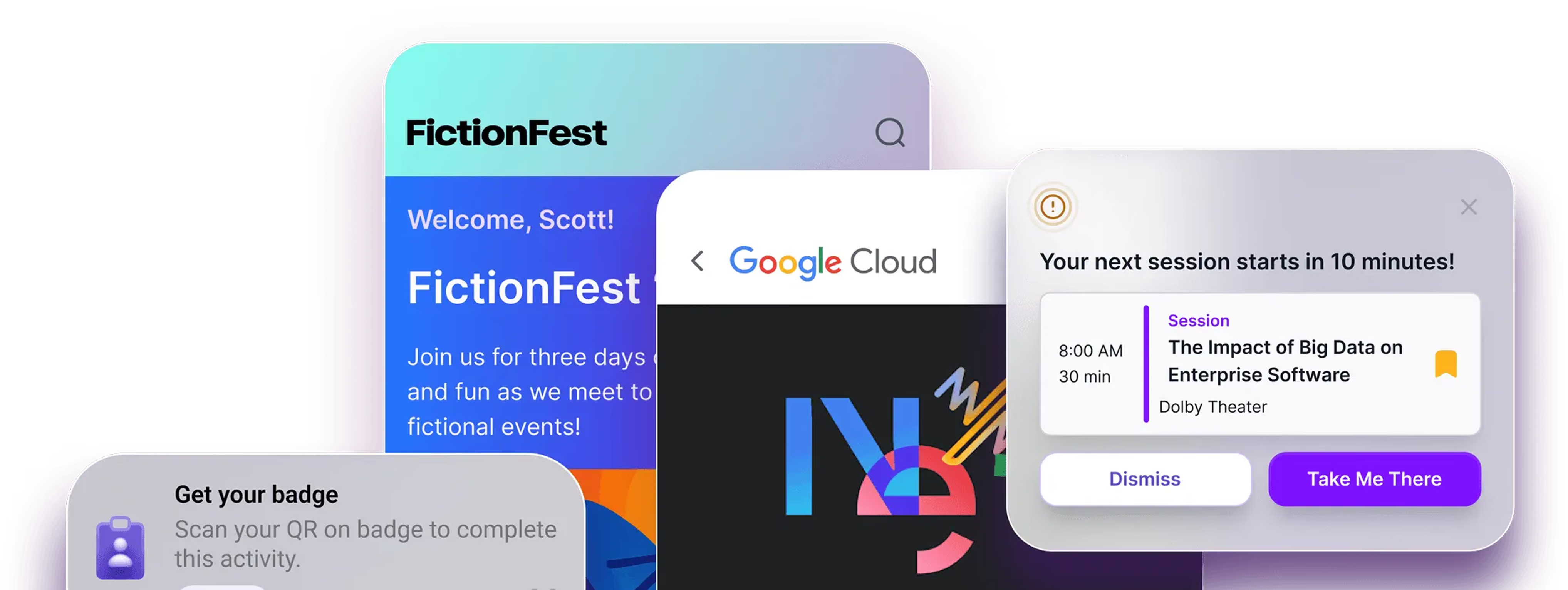
Amego's attendee mobile app is fully brandable: colors, fonts, icons, screen layouts, and navigation. The event your attendees see is yours, not a generic white-label product with your logo in the corner. Event marketers and organizers manage everything through Amego Admin, the built-in CMS, including content, schedule updates, push notifications, and analytics, from a single place, in real time.
AI companion built for events
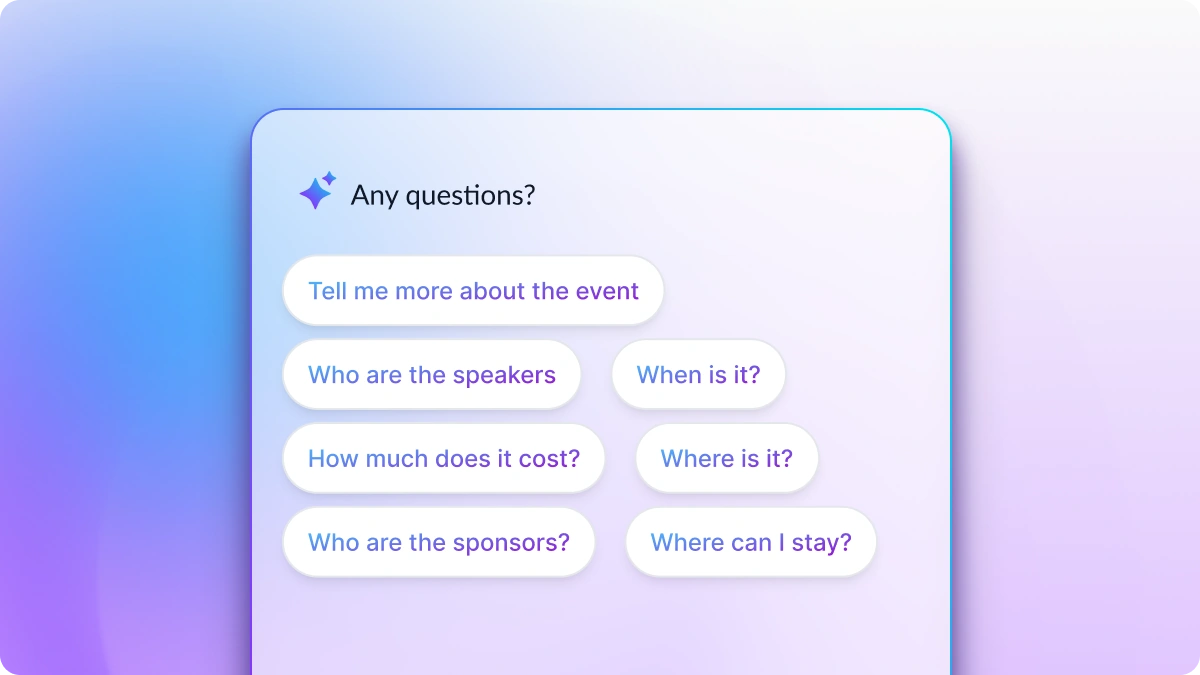
Sidekick™ is Amego's AI companion, not a generic chatbot bolted onto an event app, but a purpose-built intelligence layer trained on your specific event. Every session, every speaker, every sponsor, every venue detail. Attendees ask it where to be, who to meet, what's happening next. It answers in seconds with information that's actually useful.
Sidekick™ handled 312,000 queries over four days at a recent enterprise deployment. Average response time: 1.4 seconds. Average helpfulness rating: 4.7 out of 5. That's not AI as a marketing claim, that's AI earning its keep at showtime. Explore Sidekick™.
Event Planning Tech Stack: What Fits Where
Here's how a well-organized enterprise event tech stack maps to the tools and features described above. The goal isn't the longest list, it's the fewest gaps on event day.
| Layer | Job to be done | Where Amego fits |
|---|---|---|
| Registration | Collect attendee data, manage capacity, process payments | Amego integrates with Cvent, RainFocus, Swoogo, and others, no manual CSV sync |
| Agenda & content | Publish and update the schedule in real time | Amego Admin + Library & Agenda, live updates with no republish delay |
| Attendee experience | Navigation, session discovery, engagement | Attendee Mobile App, fully branded, personalized, real-time |
| AI companion | Answer attendee questions, surface relevant content, reduce uncertainty | Sidekick™, trained on your event, embedded in the app |
| Networking | Help attendees find and connect with the right people | Networking & AI matchmaking, profile-based and intent-driven |
| Engagement | Polls, Q&A, surveys, gamification | Engagement features + Quest, built into the same app |
| Sponsor ROI | Lead capture, visibility, post-event reporting | Lead scanning + in-app sponsor placements + Sidekick™ sponsor cards |
| Notifications | Real-time updates, room changes, targeted messages | Push notifications managed from Amego Admin |
| Analytics | Measure engagement, prove ROI, improve next time | Built-in event analytics dashboard in Amego Admin |
The fewer handoffs in your stack, the less that can break between them. Tools that cover multiple layers, like Amego covering the app, CMS, engagement, networking, and AI in one, reduce the integration surface area your team has to manage at showtime. Solid event integrations matter for the layers you keep separate.
How to Choose Event Planning Tools
There's no universal right answer, but the following criteria will get most teams to a shortlist that fits their reality, not a vendor's pitch deck.
Event size and complexity
A 300-person internal offsite and a 15,000-person customer conference are different problems. Small, single-track events can run on lightweight tools. Multi-track conferences with concurrent sessions, sponsor programs, and offsite activations need platforms built to scale without breaking under load or your team's attention.
Type of event
Sales kickoffs, user conferences, trade shows, and internal offsites all have different priorities. A user conference leans heavily on content discovery and networking. An SKO leans on engagement and internal communications. Pick tools that match the shape of the event you're actually running.
Existing technology stack
Your event tools don't sit in a vacuum. They connect to your CRM, your marketing automation, your SSO provider, and your data warehouse. Start by mapping what's already in place, then look for tools that fit into it cleanly. New platforms that force you to work around your existing systems tend to cost more than they save.
Integration requirements
Ask specifically how each tool integrates with the others you plan to use. Native integrations beat API-only connections, and API-only connections beat manual CSV exports. Confirm the direction of the sync, the frequency, and what happens when a field doesn't map cleanly.
Attendee experience goals
Decide what you want attendees to feel and do, then work backwards. If the priority is peer-to-peer networking, weight your evaluation toward matchmaking. If it's content discovery in a dense agenda, weight it toward search, personalization, and AI guidance. Every tool has strengths, they should match your goals.
Security requirements
For internal events with confidential content and any customer conference at an enterprise company, security and compliance are gating criteria, not nice-to-haves. Confirm SOC 2 Type II, GDPR, and any industry-specific requirements (HIPAA, FedRAMP) up front. Procurement will ask, and the wrong answer stalls the whole project.
Reporting needs
Think through what you'll need to prove after the event, to leadership, to sponsors, to your own team. Tools that surface those metrics in a dashboard beat tools that require a data pull and a spreadsheet. If sponsors need booth traffic reports, make sure the tool captures that natively.
Internal resources
Some platforms assume a dedicated event technologist. Others are built for a marketing lead running the event on top of their day job. Be honest about who will actually manage the tool day-to-day, and pick platforms your team can support without a full-time integrator.
FAQs
What tools do event planners use?
The tools used by event planners typically span five categories: registration software (Cvent, Eventbrite, Splash), event apps (Amego Event App), engagement tools (polls, Q&A, gamification), networking platforms, and analytics. Most enterprise event teams also use a CMS to manage content in real time. At Amego, that's Amego Admin. The exact stack depends on event size, format, and how much your team wants to manage versus outsource.
What software is best for planning a conference?
There's no single best conference planning software. The right answer depends on your event's scale, format, and what you need the technology to do. For enterprise conferences that need a fully branded attendee app, AI-powered guidance, real-time content management, and sponsor ROI tools in one platform, Amego is the choice teams at Atlassian, Cloudflare, Google Cloud, and Docusign have landed on. For registration specifically, Cvent and Swoogo are the enterprise standards. The key is building a stack where the tools integrate cleanly, not one where your team spends event week on manual data exports.
What should be included in an event technology stack?
A well-rounded event tech stack covers registration, a branded mobile event app, attendee engagement (polls, Q&A, surveys, gamification), networking and matchmaking, sponsor and lead capture tools, and analytics. Behind the scenes, your stack also needs the event integrations that keep attendee data, schedules, and reporting in sync across systems. The fewer separate platforms you can get away with, the fewer handoffs can break on event day.
How many event planning tools does an event team need?
Most enterprise teams end up with three to six core platforms: a registration system, an event app that covers the attendee experience and engagement, one or two integrations into the CRM and SSO, and an analytics layer. Small events can get by with fewer. The goal isn't to hit a number; it's to cover the five job categories (registration, experience, engagement, networking, analytics) with the fewest tools that do each job well and talk to each other cleanly.
What is the best event software for planners managing large conferences?
For large conferences (think 5,000 to 100,000+ attendees) the non-negotiables are real-time content management, a branded and scalable attendee app, reliable integrations with your registration system, and strong sponsor tools. Amego is built specifically for this tier. It's SOC 2 Type II and GDPR compliant, scales to six-figure attendee counts, and earned G2's Best Support and High Performer recognition from customers who've used it at that scale. You can see how event teams have used it in Amego's success stories.
How do I choose event organization tools for corporate events?
Start with the job your tools need to do: registration and check-in, schedule delivery, attendee engagement, sponsor management, and analytics. Then look at how well those tools integrate with each other and your existing CRM or marketing stack. For corporate events in particular, security and compliance matter, both for internal events with sensitive content and for enterprise customer conferences. Amego's solutions for internal event teams cover private, secure branded apps for SKOs, offsites, and corporate kickoffs.
See what your event could look like with Amego
Fully branded. AI-powered. Built for event pros who've seen what happens when the tools fall short.
Schedule a Demo Read More on the Blog
Sign up for our newsletter
Get insights delivered to your email.