
Sponsors don't leave because the swag was bad. They leave because they can't point to a number that justifies the invoice. If your event app can't answer "what did we actually get for this" in a sponsor's own language, renewal season gets a lot harder, no matter how good the event felt in the room.
The tricky part is that this kind of revenue loss is quiet. Nobody sends an email saying "your app cost us a renewal." Sponsors just show up with a smaller budget next year, or don't show up at all. Here are five signs your event app is already doing that damage, and what's actually driving it.
Sponsors and exhibitors aren't paying for booth space. They're paying for qualified attention: the right people, having the right conversation, soon enough to still be useful to sales. An event app is supposed to be the layer that makes that attention measurable. When it doesn't, sponsors are left reconstructing ROI from memory and gut feel, which is a losing pitch at renewal time. For a deeper look at the metrics sponsors actually care about, see our definitive guide to sponsor ROI at events .
This matters more than it used to. Sponsorship budgets get scrutinized the same way marketing budgets do now, and "it felt like a good event" doesn't survive a budget review. If your app isn't producing evidence, someone else's event is.
If a sponsor asks "how many people actually came to our booth, and were they the right people," and your app can't answer with real data, that's the first leak. Foot traffic counted by a booth staffer on a clipboard isn't a report, it's a guess with a sponsor's name attached to it.
Attribution gaps usually come from a fragmented tech stack: registration in one system, wayfinding in another, and booth check-ins nowhere at all. When digital engagement and physical interactions never connect, organizers struggle to show how app engagement translates into meaningful sponsor activity. Sponsor profile views, badge scans, meeting activity, and recorded booth visits can help build that picture, but only when the right tools are in place to capture and connect the data. Without that visibility, sponsors have a harder time justifying the same investment next year.
Trade show leads have a short shelf life, but too many exhibitors leave events without a clear follow-up process. Most of the time, that's not just a sales problem, it's a data problem. A stack of business cards and a shoebox of scanned badges doesn't turn into pipeline on its own. It turns into a spreadsheet someone builds three weeks later, by which point the lead may have forgotten which booth they even talked to.
Speed matters more than people think. A Harvard Business Review study found that companies contacting online leads within an hour were nearly seven times as likely to qualify them as companies that waited even an hour longer. While the research wasn't specific to events, the takeaway is relevant: the longer sponsors wait to follow up, the harder it becomes to turn interest into opportunity. If your app's idea of lead capture is manual entry and a CSV export at the end of the event, sponsors could be losing valuable time before sales even gets the lead.
Not every badge scan is worth the same follow-up. A VP who spent ten minutes asking pricing questions is not the same lead as someone who grabbed a sticker on the way to the coffee line. If your app dumps every scan into one flat list with no scoring, no notes, and no context, sponsors' sales teams are stuck re-qualifying from scratch, and the good leads get buried under the bad ones.
This is where custom qualification actually pays off. With the right event lead capture and qualification tools , exhibitors can build their own qualification forms, add notes, and rate leads in the moment, right at the booth. Instead of handing sales a flat list of names, sponsors can export qualified leads with the context needed to prioritize follow-up, or sync them to their CRM when the appropriate integration is configured. Without that, sponsors are doing manual triage on their own time, and slower triage means colder leads by the time anyone calls.
A sponsor's booth can be well-staffed, well-designed, and still get walked past by exactly the people who should have stopped. That's not a booth problem, it's a discovery problem. If your app treats every attendee to the same static sponsor directory instead of surfacing sponsors relevant to their interests, you're relying on luck to connect the right buyer with the right sponsor. Better sponsor discovery starts with a smarter attendee engagement strategy that connects people with relevant sessions, experiences, and exhibitors throughout the event.
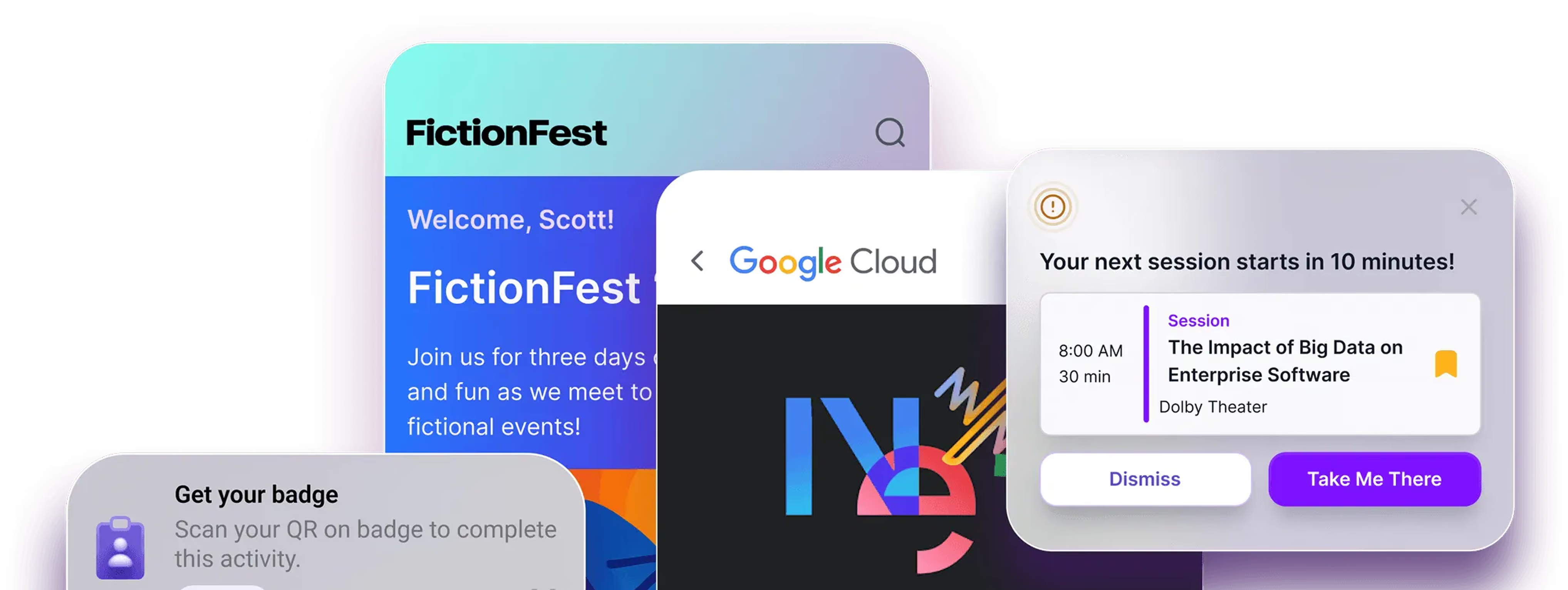
This is one of the clearest places agentic AI earns its keep over a static app or a basic chatbot. Instead of waiting for attendees to browse a sponsor list, an AI-powered event companion can recommend relevant exhibitors based on attendee interests, behavior, and event context. That creates more opportunities for meaningful booth conversations without forcing attendees to do all the discovery themselves. We covered this shift in more detail in agentic AI vs. event chatbots , and it applies directly to sponsor discovery, not just attendee convenience.
The renewal conversation happens with or without your help. If your app can't produce a clean report showing booth visits, lead volume, engagement by session, and how that compares to what was promised in the sponsorship deck, the sponsor is left filling in the blanks themselves, and they'll usually fill them in with doubt.
Visibility during the event lets your team react while a sponsor's activation is underperforming instead of finding out three weeks later. If lead capture is low on day one, there's still time to adjust the activation, promote the booth, or encourage more relevant attendees to stop by. After the event, engagement analytics and lead capture reports help turn "it felt fine" into "here's what you got." With tools like Amego Admin , organizers can bring event content, attendee engagement insights, and reporting together to understand what's working and make more informed decisions.
None of these five signs are really about sponsors being difficult. They're about an app that can't produce evidence for a relationship that runs on evidence. The fix isn't a bigger sponsorship deck next year, it's tooling that captures attribution, scores leads on the spot, connects the right attendees to the right booths, and hands sponsors a report they can actually act on.
Amego brings the tools together to help event teams deliver more measurable sponsor value. Our lead scanning tools capture and qualify leads, while Sidekick™ uses AI-powered matchmaking and real-time recommendations to help attendees discover relevant sponsors and exhibitors. Together, they give organizers more ways to drive engagement and sponsors better information to support their follow-up and ROI reporting.

Sign up for our newsletter
Get insights delivered to your email.