
Table of Contents:
- Best Whova Alternatives at a Glance
- Why Look for an Alternative to Whova?
- 1. Amego
- 2. Cvent Attendee Hub
- 3. EventMobi
- 4. Bizzabo
- 5. Swapcard
- 6. PheedLoop
- Whova vs. Competitors: What Should You Compare?
- Which Whova Alternative Is Right for You?
- Why Enterprise Event Teams Choose Amego
- FAQs About Whova Alternatives
Whova is a well-known event platform, particularly for conferences, associations, and events where attendee networking and community interaction are a priority. But it isn't the right fit for every event team.
Organizations running larger conferences, complex enterprise events, highly branded experiences, or events with more sophisticated integration and personalization requirements may need to look at other options.
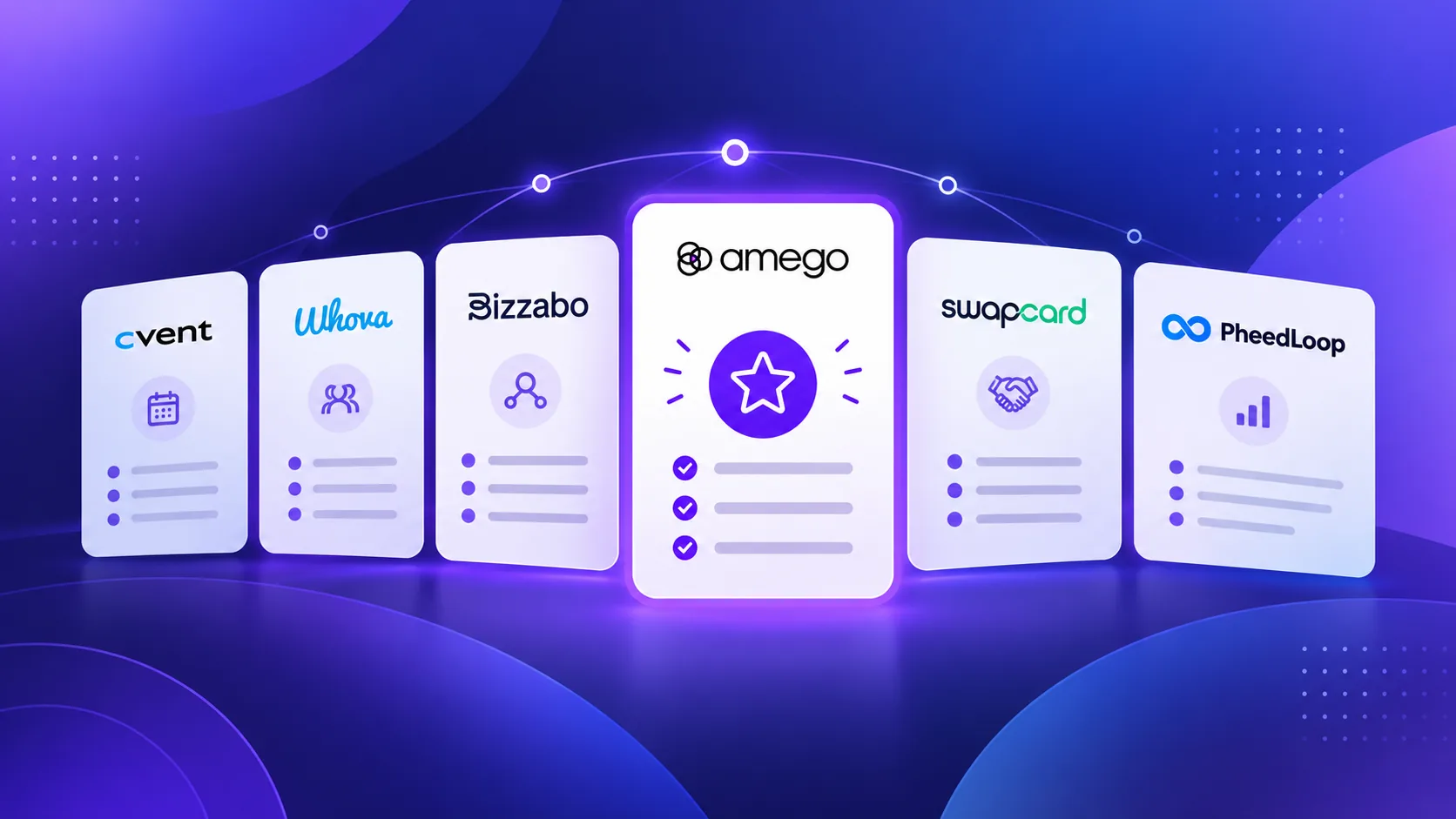
If you're researching Whova alternatives, this guide compares six platforms worth considering in 2026, including where each one stands out and what type of event it may be best suited for.
Best Whova Alternatives at a Glance
The best Whova alternative depends less on which platform has the longest feature list and more on what you're actually trying to accomplish.
A 600-person association conference has very different requirements from a 15,000-person enterprise conference, global user event, or trade show.
Why Look for an Alternative to Whova?
Whova combines event agendas, attendee networking, exhibitor information, announcements, community features, and other common event app functionality.
For many organizations, that's enough.
But teams comparing Whova competitors are often looking for something more specific, such as:
- More control over the event brand and attendee experience
- Greater flexibility for large or complex enterprise events
- More advanced attendee personalization
- AI-powered recommendations and guidance
- More sophisticated event technology integrations
- Deeper sponsor and exhibitor experiences
- Greater control over engagement and gamification
- Support for complex attendee segments and event programs
- A platform that can work across a broader enterprise event strategy
That's why the best alternative to Whova isn't necessarily the platform with the most features.
It's the one that aligns best with how your events actually work.
1. Amego
Best Whova alternative for: Enterprise conferences and branded attendee experiences
Amego is an attendee experience platform built for conferences, trade shows, corporate events, and complex enterprise programs.
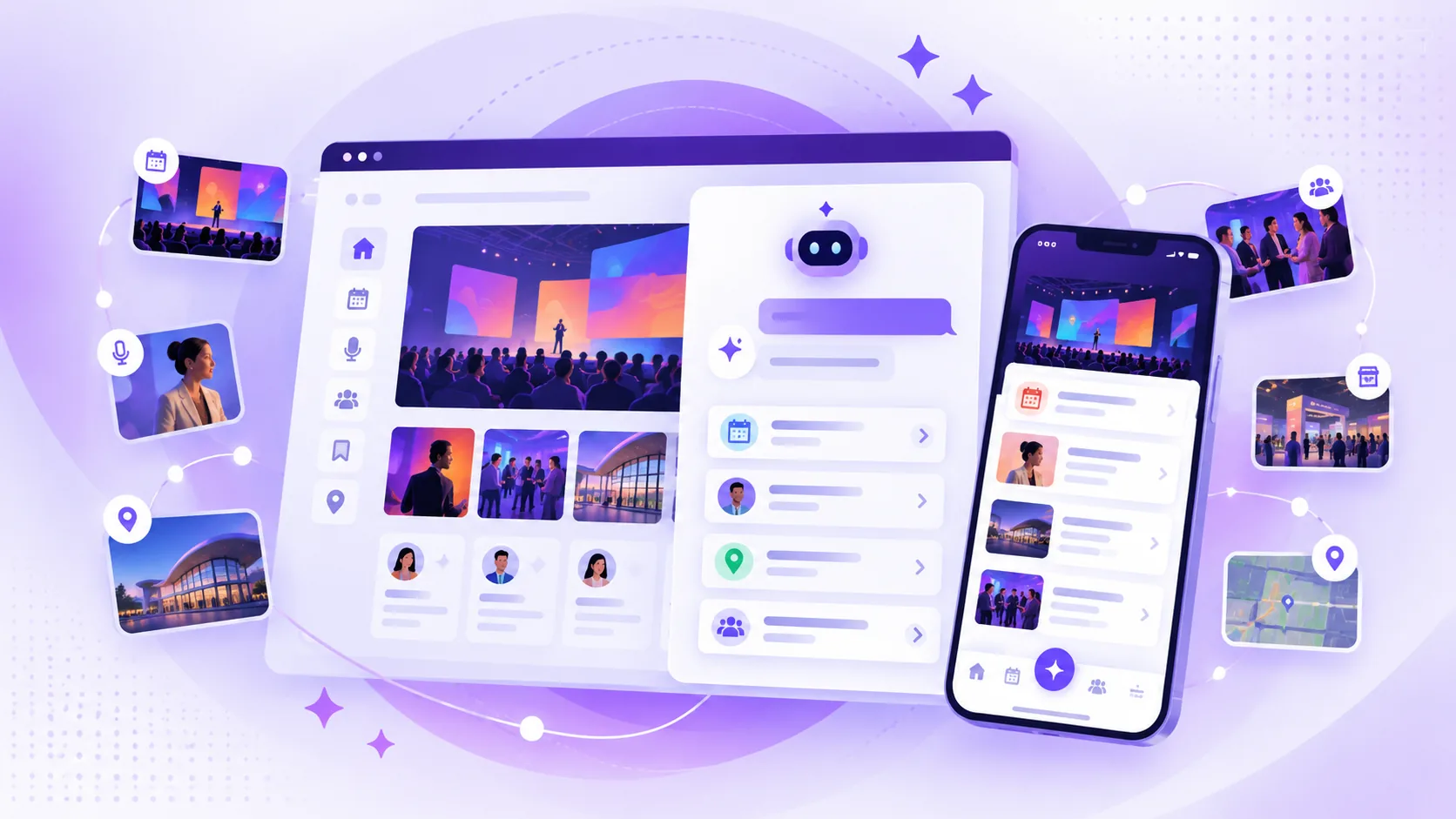
Rather than treating the mobile app as a digital version of the event program, Amego brings agendas, networking, engagement, gamification, maps, sponsor experiences, lead scanning, analytics, and AI-powered attendee guidance together in one connected experience.
Where Amego stands out
One of the biggest differences between Amego and more traditional event apps is how much emphasis is placed on the individual attendee journey.
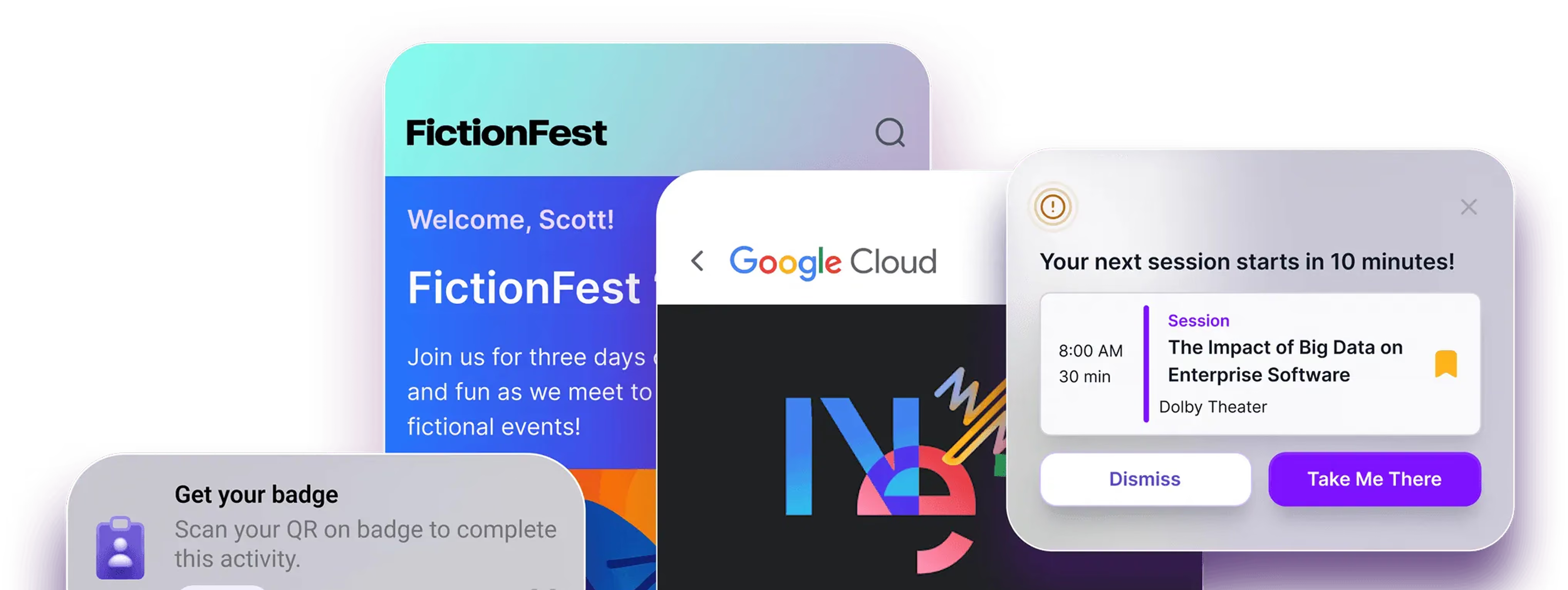
Amego's platform supports everything from personalized schedules and targeted notifications to AI-powered recommendations designed to help attendees figure out what they should do next.
That becomes especially important at large conferences where attendees may be choosing between dozens of sessions, hundreds of exhibitors, and thousands of people they could potentially meet.
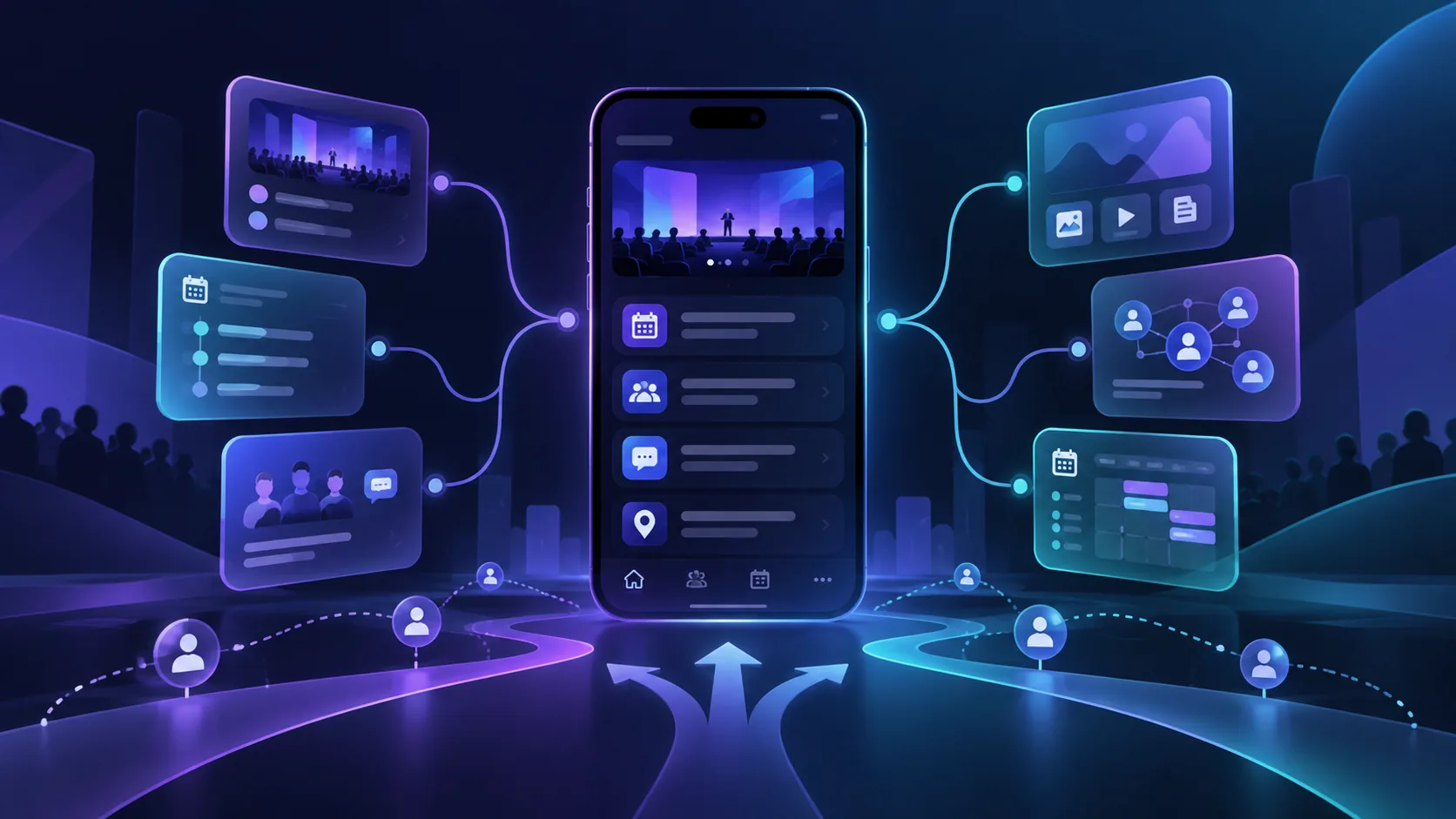
Instead of giving everyone the same experience, organizers can create more relevant journeys based on attendee attributes, interests, roles, and behavior.
Networking
Amego's event networking tools include attendee profiles, directories, messaging, meeting experiences, digital connections, and AI-supported matchmaking.
For events where networking is one of the primary reasons people attend, these tools make it easier to move beyond simply providing a searchable attendee directory.
Engagement
The platform also includes event engagement tools such as:
- Live polls
- Surveys
- Q&A
- Push notifications
- News and updates
- Interactive attendee experiences
Organizers can use these tools throughout the event rather than relying on attendees to repeatedly navigate back through the same static app content.
Gamification
Amego's native event gamification experience, Quest, lets organizers create challenges around the behaviors they want to encourage.
Those might include:
- Visiting sponsor booths
- Attending sessions
- Completing attendee profiles
- Participating in polls
- Networking with other attendees
- Exploring specific parts of the event
This allows gamification to support actual event objectives instead of existing as a disconnected scavenger hunt.
Integrations
Enterprise event teams rarely use one platform for everything.
Amego's event integrations connect the attendee experience with platforms and technologies across registration, event management, networking, maps, analytics, and other parts of the event technology stack.
Current integrations include systems such as Cvent, Swoogo, RainFocus, Braindate, CrowdConnected, ExpoFP, Pointr, Wicket, VOXO, and others.
Amego vs. Whova
Whova can be a strong choice for organizations prioritizing built-in community and networking capabilities.
Amego becomes particularly worth evaluating when your requirements expand into enterprise branding, complex attendee segmentation, deeper integrations, AI-guided experiences, sponsor engagement, and large-scale event programs.
If you're specifically comparing apps like Whova for an enterprise conference, Amego should be on the shortlist.
You can also compare Amego with other leading platforms in our guide to the best event apps of 2026.
Schedule an Amego demo to see the platform in action.
2. Cvent Attendee Hub
Best for: Organizations already using Cvent
Cvent Attendee Hub is another major option for teams researching Whova alternatives, particularly organizations already using Cvent for registration and event management.
Its biggest advantage is the broader Cvent ecosystem.
Attendee Hub can give attendees access to features such as personalized agendas, session recommendations, networking, chat, Q&A, polling, surveys, exhibitor content, appointments, and mobile event experiences.
That means a team already using Cvent for registration and other event operations may be able to keep much of its technology within the same ecosystem.
When Cvent makes sense
Cvent Attendee Hub may be a good fit if:
- Your organization already runs registration through Cvent
- You want your attendee app connected to a larger event management platform
- You manage a broad portfolio of events
- Virtual or hybrid content is an important part of your program
- Consolidating vendors is more important than having a specialized attendee experience platform
Cvent vs. Whova
The primary distinction is scope.
Whova is widely used as an attendee-facing conference and community platform, while Cvent is part of a much broader event management ecosystem.
For teams already invested in Cvent, that ecosystem can be the deciding factor.
For teams primarily focused on the attendee experience, it is worth comparing Cvent with more specialized event app platforms before making a decision.
3. EventMobi
Best for: Mid-market conferences looking for flexible event app tools
EventMobi is another established name that regularly comes up when event planners research Whova competitors.
The platform offers event app capabilities alongside tools designed to help organizers manage attendee content and engagement.
For teams that want a configurable conference app without necessarily requiring the complexity of a full enterprise technology ecosystem, EventMobi can be worth evaluating.
When EventMobi makes sense
Consider EventMobi when:
- You want a broad set of traditional event app features
- Your event is primarily focused on attendee content and engagement
- You need configurable branding and event experiences
- You run conferences across in-person, virtual, or hybrid formats
EventMobi vs. Whova
Both platforms cover many of the core needs conference organizers expect from an event app.
The decision will generally come down to the specific attendee experience you want to create, your event format, implementation requirements, integrations, and the level of customization your organization needs.
For larger enterprise programs, it is also worth comparing both platforms against solutions designed specifically around enterprise scale and complex attendee experiences.
4. Bizzabo
Best for: B2B event marketing programs
Bizzabo is particularly relevant for marketing organizations that view events as part of a broader demand generation and revenue strategy.
Its positioning extends beyond the attendee app into event marketing, data, onsite experiences, and the broader event lifecycle.
When Bizzabo makes sense
Bizzabo may be worth considering when:
- Events are closely tied to your marketing organization
- You need to connect event activity with broader marketing data
- You run B2B conferences, customer events, or field marketing programs
- Measuring engagement across the event lifecycle is a major priority
Bizzabo vs. Whova
Whova's strengths are often most visible in attendee networking and conference community features.
Bizzabo is more likely to enter the conversation when the event is part of a larger B2B marketing strategy.
If your event team works closely with demand generation, marketing operations, sales, or revenue teams, that distinction can matter.
5. Swapcard
Best for: Trade shows, exhibitions, networking, and hosted buyer programs
Swapcard is one of the more relevant Whova alternatives for conferences where networking, exhibitors, meetings, and buyer-seller connections play a major role.
Its networking tools use attendee profile and behavioral data to recommend relevant connections, while meeting functionality helps attendees move from discovery to actual conversations.
Swapcard also places significant emphasis on exhibitor engagement, lead generation, and event monetization.
Where Swapcard stands out
Swapcard is particularly strong around:
- AI-powered matchmaking
- Attendee networking
- One-to-one meetings
- Hosted buyer programs
- Exhibitor discovery
- Lead capture
- Networking analytics
- Trade show experiences
Swapcard vs. Whova
Both platforms provide attendee networking, but Swapcard's positioning is particularly relevant to events where networking has a direct commercial objective.
Think trade shows, exhibitions, hosted buyer programs, and events where connecting buyers with exhibitors is a core part of the business model.
Organizations evaluating a Whova alternative for conferences should therefore look beyond whether both platforms technically offer networking.
The better question is what kind of networking your event needs to create.
6. PheedLoop
Best for: Conferences and organizations looking for broader event management functionality
PheedLoop is another platform commonly evaluated by conferences, associations, and event organizers looking for an all-in-one event technology option.
Its broader event management approach can make it worth considering for teams that want attendee experiences and operational tools within the same ecosystem.
When PheedLoop makes sense
PheedLoop may be relevant when:
- You want a wider collection of event management functionality
- Exhibitor and sponsor management are significant parts of your event
- You run association conferences or trade shows
- You're trying to reduce the number of separate event technology vendors in your stack
PheedLoop vs. Whova
The choice between PheedLoop and Whova will often depend on whether your priority is the attendee community experience or a broader collection of event management and operational capabilities.
For more complex events, you'll also want to compare how each platform handles integrations, attendee segmentation, customization, support, analytics, and scale.
Whova vs. Competitors: What Should You Compare?
Looking at a list of features isn't enough.
Most modern event platforms have some version of an agenda, push notifications, networking, sponsor profiles, and surveys.
The meaningful differences appear in how those features work together.
When comparing Whova vs. competitors, evaluate these areas.
1. Attendee Experience
Start with the person actually using the app.
Can attendees quickly answer questions like:
- Where do I need to be?
- What's happening next?
- Which sessions are relevant to me?
- Who should I meet?
- Where is this room or booth?
- Did the schedule change?
- What should I do with the next 30 minutes?
The best event app should reduce the mental work required to navigate the event.
2. Personalization
At a small conference, one shared experience might work.
At an enterprise event with thousands of attendees, it usually doesn't.
Look at whether the platform can personalize:
- Agendas
- Recommendations
- Notifications
- Content
- Networking
- Sponsor discovery
- Home-screen experiences
- Attendee communications
The larger and more diverse the audience, the more important personalization becomes.
3. Networking
Don't stop at "Does it have networking?"
Ask:
- Can attendees search by relevant attributes?
- Are matches recommended automatically?
- Can people message one another?
- Can attendees schedule meetings?
- Are networking recommendations personalized?
- Can sponsors and exhibitors participate?
- Can organizers measure networking activity?
Networking functionality varies dramatically between event platforms even when the checkbox says "yes."
4. Engagement
Look at the tools available to keep people participating throughout the event.
These may include:
- Live polls
- Q&A
- Surveys
- Push notifications
- Newsfeeds
- Session interaction
- Gamification
- Sponsor challenges
- Networking prompts
A good engagement strategy should generate useful attendee data as well as activity.
5. Branding and Customization
Your event app shouldn't feel like somebody else's software with your logo dropped into the header.
For brand-sensitive events, look at:
- App icon and store presence
- Fonts
- Colors
- Navigation
- Home-screen design
- Content layouts
- Sponsor experiences
- Custom screens
- Audience-specific experiences
This can be particularly important for flagship customer conferences and enterprise events.
6. Integrations
Your event app doesn't live alone.
Determine whether it can work with the systems already powering your event, including:
- Registration platforms
- Event management systems
- CRMs
- Marketing automation
- Interactive maps
- Lead retrieval
- Networking tools
- Analytics platforms
- Session technology
A platform that looks simple in the demo can create a lot of manual work if event data doesn't flow properly between systems.
7. AI Capabilities
"AI-powered" has become an extremely broad label.
Ask what the AI actually does.
Can it:
- Answer attendee questions?
- Recommend sessions?
- Recommend people?
- Build personalized schedules?
- Surface sponsors?
- Respond to real-time attendee context?
- Help people navigate the event?
- Personalize experiences before, during, and after the event?
The important distinction isn't whether AI appears on the feature page.
It's whether it removes friction for attendees or event teams.
8. Sponsor and Exhibitor Value
If sponsors help fund your event, evaluate their experience separately.
Look at tools for:
- Lead scanning
- Lead qualification
- Booth discovery
- Sponsor content
- Gamification
- Meetings
- Analytics
- Lead export
- CRM workflows
A platform that improves the attendee experience but gives exhibitors little measurable value only solves half the problem.
9. Scale and Complexity
Finally, think beyond your next event.
Can the platform support:
- Thousands or tens of thousands of attendees?
- Multiple attendee types?
- Complex permissions?
- Multi-track agendas?
- Multiple languages?
- Global event programs?
- Event series?
- Enterprise security requirements?
- Multiple integrations?
A platform that is perfect for one conference may not be the right foundation for an entire event program.
Which Whova Alternative Is Right for You?
There isn't one Whova alternative that makes sense for every organization.
The better choice depends on what you're optimizing for.
Consider Amego if attendee experience, enterprise scale, brand control, AI personalization, networking, engagement, gamification, and integrations are priorities.
Consider Cvent Attendee Hub if your organization already operates heavily within the Cvent ecosystem.
Consider EventMobi if you're looking for a flexible event app for a mid-market conference or event program.
Consider Bizzabo if events are deeply connected to your B2B marketing and revenue strategy.
Consider Swapcard if trade show networking, hosted buyer programs, exhibitors, and commercial connections are at the center of your event.
Consider PheedLoop if you're looking for a broader collection of conference and event management capabilities.
The important thing is to evaluate each platform based on your event requirements instead of choosing based on a generic list of features.
For another look at the market, see our guide to the best event apps of 2026.
Why Enterprise Event Teams Choose Amego
Amego is built around a simple idea: event technology should make the event easier to experience.
The Amego platform combines the event mobile app, attendee networking, engagement, gamification, sponsor tools, integrations, analytics, and AI-powered guidance in one connected attendee experience.
Event teams can use Amego to create highly branded experiences while still giving individual attendees more relevant information, recommendations, and connections.
Explore:
Ready to see how Amego compares with Whova and other event platforms?
FAQs About Whova Alternatives
What are the best Whova alternatives?
Popular Whova alternatives include Amego, Cvent Attendee Hub, EventMobi, Bizzabo, Swapcard, and PheedLoop. The best platform depends on your event size, attendee experience requirements, integrations, networking strategy, branding needs, and broader event technology stack.
What is the best Whova alternative for large conferences?
For large and complex conferences, prioritize platforms built to support enterprise scale, complex agendas, attendee segmentation, integrations, personalization, security, and real-time event changes. Amego is designed specifically around enterprise attendee experiences and large-scale conferences.
What is the best Whova alternative for networking?
Whova itself is known for conference networking, so teams replacing it should look closely at networking functionality. Amego and Swapcard both provide networking experiences that go beyond a basic attendee directory, including personalized or AI-supported connection discovery.
What apps are like Whova?
Apps like Whova include Amego, Cvent Attendee Hub, EventMobi, Bizzabo, Swapcard, and PheedLoop. While they overlap in features such as agendas, attendee profiles, notifications, networking, and engagement, they serve different types of events and event strategies.
How should I compare Whova vs. competitors?
Compare Whova vs. competitors based on attendee experience, networking, engagement, branding, integrations, AI capabilities, sponsor tools, analytics, scalability, support, and total platform requirements. Avoid choosing solely based on the number of features listed on each vendor's website.
Is Amego an alternative to Whova?
Yes. Amego is an alternative to Whova for organizations looking for a customizable event app and attendee experience platform, particularly for enterprise conferences, corporate events, trade shows, and other complex event programs.
What should I look for in a Whova alternative?
Look for a platform that fits your event rather than simply matching Whova feature for feature. Important criteria include event size, attendee experience, networking, engagement, customization, integrations, AI, sponsor tools, analytics, scalability, and the level of support your team requires.

Sign up for our newsletter
Get insights delivered to your email.