
Ask an attendee what they want from an event app and they won't say "chatbot." They'll say something like: "Tell me where to go next" or "Find me the right people to talk to." That gap between what event tech promises and what attendees actually need is exactly why the term agentic AI has started showing up in every vendor's pitch deck this year.
But agentic AI and a chatbot are not the same thing, even though they get lumped together constantly. One answers questions. The other gets things done. If you're evaluating event technology in 2026, including agentic platforms like Amego's Sidekick, understanding that difference will save you from buying a feature that looks smart in a demo and does nothing for your attendees at 8 a.m. on show day.
An event chatbot is a conversational tool built to answer questions. You type "what time does the keynote start" and it pulls the answer from a knowledge base or FAQ list. Some are powered by simple rules and decision trees. Others use natural language processing to sound more conversational. Either way, the job is the same: understand the question, retrieve the answer, respond.
Chatbots are reactive by design. They wait for a prompt. They don't know an attendee is standing outside the wrong ballroom, they don't notice a session filling up, and they can't act on anything unless someone asks first. That's not a flaw, it's the category. A chatbot is a search bar with better manners.
For simple, high-volume questions, that's genuinely useful. Attendees want a fast answer to "where's the closest coffee," not a long chat thread. The problem shows up when event teams expect a chatbot to do more than answer, like guide attendees through a three-day agenda or personalize recommendations based on who they are and what they came for.
Agentic AI is built to act, not just respond. It can plan a sequence of steps, make decisions based on context, and carry out tasks without someone prompting it at every stage. Instead of waiting for a question, it notices a situation and does something about it.
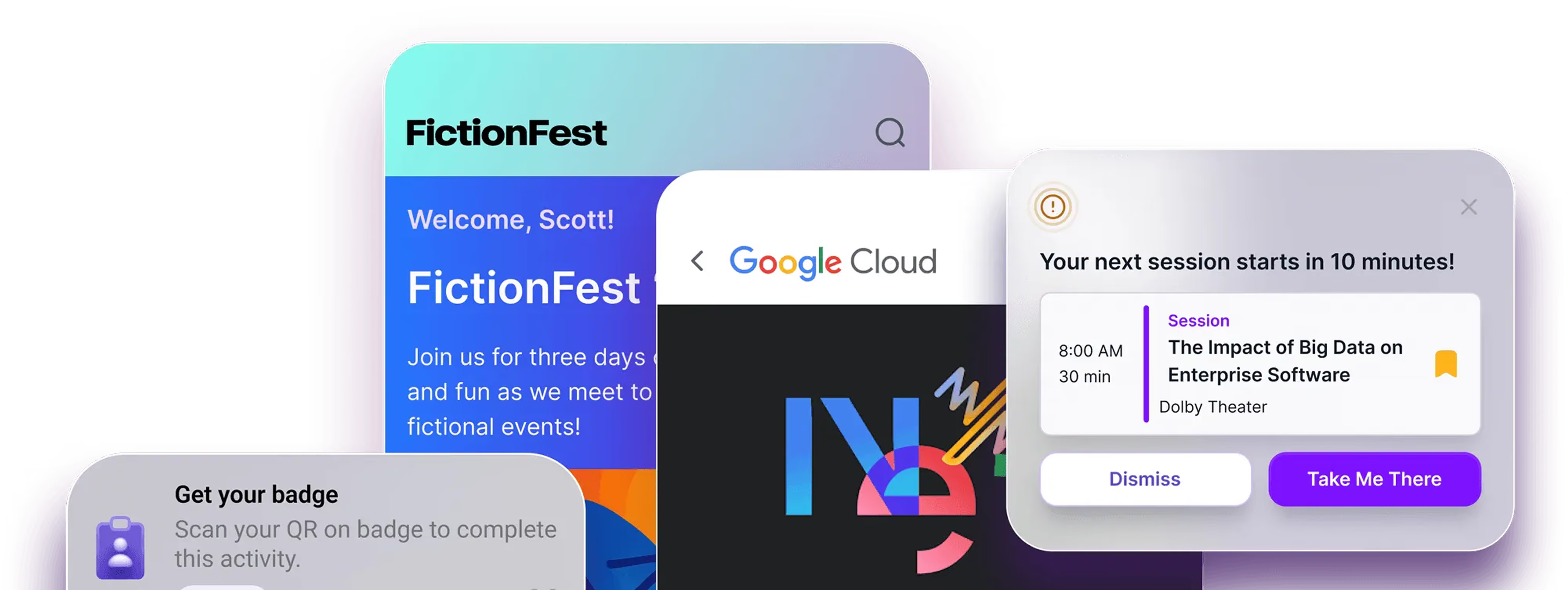
In an event context, that might look like recognizing an attendee's next session is 12 minutes away on the other side of the venue and proactively sending a nudge with directions, before they even open the app to ask. It might mean building a personalized agenda from someone's registration data and interests, then adjusting it in real time as sessions fill up or speakers change. The system isn't answering a question. It's anticipating one and closing the loop on its own.
This is the shift industry analysts point to when they talk about AI moving "from chatting to doing." The underlying models have gotten better at reasoning over live data and taking multi-step action, not just retrieving static answers (DevRev's 2026 guide to the shift breaks this down well from a support-ops angle, and the pattern holds just as true on the show floor).
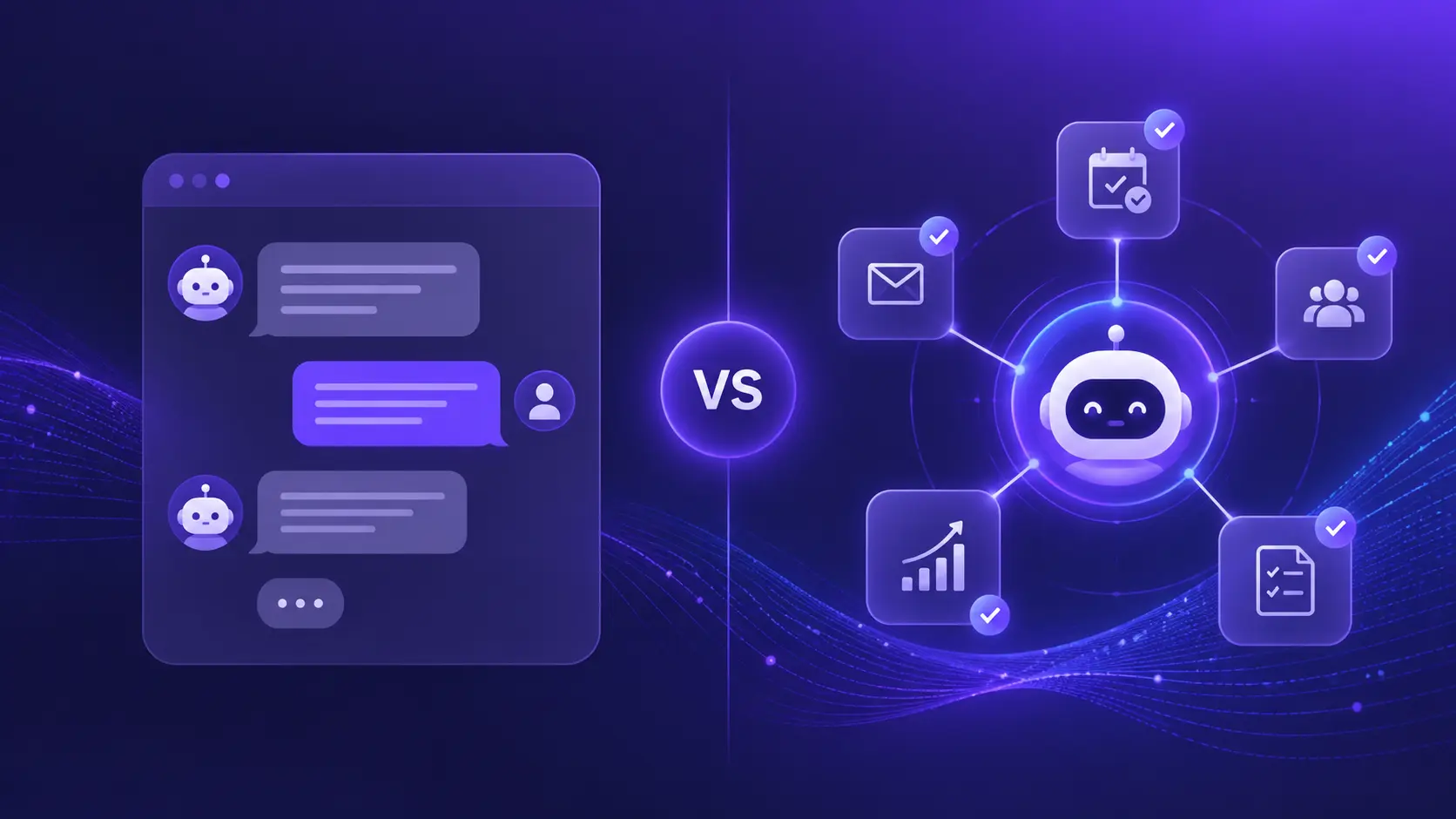
Here's the distinction in plain terms: a chatbot responds to what an attendee asks. Agentic AI proactively recommends next steps and helps complete the task itself, inside the event experience, without waiting to be asked.
Reactive vs. proactive
A chatbot sits idle until someone types a question. Agentic AI is always working in the background, watching schedules, locations, and behavior, and stepping in when it sees an opportunity to help.
Answering vs. completing tasks
A chatbot can tell an attendee which sessions match their interests. Agentic AI builds the agenda, adjusts it as the event changes, and reminds them when it's time to move.
Static knowledge vs. live context
Chatbots typically pull from a fixed FAQ or knowledge base. Agentic AI reasons over live data, like registration details, real-time location, past engagement, and session capacity, to make decisions that fit the moment.
One-off answers vs. an ongoing companion
A chatbot conversation ends when the question is answered. Agentic AI stays with the attendee across the entire event, learning their patterns and filling gaps in their day before they notice the gap exists.
Neither approach is inherently better in the abstract. A chatbot is fine, even ideal, for straightforward FAQ deflection. But if the goal is a personalized, guided experience that reduces the mental load on attendees during a jam-packed conference, agentic AI is doing a fundamentally different job.
Event apps aren't daily tools. Attendees open them when something is unclear, not for entertainment. That means the app has one real job in that moment: reduce uncertainty, fast. A chatbot can only do that if the attendee already knows what to ask. Agentic AI removes that requirement entirely.
Think about the moments that actually shape how someone remembers an event. The last-minute room change nobody announced from the stage. The session that filled up while an attendee was still deciding whether to go. The sponsor booth that would have been a perfect fit, but nobody made the connection. These aren't FAQ questions. They're gaps that only get closed if something is watching and acting in real time.
That's also where the ROI conversation changes for organizers and sponsors. A chatbot can reduce support tickets. Agentic AI can increase session attendance, surface qualified booth traffic through interest-based matching, and give organizers attendee data that reflects actual behavior instead of just registration form answers. For a deeper look at how that plays out across an event lifecycle, see our breakdown of what makes an event app AI-powered versus one that just uses AI as a buzzword.
Amego built Sidekick™ as an agentic companion, not a chatbot bolted onto an existing app. It's fully integrated into the Amego mobile event app, which means it keeps working even when venue wifi doesn't cooperate, a real problem for chatbots that depend on constant web embedding.
Sidekick works across the moments that matter most during an event:
Sidekick Now delivers real-time nudges, like a reminder about an upcoming session or a sponsor recommendation based on what an attendee has already shown interest in.
Sidekick Here uses location-aware technology to guide attendees through the venue and alert them when something relevant is nearby, without them having to ask for directions.
Sidekick Orchestrate learns how an attendee moves through the event and fills gaps in their schedule proactively, so a free 40 minutes becomes a recommendation instead of a dead spot on the agenda.
None of this replaces the human parts of an event: the conversations, the serendipitous run-ins, the energy in a room. It's about removing the friction that gets in the way of those moments, so attendees spend less time digging through the app and more time actually at the event. You can see the full breakdown of these capabilities on the Sidekick AI event app page, and organizers can also bring their own LLM if they've already invested in a specific AI stack.
Not every event needs agentic AI, and not every use case calls for it. If your app's main job is answering "where's registration" a hundred times a day, a well-built FAQ chatbot handles that fine. But if you're trying to personalize the experience for thousands of attendees, keep sponsors' booth traffic qualified, or give organizers real visibility into engagement as it happens, a reactive chatbot will always be one step behind.
The questions worth asking before you buy: Does this tool wait to be asked, or does it act on its own? Does it work from a static FAQ, or does it reason over live event data? Does it stop at the answer, or does it help complete the task? Event organizers who ask these questions upfront tend to end up with tools that actually reduce their workload during showtime instead of adding another dashboard to babysit.
If you're rethinking how your event app should work for attendees, sponsors, and your own team, our guide to event engagement platforms that increase participation is a good next stop, along with our roundup of the best conference networking apps for 2026.
Is agentic AI just a chatbot with extra features?
No. The difference isn't feature count, it's whether the tool waits to be asked. A chatbot with a longer list of answers is still reactive. Agentic AI notices context, like a session filling up or a schedule gap, and acts on it without a prompt.
Do I need agentic AI for a smaller or single-day event?
Not always. If your app's job is mostly answering "where's registration" and "what time does X start," a well-built FAQ chatbot covers that fine. Agentic AI earns its keep on multi-track, multi-day events where attendees have real decisions to make and organizers need more than a support-ticket log.
Can Sidekick work alongside a chatbot we already have?
Yes. Plenty of event teams keep a lightweight FAQ chatbot for simple logistics questions while Sidekick handles the proactive layer, personalized agendas, real-time nudges, and location-aware guidance, on top of it.
How is this different from "AI-powered" event apps in general?
Plenty of apps bolt a chat widget onto an existing product and call it AI-powered. The test is the same one we outline above: does it wait to be asked, or does it act on its own? See our related breakdown of what actually makes an event app AI-powered for more on that distinction.

Sign up for our newsletter
Get insights delivered to your email.