
Table of Contents:
- What We Talk About When We Talk About AI at Events
- AI for Event Planning: Before the Doors Open
- AI on Your Event Website: Closing the Pre-Event Gap
- AI for Event Management: Day-Of Operations
- AI for the Attendee Experience: The Most Underserved Layer
- Chatbot vs. AI Event App: Not the Same Thing
- Agentic AI at Events: What's Coming Next
- How to Evaluate AI Event Technology
- How to Add AI to Your Event: Where to Start
- FAQs
There's no shortage of content about AI for events right now. There is a shortage of content that's actually useful for the person who has been running conferences for eight years and needs to understand what changes, what doesn't, and what's worth the investment.
This guide is written for that person.
We'll cover AI for event planning, AI on your event website, AI for day-of operations, AI for the attendee experience, and agentic AI, the category most guides haven't caught up to yet. We'll also be direct about where AI helps and where the hype is ahead of the reality.
What We Talk About When We Talk About AI at Events
AI for events is the use of artificial intelligence to plan, run, and personalize events: drafting content, forecasting attendance, answering attendee questions, recommending sessions and people, and increasingly, taking action on an attendee's or organizer's behalf. The problem with most "AI for events" content is that it treats AI as a single thing. It isn't.
There are at least four distinct categories of AI in the event space, and they serve completely different purposes.
Generative AI creates content. You describe what you want, whether that's a speaker bio, a promotional email, or a post-event summary, and AI produces a draft. ChatGPT, Jasper, and similar tools live here.
Predictive AI forecasts outcomes from historical data. Which sessions will be most attended? Which attendees are likely to skip next year's conference? What's the best send time for this email campaign? This is the layer enterprise event management platforms are building into their analytics.
Recommendation AI surfaces relevant content or connections. It uses individual behavior and stated preferences to power session recommendations, attendee matching, and personalized agendas inside event apps.
Agentic AI takes action on behalf of a user. It doesn't just suggest the meeting you should schedule. It finds the person, proposes a time, and sends the invite. This is the newest and most consequential category in the events space, and we'll spend time on it specifically.
Most event teams are using the first category. The ones pulling ahead are building infrastructure for the third and fourth. Knowing where each category applies, and where it doesn't, is the foundation for thinking clearly about AI at your events.
AI for Event Planning: Before the Doors Open
The pre-event planning phase is where AI has the most visible immediate impact, and where the tools are the most accessible.
Content creation. Writing event descriptions, speaker bios, session summaries, sponsor prospectuses, and promotional copy is time-consuming work that AI handles well as a first draft. Treat AI output as a starting point, not a finished product. Feed it your brand voice, your speaker's actual background, and the audience you're writing for. What comes back needs editing, but it can turn a two-hour task into a 20-minute one.
Email and marketing campaigns. AI tools can generate subject line variations, body copy, and segmentation logic for pre-event email campaigns. Email is still the highest-converting channel for most event registrations, so even small improvements in open and click rates add up quickly.
Agenda structure and session planning. Tools with access to your historical attendance data can suggest which content formats, topics, and time slots tend to perform best with your audience. Your team may have developed that intuition over years. AI surfaces it faster. Pair it with an agenda and content library that updates the app in real time, and the plan you build is the plan attendees see.
Venue and vendor sourcing. Some platforms now use AI matching to pair event requirements with venue options based on geography, group size, budget, and format. For teams that source venues across spreadsheets and email threads, this is a real time save.
Budget modeling. AI-assisted budget tools can identify historical cost patterns and flag where overspending typically happens. For teams managing complex multi-session budgets, a system that learns from past events and surfaces anomalies is useful.
The honest caveat: AI for event planning is a productivity multiplier for experienced planners. It does not replace judgment. The best session agenda in the world doesn't matter if the content doesn't match what your audience needs. AI can help you move faster in the right direction. It can't tell you which direction is right.
AI on Your Event Website: Closing the Pre-Event Gap
Most AI conversations in events jump straight from planning tools to the event app. That skips the place where attendees spend most of their pre-event time: your event website.
In the six to eight weeks before an event, attendees are on your site deciding whether to register, which sessions to plan around, and how to get there. Most of them haven't downloaded the app yet. So their questions go to your inbox instead. What time does registration open? Is there a virtual option? Which sessions cover security? Where do I park? Every one of those lands on your team's plate at the busiest point in the planning cycle.
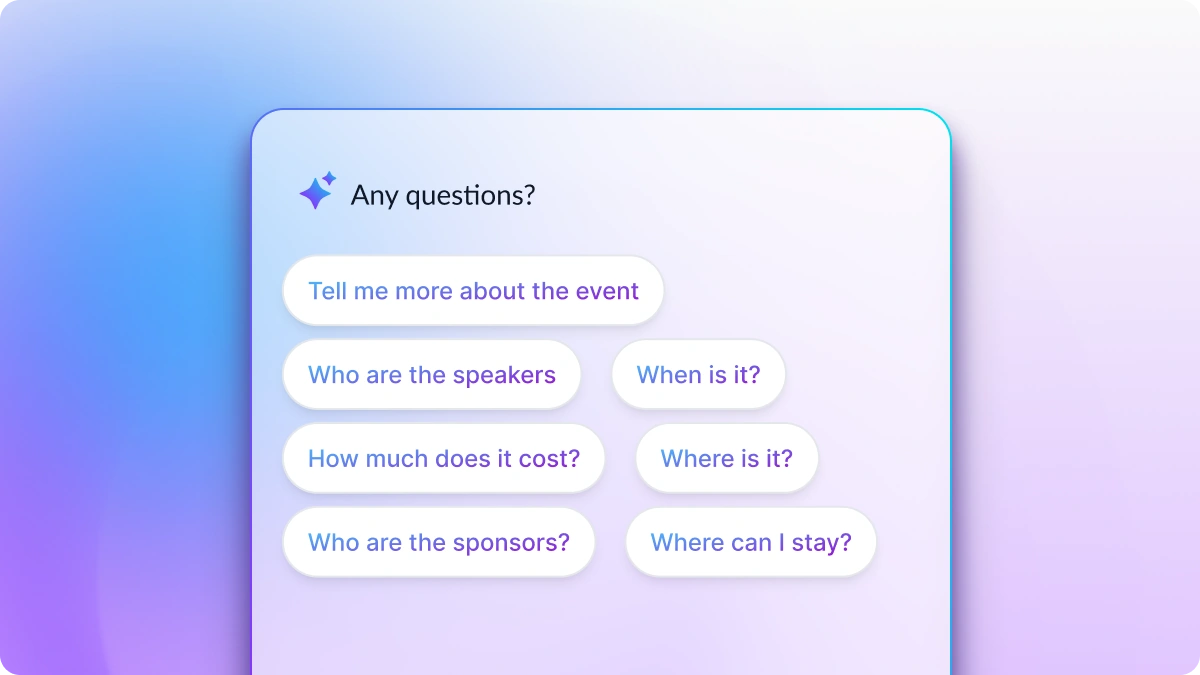
This is the gap Sidekick™ Spark was built to close. Spark is Amego's AI companion for event websites, launched publicly in September 2026. It brings the same intelligence behind Sidekick™ in the Amego app to your event website, so attendees get guidance before they ever open the app.
What Spark does on your event website:
- Answers event-specific questions about sessions, speakers, schedules, venues, and policies
- Recommends sessions based on each attendee's interests
- Points attendees to relevant sponsors, activations, and networking opportunities
- Surfaces content attendees would otherwise miss
How it gets set up. Spark learns from the event information you already have: uploaded PDFs, pasted text, or connected URLs with your agenda, speaker details, FAQs, and venue information. It installs with a single line of code on Webflow, WordPress, Squarespace, or a custom-built site, with no developer required. It's Amego's first fully self-serve product, and the average time from sign-up to a live widget is under 10 minutes.
Why it matters for your team. Event teams using Spark report a 60%+ reduction in pre-event support tickets. That's time back during the weeks when your team has the least of it. And because Spark and the in-app Sidekick™ share one AI credit balance, the experience carries from the website into the app without a second vendor or a second bill.
For the full story on why we built it, read Meet Sidekick™ Spark: The Agentic Concierge for Your Event Website, or try Spark free.
AI for Event Management: Day-Of Operations
This is where event AI moves from interesting to operationally important.
Real-time schedule management. Large conferences are dynamic. Sessions shift, speakers run long, rooms change. AI tools that monitor real-time data and push updates to attendees reduce the fire-fighting burden on your team. Changes will happen. They always do. The question is how fast the right people find out.
Attendance tracking and session insights. AI-powered analytics during the event can show which sessions are over or under capacity, which time slots drive the most engagement, and which formats are falling flat. That's information you can act on in the moment, not just include in a post-event report.
On-site Q&A and attendee support. AI can handle the high-volume, low-complexity questions that flood event staff: where is registration, what's the Wi-Fi password, when does the afternoon session start, how do I get my badge reprinted. Automating these frees your team for the questions that need a human.
Notification and communication targeting. Rather than blasting every attendee with every announcement, AI can segment communication based on what's relevant to each person. Someone in track A doesn't need updates about track B. The attendee who bookmarked a session should get the reminder. Targeted push notifications sent from Amego Admin make updates feel useful rather than noisy.
AI for the Attendee Experience: The Most Underserved Layer
Here's where most AI-for-events guides have a gap.
Most content in this space is written for event organizers. It covers planning tools, content generators, and management platforms. All of that is legitimate. But it misses the layer where AI creates the most visible impact for the people attending your event.
Most event apps still show every attendee the same content in the same order. A startup founder and a senior enterprise architect check in to the same 50,000-person conference and open the same app. They see the same session list, the same sponsor directory, and the same default agenda.
That's not a personalized experience. It's a digital program guide. It's been the norm because building real personalization at the app layer has historically been hard. AI changes that.
Personalized session recommendations. An AI-powered event app understands each attendee's role, stated interests, and real-time behavior inside the app. It uses that signal to surface the sessions most likely to matter to them, not to the average attendee. At a 60-session conference, a curated shortlist of 8 versus a scrollable list of 60 is the difference between an attendee who feels guided and one who feels overwhelmed.
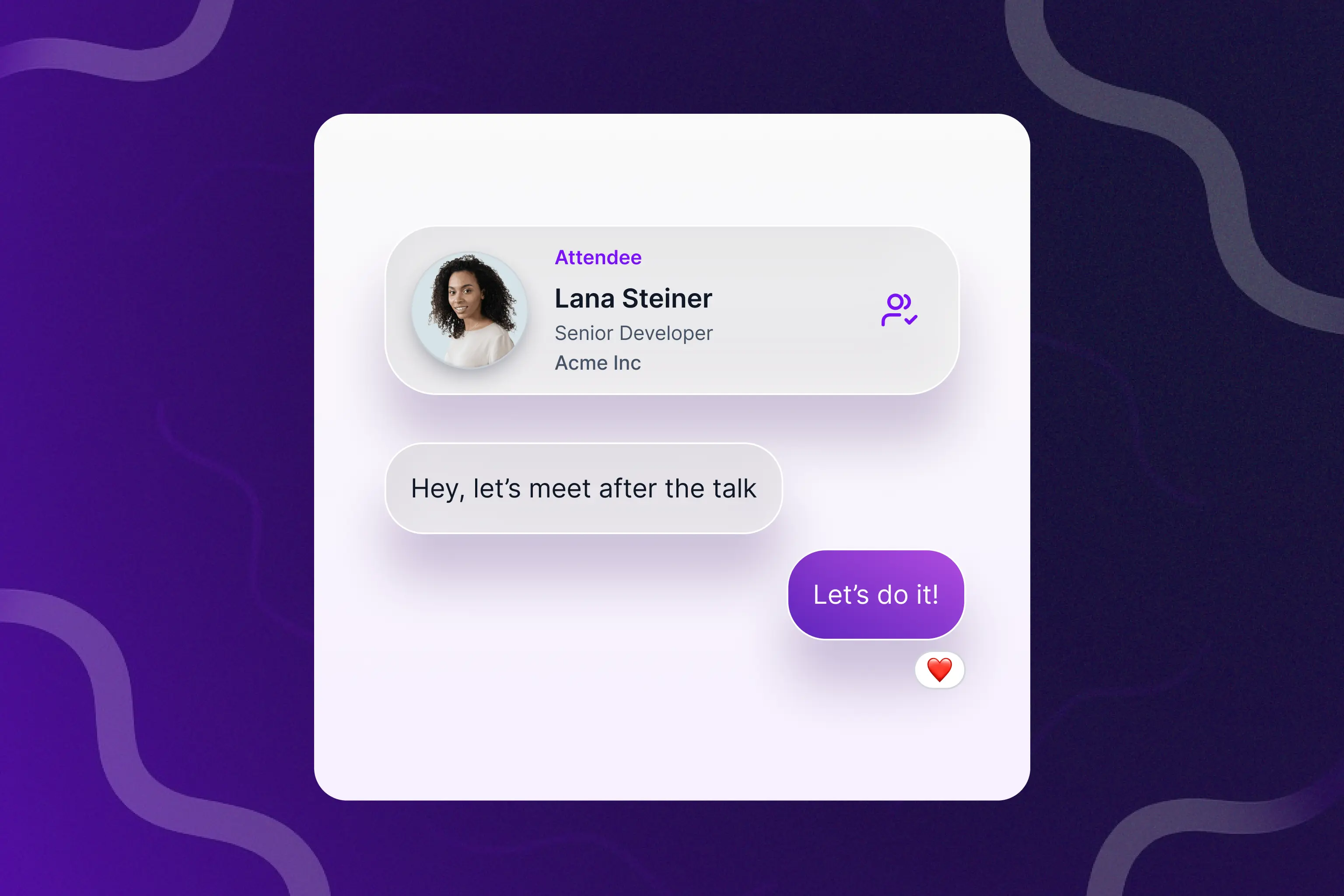
Intelligent networking. Networking is the reason most people attend conferences in person. AI matchmaking changes networking from "hope you run into the right people" to "here are three people you should meet, and here's why." Connections based on shared interests, complementary roles, and live engagement patterns convert at higher rates than cold introductions, because they aren't cold. See how Amego handles this with AI-powered networking.
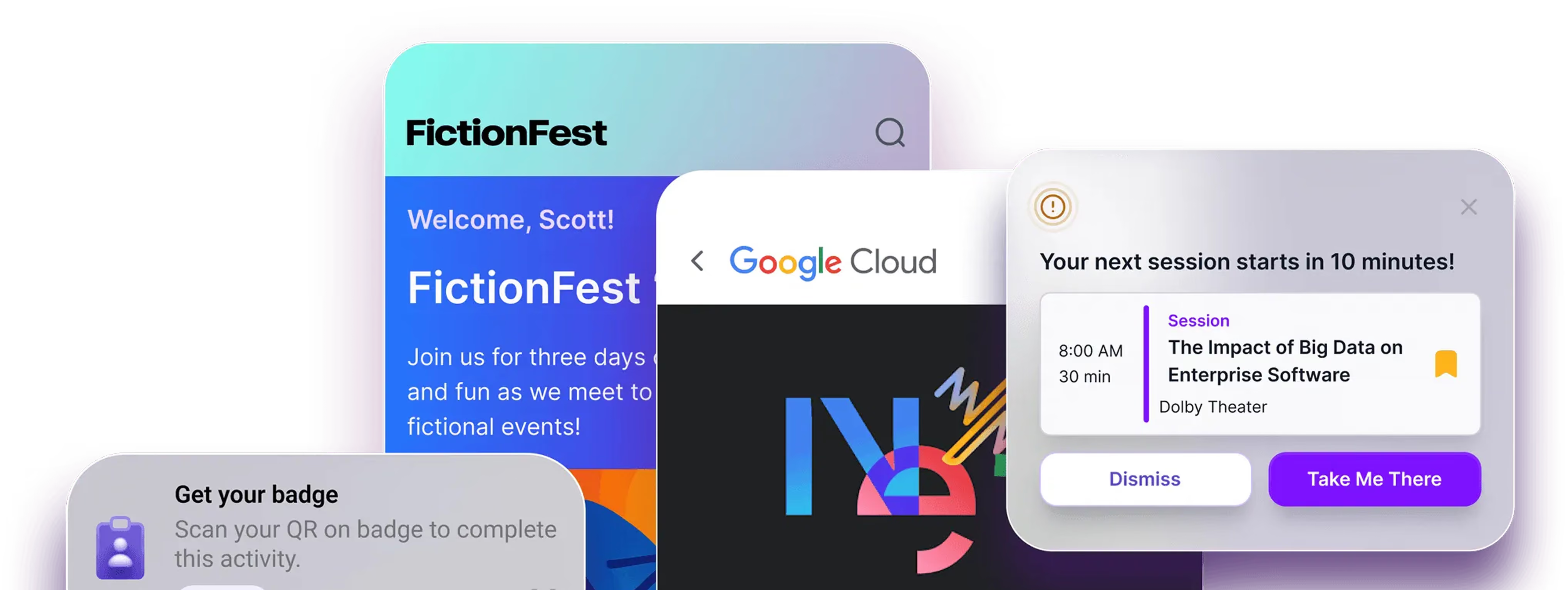
Just-in-time nudges. The best AI event experiences don't make attendees search for what they need. They deliver information at the moment it's useful. A saved session is starting in 10 minutes. Someone worth meeting is at the same keynote. A sponsor booth that matches their interests is two rows over. These are the moments that make an event feel built for the person attending it. Sponsors benefit from the same signals, which is why AI for event sponsors is changing how sponsorship ROI gets measured.
Adaptive content delivery. As attendees engage throughout the event, an AI companion adjusts what it surfaces. Day two should feel different from day one, because the app has learned what this person cares about. We go deeper on this in how AI-powered event apps personalize experiences in real time.
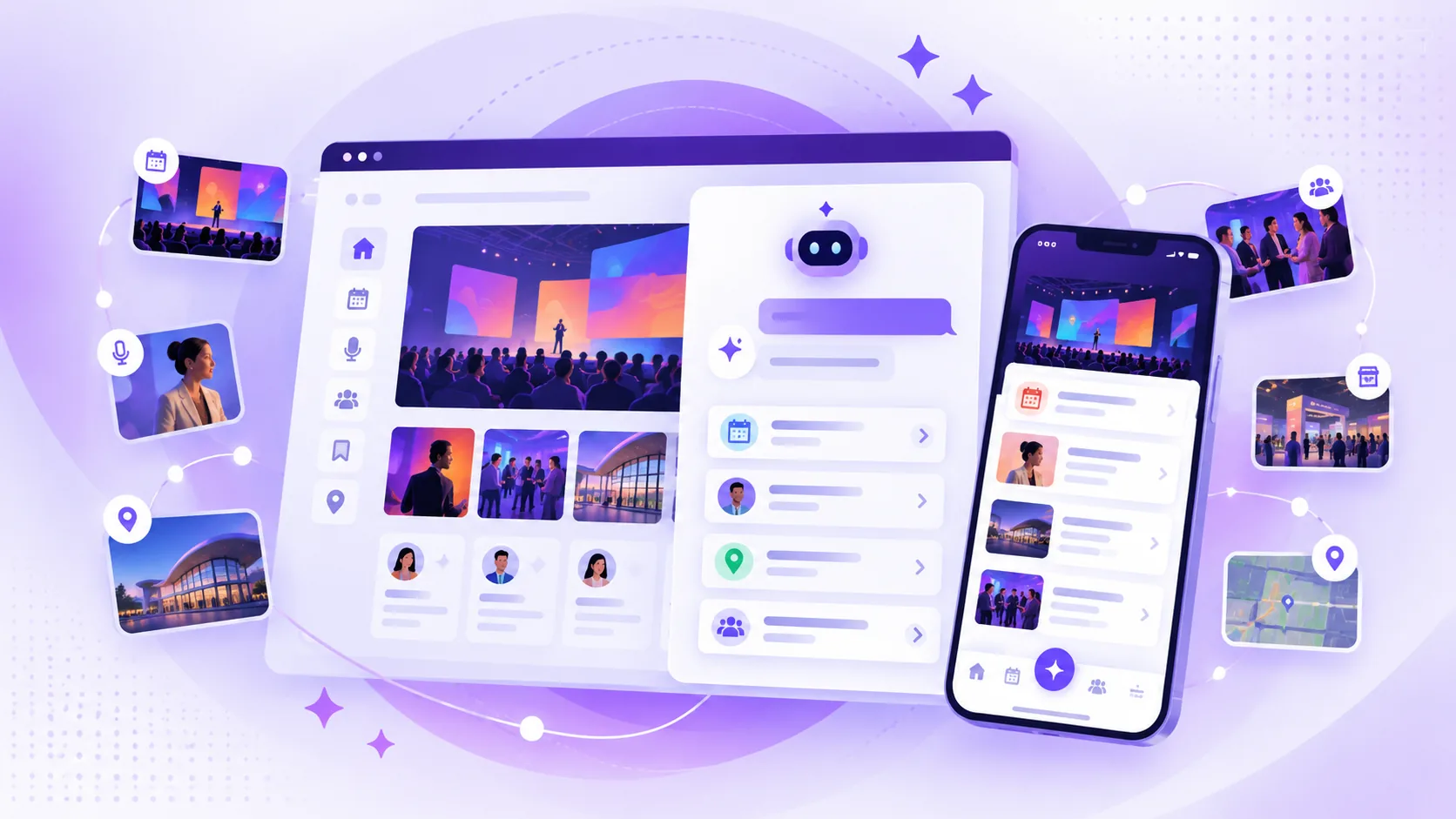
This is the layer where Amego focuses. Sidekick™ is Amego's AI event companion, built natively into the event app as an intelligence layer at the core of the attendee experience rather than a feature added on top. It builds personalized schedules, surfaces networking matches and relevant sponsors, delivers wayfinding and location-aware nudges, and adapts in real time based on what each attendee is doing. That's the difference between an app with AI added to it and one designed with AI at the core.
With Spark on the website and Sidekick™ in the app, the same intelligence follows attendees from their first visit to your site through the last session of the event.
Chatbot vs. AI Event App: Not the Same Thing
These terms get conflated often enough that it's worth drawing the line clearly.
A chatbot is a question-and-answer interface. The attendee asks something, and the chatbot retrieves an answer. It can help with basic navigation questions and FAQs. But it requires the attendee to start every interaction, and it has no persistent awareness of who they are, what they've done, or what they might need next.
An AI event companion uses continuous intelligence. It observes, learns, and acts without waiting to be asked. It knows this attendee has been to three cybersecurity sessions and hasn't added anything from the product track. It knows they bookmarked a speaker two weeks before the event. It knows they've been in the app for six minutes and haven't built a schedule yet. All of that signal shapes what the app does next.
The practical difference is significant. A chatbot makes finding information slightly easier. An AI event companion makes the event itself better.
The same distinction applies on your event website. A generic website chatbot waits for a question and returns a FAQ link. Sidekick™ Spark is designed to guide, recommending sessions and pointing attendees to what they should do next based on the event data you've given it.
Most platforms that claim AI have chatbots. A handful are building real AI companions. The question to ask any vendor is: where does the intelligence live? If it only activates when the attendee types something, it's a chatbot. If it's running in the background, surfacing and adapting continuously, it's something more useful. For a deeper comparison, read event chatbots vs. agentic AI event apps.
Agentic AI at Events: What's Coming Next
Agentic AI refers to AI systems that don't just recommend actions but take them. It's the category that's earliest in its development in the events space and farthest ahead in its implications.
Here's what it looks like in practice.
Meetings. Today, an AI event app recommends people for an attendee to meet. Next, an agentic system requests the meeting, proposes a time that works for both schedules, and confirms the appointment with the attendee's approval, without anyone having to execute the steps.
Capacity. Today, an AI-powered platform flags that a session is likely to be over capacity based on early attendance patterns. Next, an agentic system messages the attendees most likely to attend, suggests room changes, and updates the app in real time, without waiting for a staff member to catch the data.
Post-event. Today, AI analyzes survey responses and identifies themes. Next, it drafts the post-event report, segments the follow-up email campaign, and recommends content updates for next year's agenda, all queued up for organizer review.
The key phrase is "queued up for organizer review." Agentic AI that operates without oversight is a risk in any high-stakes environment, and events are high-stakes environments. The realistic near-term model is AI that does the work and surfaces it for human approval, compressing cycle time without removing human judgment from consequential decisions.
This is already starting to show up in attendee-facing tools. Sidekick™ Spark is built as an agentic concierge for the event website: instead of waiting behind a help link, it anticipates what attendees need and guides them toward it. Platforms building these capabilities today are building for where attendee expectations are heading. An event that can proactively manage the attendee's day, from scheduling and routing to connecting and alerting, is meaningfully better than one that can't.
How to Evaluate AI Event Technology
AI claims in event tech are multiplying faster than the substance behind them. Here's a practical filter for evaluating what's real.
Ask where the AI actually lives. Is it a third-party tool bolted onto an existing platform, or built natively? Native AI has access to all of the platform's data and can operate across the full experience. Bolted-on AI is typically narrower in scope and creates data handoff problems.
Ask what data the AI learns from. Personalization is only as good as the data feeding it. An AI that knows an attendee's job title can make basic inferences. One that can observe real-time in-app behavior and combine it with event data can make useful recommendations.
Ask what the AI does without prompting. If the answer is "nothing," it's a chatbot. The most valuable AI event tools operate continuously, not just in response to questions.
Ask where it shows up. Does the AI only exist inside the app, or does it reach attendees on your event website before they download anything? Coverage across the website and the app means attendees get help during the weeks when most of their questions happen.
Ask for specifics, not narratives. "AI-powered personalization" means nothing without detail. How does the system decide which sessions to recommend? What signals does it use for attendee matching? How does it adapt during the event versus before it? If the answers are vague, the capability is vague.
Ask about the human layer. Good AI event technology makes organizers and attendees more effective. It doesn't try to replace the judgment of experienced event professionals. Look for platforms that show you what the AI is doing and give you control over the outcomes. Our guide to what to look for in an event app covers AI alongside security and scale.
How to Add AI to Your Event: Where to Start
The most common mistake event teams make with AI is trying to adopt too much at once. New tools have learning curves. They need data and time to calibrate. And your team has to trust them before they'll be used well.
A more practical approach is to start with one layer and do it well.
If you're starting with planning: Pick one high-volume content task where AI can realistically save time. Speaker bios or post-event recap drafts are good options. Run the process for a real event, measure the time saved, and adjust from there.
If you're starting with your event website: This is the fastest win on the list. Sidekick™ Spark is self-serve, installs with one line of code, and can start taking pre-event questions off your team's plate the same day. You can start with free credits before committing budget.
If you're starting with day-of operations: Look at where your team spends the most time on repetitive communication during events. FAQ handling and attendee notification workflows are good starting points. Automating those frees your team for the decisions that need judgment under pressure.
If you're starting with the attendee experience: This is the highest-impact layer and the one where platform selection matters most. An event app with native AI personalization doesn't require a separate implementation. The starting point is choosing an event app built with AI at its core, rather than retrofitting AI into one that wasn't.
For teams that want one platform doing all of this coherently, Amego brings together personalized attendee experiences with Sidekick™, AI guidance on your event website with Spark, real-time engagement tools, and intelligent networking. See how Cloudflare unifies global event experiences with Amego.
The events industry often moves more slowly than it should on technology. The planners and organizers who build a working understanding of AI now, not a theoretical one, are the ones who will run the most differentiated events over the next several years.
That gap is still open. It won't be for long.
FAQs
What is AI for events?
AI for events is the use of artificial intelligence across the event lifecycle: generating content during planning, predicting attendance, answering attendee questions on the event website and in the app, recommending sessions and people, targeting notifications, and increasingly taking actions like scheduling meetings for human approval.
How is AI used in event planning?
Event teams use AI to draft speaker bios, session descriptions, and marketing emails, to analyze historical attendance data for agenda planning, to match venues to event requirements, and to flag budget patterns. It speeds up experienced planners but doesn't replace their judgment.
What is Sidekick™ Spark?
Sidekick™ Spark is Amego's AI companion for event websites. It answers event-specific questions, recommends sessions, and points attendees to sponsors and networking opportunities before they download the event app. It installs with one line of code, learns from your agenda, FAQs, and venue details, and shares an AI credit balance with Sidekick™ in the Amego app.
What's the difference between an event chatbot and an AI event app?
A chatbot waits for a question and returns an answer. An AI event app or companion works continuously, using each attendee's interests and behavior to recommend sessions, people, and next steps without being asked.
What is agentic AI at events?
Agentic AI takes action instead of only making recommendations. At events, that means requesting and confirming meetings, managing session capacity, or drafting post-event reports, with the output queued for organizer or attendee approval.
Where should an event team start with AI?
Start with one layer. Content drafting is the easiest planning win, AI on the event website is the fastest way to reduce pre-event support questions, and an AI-native event app has the biggest impact on the attendee experience.
Want to see what an AI-powered attendee experience looks like in practice? Schedule a demo.

Sign up for our newsletter
Get insights delivered to your email.