
Table of Contents:
- Cvent Attendee Hub Competitors Compared
- What Is Cvent Attendee Hub?
- Why Event Teams Look for Cvent Attendee Hub Alternatives
- What to Look for in an Event App That Integrates With Cvent
- The Best Cvent Event App Alternatives, Reviewed
- Can You Keep Cvent Registration and Switch Apps?
- How to Choose the Right Alternative
- Frequently Asked Questions
If you run events on Cvent, you already know the pitch for Attendee Hub: one platform, one attendee record, registration flowing straight into the app. For a lot of teams, that is genuinely enough. But if you have ever spent a Tuesday night resizing sponsor logos to fit a circle, or fielded a dozen "how do I log in?" emails the morning of your keynote, you have probably wondered what else is out there.
This guide is for event pros evaluating alternatives to Cvent Attendee Hub in 2026. We cover what Attendee Hub does well, where planners say it falls short, how it is priced, how seven other event apps compare, and whether you can replace Cvent Attendee Hub without replacing Cvent Registration. We are Amego, so we are one of the options. Where a competitor is the better fit for your event, we say so.
Already using Cvent Registration? You don't have to replace your registration system to switch event apps. Amego integrates with Cvent so attendee, session, and enrollment data can flow into your branded mobile experience.
Cvent Attendee Hub Competitors Compared
Here is the quick view of how the leading Cvent event app alternatives stack up, including which ones are designed to sit alongside Cvent Registration and which ones replace it.
Pricing for each platform is covered in its section below, based on published rates and review-site listings as of 2026. Real costs vary with event volume, attendee counts, and negotiated terms, so use the table to build a shortlist, not a budget.
What Is Cvent Attendee Hub?
Cvent Attendee Hub is the attendee engagement layer of Cvent's event marketing and management platform. It has two parts: Attendee Hub Web, a browser-based attendee website for content, live and on-demand sessions, virtual expo, and networking, and the Attendee Hub Event App, a native mobile app focused on onsite engagement like maps, push notifications, session check-ins, and networking. Both run on the same event data, so one program can serve in-person, hybrid, and virtual audiences.
Cvent has been shipping steadily in 2026. Its February release added Session Snapshots, which let attendees capture the slide on stage plus a transcript snippet with an AI-generated title and summary, and Session Takeaways, AI-generated key points published after a session ends. The April release made it possible to switch an event to hybrid after registration opens. Cvent's AI layer, CventIQ, powers recommendations, AI-assisted networking, and engagement scoring.
One detail matters a lot for anyone shopping alternatives: Cvent does not position Attendee Hub as a standalone app. Cvent describes it as the layer that powers the attendee experience after registration, with Cvent Registration as the system of record. In other words, Attendee Hub's biggest strength and its biggest constraint are the same thing.
How Cvent Attendee Hub is priced
Cvent does not publish pricing, but some customers do. The University of Washington's published Cvent rates list Attendee Hub plus the Event App at $7 per registrant, per event, on top of a $4.25 per-registrant Platform Usage Fee. The same page notes that Attendee Hub and the Event App are now one product that cannot be purchased separately.
Per-registrant pricing is simple to understand and easy to underestimate. A program of five events with 2,000 registrants each comes to $70,000 a year for the app layer alone at that rate, before the platform license. Third-party estimates place Cvent platform costs anywhere from roughly $20,000 to $79,000 or more a year, with first-year implementation fees on top. Treat those as directional, not quotes.
Why Event Teams Look for Cvent Attendee Hub Alternatives
Attendee Hub is not a bad product. On G2 it holds a 4.3 out of 5, with strong marks for ease of use and support, and Capterra users rate it 4.6. Most reviews are positive. The reasons people look to replace Cvent Attendee Hub tend to be specific, and they show up again and again.
Setup takes longer than teams expect
G2 users rate ease of setup lower than ease of use. Reviewers describe a steep learning curve, and one Capterra reviewer said the branding and editing options were intimidating at first precisely because there are so many of them.
Customization stops where your brand guidelines start
Limited customization is one of the most-tagged themes in G2's Attendee Hub reviews. Planners ask for more flexibility in page layouts and visual design so the app can fully match their branding. On Cvent's own community forum, one planner described re-saving every exhibitor logo to fit Attendee Hub's circular image requirements.
Login and access friction
Reviewers mention attendees who struggle to switch between events, device compatibility limits on older phones, and SSO configurations that get in the way of adding sessions to a personal agenda. Each of those becomes a help-desk line on day one.
Networking and reporting trail specialist tools
In G2's comparison data, Attendee Hub scores below 8 out of 10 for both virtual networking and advanced reporting. Those are respectable numbers, but they trail engagement-first platforms, and networking is usually the reason attendees open the app at all.
It is an all-or-nothing ecosystem
A reviewer on Gartner Peer Insights summed up a common frustration by calling Cvent an all-or-nothing product. If your registration lives somewhere else, or your company is consolidating on a different system, Attendee Hub's tight coupling to Cvent stops being a benefit.
The pattern behind most switches is not "Cvent is broken." It is "our app should feel like our brand, and our attendees should not need a tutorial to use it."
What to Look for in an Event App That Integrates With Cvent
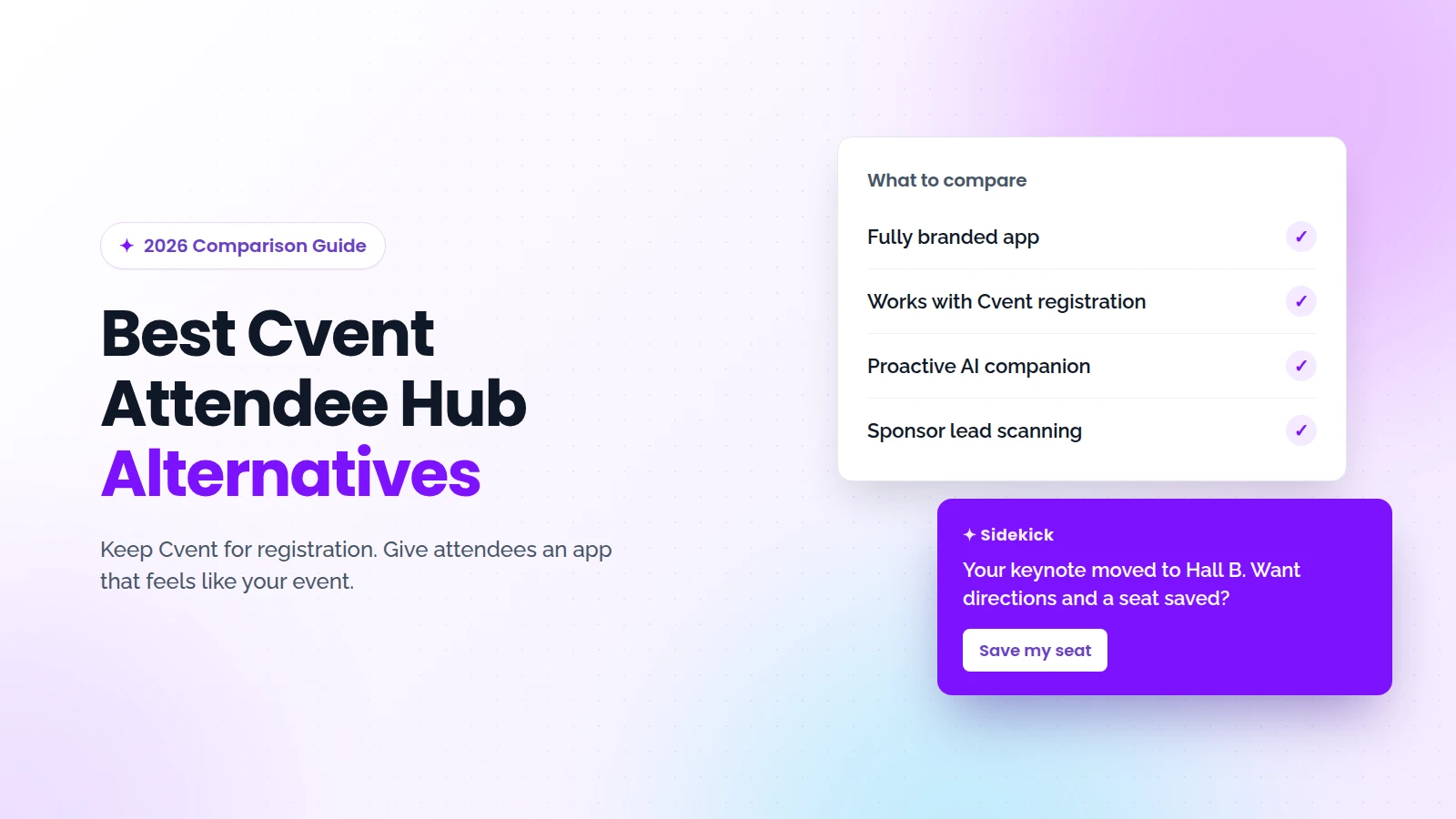
Before you compare logos on a slide, decide which problem you are actually solving. In our experience running enterprise events, five criteria separate a good Cvent-compatible event app from a lateral move.
- Integration with your registration system. If you are staying on Cvent for registration, the new app has to sync attendees, sessions, and enrollments without CSV exports. Ask how often data refreshes and whether agenda changes write back.
- Brand control. Can the app run under your own name in the app stores, with your fonts, colors, and navigation, or is it a template with your logo on top?
- AI that does something. A chatbot that answers "where is lunch?" is table stakes. The useful question is whether the AI proactively helps attendees decide what to do next, who to meet, and which sponsors are worth their time.
- Sponsor value you can prove. Lead scanning, sponsor placements, and engagement data that ties to pipeline are what renew sponsorship contracts.
- Support at showtime. Find out who picks up the phone when a session moves rooms 30 minutes before a keynote.
The Best Cvent Event App Alternatives, Reviewed
The seven platforms below are the ones enterprise and mid-market event teams most often compare against Cvent's attendee app. Pricing notes come from published rates and review sites where vendors do not publish their own. Always get a current quote.
1. Amego: Best for enterprise events that want a branded app with proactive AI
Amego is an attendee experience platform built by event pros. It supports events from 500 to 100,000+ attendees and is used by teams at Atlassian, Cloudflare, Docusign, Google Cloud, ServiceNow, and Palo Alto Networks. The Amego platform has four pieces that work together:
- Amego Classic, a fully branded mobile event app that can live in your own app store listing, with offline support and 30+ languages.
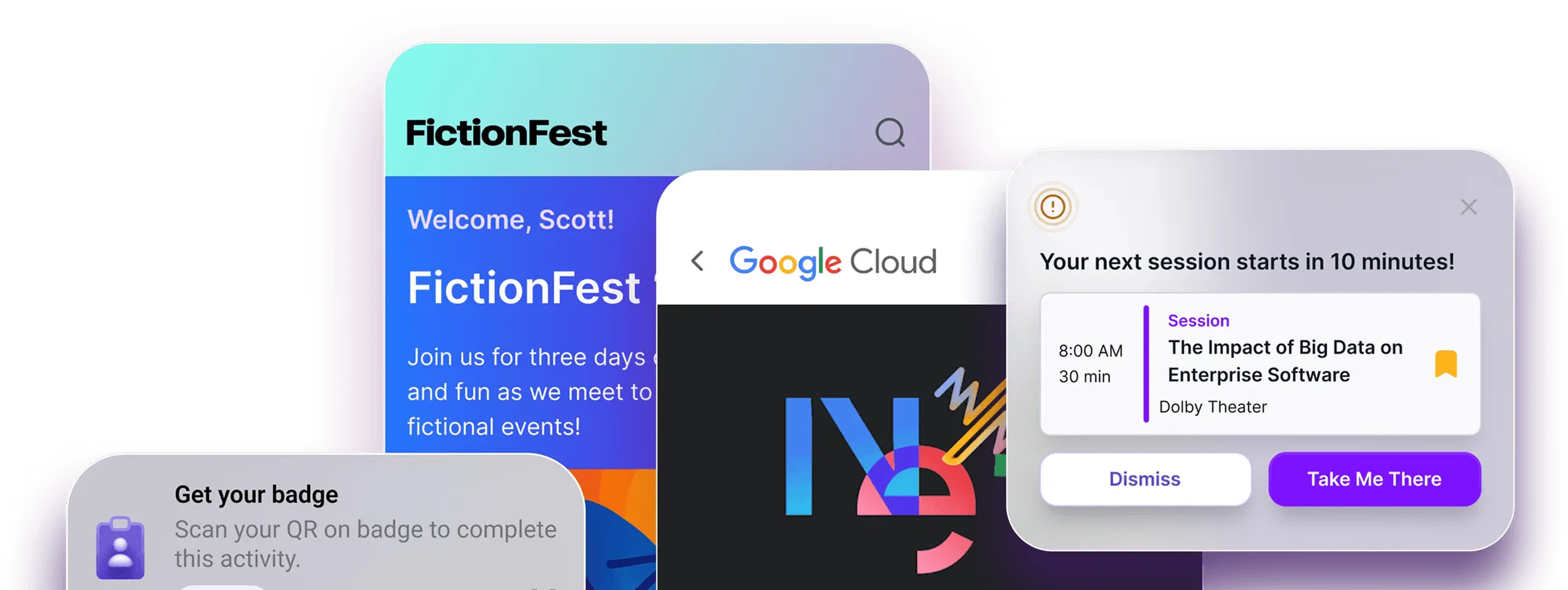
- Sidekick, the agentic AI companion built into the app. Instead of waiting for a question, Sidekick surfaces what matters right now: your next session, a gap in your agenda worth filling, a peer worth meeting, a sponsor demo nearby. Paired with location beacons, it can deliver location-aware nudges on the show floor.
- Amego Admin, the web-based CMS where your team pushes live content changes, segments notifications, and reads engagement analytics.
- Amego Studio, an in-house design team that builds custom screens and branded assets when you want the app to look like your keynote stage, not a template.
Around that core sit the features attendees actually use: networking with AI matchmaking, 1:1 meeting booking, and contact sharing; engagement tools like polls, Q&A, and timed surveys; Quest gamification with passport or leaderboard formats; and lead scanning for sponsors, with custom qualifying questions and a quick-scan mode for busy booth hours.
Amego integrates with Cvent, RainFocus, Swoogo, Braindate, and other enterprise systems, which is why it shows up so often as a Cvent Attendee Hub alternative for teams that do not want to replace registration. Cloudflare evaluated five mobile event apps before choosing Amego and reached 98% adoption across its global events. Atlassian runs 20+ global events on Amego and saw 10x survey responses; Lauren Wolf, Sr. Event Strategist at Atlassian, calls it "our Goldilocks solution: agile enough for our team to move fast, customizable enough to feel like our brand." Amego is SOC 2 Type II and GDPR compliant and was named a Leader in G2's Mobile Event Apps Grid for Summer 2026.
Where Amego is not the right fit: if you need venue sourcing, hotel block management, and registration from one vendor, Amego does not do those. It plugs into the system that does. Pricing is quoted based on attendee count, app type, integrations, and add-ons.
Best for: enterprise conferences, global tours, and internal events where brand, attendee guidance, and sponsor ROI all need to work at once. See how it fits enterprise events.
2. Whova: Best for associations, academic conferences, and mid-size events
Whova is an all-in-one event management platform with a well-liked attendee app. Reviewers praise its community board, agenda tools, and how quickly attendees get comfortable with it, which makes it popular with associations and education events. Its registration product charges a percentage plus a flat fee per paid ticket, and the app itself is custom-quoted per event.
Watch out for: branding happens inside Whova's own app environment rather than a fully white-labeled app, and users on several review sites mention notification volume and in-app upsell messages.
Best for: associations and academic conferences that value attendee community over enterprise brand control.
3. EventMobi: Best for mid-size teams that want modular, predictable pricing
EventMobi sells modular event software (event app, virtual and hybrid platform, registration, onsite) and is known for strong support and ease of use, with a 4.7 out of 5 on Capterra. Software Finder lists the event app and virtual platform at $3,500 for a single event or $9,000 per year for unlimited events, which is unusually transparent for this category.
Watch out for: reviewers mention fewer polling and gamification options than engagement-first platforms, and some exhibitors have been confused about which app to download for lead capture.
Best for: associations and mid-market organizers running several events a year who want a single, predictable budget line.
4. Eventbase: Best for massive flagship and consumer-facing events
Eventbase powers apps for some of the largest events in the world, including CES, SXSW, and Microsoft Ignite. G2 reviewers rate it 4.8 out of 5 and highlight its design quality, agenda clarity, and scalability.
Watch out for: pricing reflects a full-service enterprise model, and reviewers cite the cost. For a portfolio of smaller internal events, it can be more platform than you need.
Best for: one or two flagship events a year with 50,000+ attendees and a big brand budget.
5. Bizzabo: Best for B2B marketing teams that want registration and app in one
Bizzabo bills itself as an Event Experience OS, combining registration, event websites, a mobile app, networking, onsite tools, and its Klik smart badges. It competes with Cvent as a full platform rather than as an app alone. Capterra lists a starting price of $17,999 per year, billed annually with a three-user minimum, and Klik hardware is priced separately.
Watch out for: reviewers describe a learning curve and add-on costs for features like SSO and advanced integrations.
Best for: B2B event marketing teams willing to replace Cvent entirely, not just the app.
6. Swapcard: Best for trade shows built around matchmaking and exhibitors
Swapcard focuses on AI-powered matchmaking between attendees, exhibitors, and sponsors, and is used by large exhibition organizers like Informa and Clarion. Its engagement platform starts at $610 per user per year according to Capterra, with registration priced separately.
Watch out for: subscriptions are annual, attendee and exhibitor limits apply across the whole subscription period on lower tiers, and some users report setup complexity for multi-track agendas.
Best for: exhibition organizers whose revenue depends on exhibitor meetings.
7. PheedLoop: Best for budget-conscious associations and trade shows
PheedLoop is an end-to-end platform covering registration, exhibitor and speaker management, badge printing, and a mobile app. It holds a 4.8 out of 5 on G2, and its pricing is credit-based at $1.75 per user per module for live and hybrid events, which works well for teams that only need a few modules.
Watch out for: the breadth of features can overwhelm first-time admins, and at least one reviewer noted losing access to reports once the contract expired.
Best for: associations and trade show organizers who want one affordable system and do not need deep enterprise brand control.
Can You Keep Cvent Registration and Switch Apps?
Yes, and for many enterprise teams this is the smartest move on the board. You don't necessarily have to replace Cvent. You can keep Cvent Registration and replace Attendee Hub. Most of the complaints about Attendee Hub are about the attendee-facing layer: layouts, branding, login, networking. Very few are about Cvent Registration itself. So the question is not always "should we leave Cvent?" It is often "should our attendees be living inside Cvent's app?"
Amego integrates directly with Cvent, so registrants, sessions, and enrollments flow into your branded app without manual exports. Your ops team keeps the registration workflows, hotel blocks, and reporting they already trust, and your attendees get an app that looks like your event and guides them through it. Cloudflare's events team put the requirement plainly: the app could not be another silo, it had to fit within their ecosystem.
If you want to test the idea before committing, Sidekick Spark puts an AI companion trained on your event content on your existing event website, with no app required.
For a deeper look at how event management platforms and event apps divide the work, see our guide to the best event management platforms in 2026.
How to Choose the Right Alternative
Match the platform to the event you run most often, not the biggest one on your calendar. Here is the short version.
- You are staying on Cvent for registration but want a better attendee experience: Amego.
- You want an AI companion that guides attendees, not just a chatbot: Amego with Sidekick. Our breakdown of event chatbots vs. agentic AI event apps explains the difference.
- You run association or academic conferences with tight budgets: Whova or PheedLoop.
- You want one predictable annual price for several mid-size events: EventMobi.
- You run one massive consumer-facing flagship: Eventbase.
- You are replacing Cvent entirely with a B2B marketing platform: Bizzabo.
- Your revenue depends on exhibitor matchmaking: Swapcard.
Whatever you shortlist, run the same test with each vendor: hand them your messiest real agenda, a last-minute room change, and a sponsor who wants proof of ROI, and watch how the demo handles it. For more comparisons, see our roundups of the best event apps of 2026, the best platforms for creating a custom event app, and the best white label event apps for large conferences.
Want to see what your Cvent registration data looks like inside a fully branded app with Sidekick? Book a demo and we will walk through it with your own event in mind.
Frequently Asked Questions
What is the best Cvent Attendee Hub alternative?
It depends on what you want to change. For enterprise teams that want to keep Cvent Registration but replace the attendee-facing app, Amego is a strong Cvent Attendee Hub alternative because it integrates with Cvent and adds a fully branded app with Sidekick, a proactive AI companion. For associations, Whova and PheedLoop are strong fits. For massive flagship events, Eventbase is purpose-built.
Can I replace Cvent Attendee Hub without replacing Cvent Registration?
Yes. Some attendee experience platforms integrate directly with Cvent Registration, allowing event teams to keep Cvent as their registration system while using a different mobile event app. Amego, for example, can sync attendee, session, and enrollment data from Cvent into a branded attendee experience.
Which event apps integrate with Cvent?
Several apps that integrate with Cvent are designed to complement Cvent Registration rather than replace it, including Amego, EventMobi, Eventbase, and Swapcard. Integration depth varies, so ask each vendor how often data syncs and whether agenda changes write back to Cvent. See Amego's integrations for details.
How much does Cvent Attendee Hub cost?
Cvent does not publish pricing. The University of Washington's published Cvent rates list Attendee Hub plus the Event App at $7 per registrant, per event, on top of a $4.25 per-registrant Platform Usage Fee. Total cost depends on your platform license, event volume, and attendee counts.
Is Cvent Attendee Hub a standalone app?
No. Cvent positions Attendee Hub as part of its event marketing and management platform, designed to work with Cvent Registration as the system of record.
Who are Cvent's main competitors?
Cvent's main competitors for the attendee app include Amego, Whova, EventMobi, Eventbase, Bizzabo, Swapcard, and PheedLoop. For full event management, Bizzabo, RainFocus, and Swoogo are common comparisons.
What is the difference between an AI event companion and an event chatbot?
An event chatbot answers questions when an attendee asks. An AI event companion like Sidekick works proactively, using the attendee's agenda, interests, and location to suggest sessions, people, and sponsors at the moment they are useful.
Which Cvent alternative is best for trade shows and sponsors?
Swapcard is strong for exhibitor matchmaking at trade shows. Amego is a good fit when sponsors need branded placements, lead scanning with qualifying questions, and AI-driven booth traffic. See Amego for conventions, trade shows, and associations.
How long does it take to switch event apps?
It depends on your integration and how much design work you want. Teams that keep their registration system and connect it to a new app avoid rebuilding attendee and session data. For a first event, plan around 4–8 weeks to allow for app store approval, branding, and testing.

Sign up for our newsletter
Get insights delivered to your email.