
EventMobi has a loyal following, and it earned it. Planners describe it as easy to learn, volunteers can run check-in after a short walkthrough, and the support team gets consistent praise. For a lot of association conferences and annual meetings, that is exactly what the job calls for.
Then the event grows. The sponsor list doubles, leadership wants the app to look like the keynote stage, and somebody asks why attendees still have to dig through 60 sessions to find the four that matter to them. That is usually when teams start searching for EventMobi alternatives.
This guide covers what EventMobi does well, where planners say it falls short, what it costs, and how seven EventMobi competitors compare. We are Amego, so we are on the list. Where another platform is a better fit for your event, we say so. The table below puts EventMobi and all seven alternatives side by side.
EventMobi vs. Competitors at a Glance
Pricing reflects vendor pages and review-site listings as of 2026 and will change with attendee counts and negotiated terms. Use the table to build a shortlist, then test each vendor against your real agenda.
EventMobi can still be the right fit for smaller association and member programs that want registration, badges, and app functionality together. If that sounds like your event, jump to when EventMobi is still the right call. If your event has outgrown a template app, keep reading.
What Is EventMobi?
EventMobi is a modular event management platform from Toronto-based 5Touch Solutions. It covers event websites and registration, check-in and badge printing, exhibitor lead capture, a mobile event app, a virtual event platform, and call for speakers. Engagement features include gamification, live polls and surveys, networking, and appointment booking. In 2026 it added MobiAI, which includes an AI registration concierge.
EventMobi positions itself deliberately against enterprise suites. Its own site says it avoids the long contracts and heavy configuration of enterprise event software, and that it is built for professional teams with real operational complexity. The company reports 40,000+ events and 17 million attendees, and it is SOC 2 Type II certified and GDPR compliant. On G2 it holds a 4.6 out of 5 from more than 250 reviews, with most reviewers coming from small businesses.
How EventMobi is priced
EventMobi is one of the few platforms in this category that publishes real numbers. According to its pricing page, per-event pricing starts at $3,000 and scales with attendee count and selected products. Annual pricing starts at $8,900 per year and includes unlimited events, plus a dedicated Event Success Manager.
A few costs sit on top of the base package. Standard integrations start at $1,000 each, streaming and video storage packs start at $500 per event, and onsite badge printer rentals start at $1,000 for a seven-day kit. EventMobi does not charge registration fees on free or paid tickets, which is a genuine advantage for associations selling conference passes.
Why Teams Compare EventMobi Competitors
Most EventMobi reviews are positive, so the reasons people start comparing EventMobi competitors tend to be specific. These are the ones that come up most in reviews and in the conversations we have with teams who are switching.
Some reviewers want a more modern interface
One Capterra reviewer whose team ran a successful event on EventMobi still described the interface as a little clunky and overdue for a refresh. When the app is the most visible piece of your event, attendees notice how it looks next to the consumer apps on their phone.
Agenda management gets tedious at scale
A reviewer at a financial services firm found it tedious to keep consecutive sessions in their preferred order rather than alphabetical, and ended up adding a third-party agenda tool that syncs with EventMobi. A multi-track conference with hundreds of sessions makes small workflow gaps add up quickly.
Separate apps for different jobs
Reviewers mention needing one app for the branded attendee experience and another for lead capture. Login details also carry across EventMobi apps, so attendees who used an EventMobi app at a previous event sometimes have to recover an old password. Each of those is minor on its own. On day one of a 5,000-person show, each one becomes a line at the help desk.
Brand control has limits
EventMobi supports logos, colors, and custom content, and it sells custom app design as a professional service. Reviewers still mention limits in areas like registration page design. Teams running flagship customer conferences often want the app to carry their brand in their own app store listing, with their own navigation and screens.
AI that guides attendees, not just registrants
MobiAI focuses on registration and automation today. Teams who want an AI companion inside the app, one that tells each attendee what to do next during the event, usually look elsewhere.
What to Look for in an EventMobi Alternative for Large Events
Before you compare feature grids, decide what problem you are solving. If EventMobi works and you only want a lower price, you may not need to switch at all. If the event has outgrown the app, these are the areas that matter most at large-event scale.
- Personalization for each attendee. At a large conference, one shared home screen does not work. Look for agendas, recommendations, and content that change based on who the attendee is.
- Notifications you can target. Blasting every push alert to everyone trains attendees to ignore them. Check whether you can segment by audience, session, interest, and location.
- Gamification tied to real goals. A scavenger hunt is fun. A challenge that sends attendees to the sponsor booths that funded the event is better.
- Networking that does more than list names. Searchable directories are table stakes. Matchmaking, meeting booking, and contact sharing are where attendees actually get value.
- Fit with your registration system. If registration lives in Cvent, RainFocus, or Swoogo, the app has to sync with it cleanly.
When EventMobi Is Still the Right Call
A comparison post that tells everyone to switch is not much use, so here is the honest version. EventMobi is a strong choice if you run a handful of association or member events a year, your team is small, and you want registration, badges, and the app from one vendor at a published price. The no-fee ticketing alone can save an association real money.
In an EventMobi vs. Amego decision, the registration question usually settles it. EventMobi handles registration natively. Amego connects to the system that does.
The case for switching gets stronger as the event's role changes. At a 400-person chapter meeting, the app is a digital program. At a 10,000-person user conference, the app is the brand experience, the wayfinding system, the sponsor storefront, and the closest thing each attendee has to a personal guide. Those jobs ask more of the app, and that is usually the point where teams look for an EventMobi alternative for enterprise events built for that scale.
The Best EventMobi Alternatives in 2026
These are the EventMobi competitors, and the event apps similar to EventMobi, that teams compare most often. Pricing notes come from vendor pages and review sites. Always get a current quote.
1. Amego: Best for enterprise events that have outgrown a template app
Amego is an attendee experience platform built by event pros, founded in 2021 by Scott Owens after years of running event tech at large enterprises. It supports events from 500 to 100,000+ attendees, and teams at Atlassian, Cloudflare, Docusign, Google Cloud, ServiceNow, and Palo Alto Networks run their events on it.
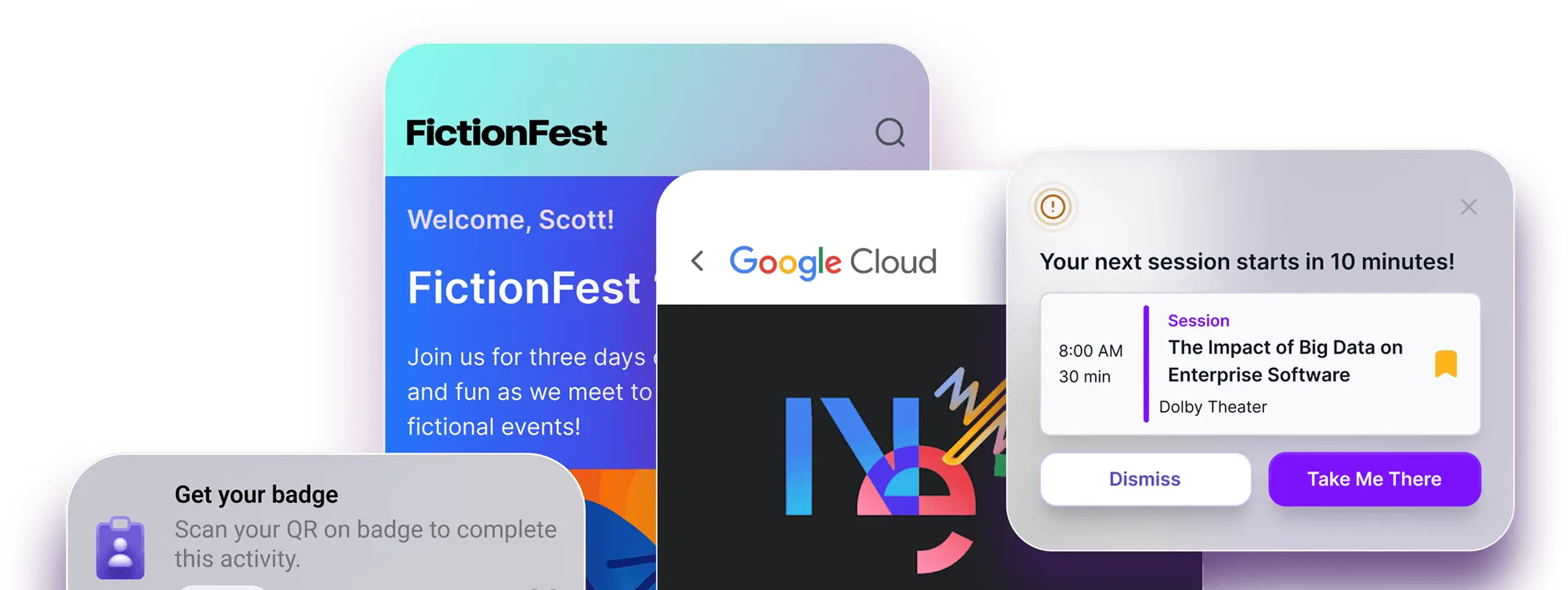
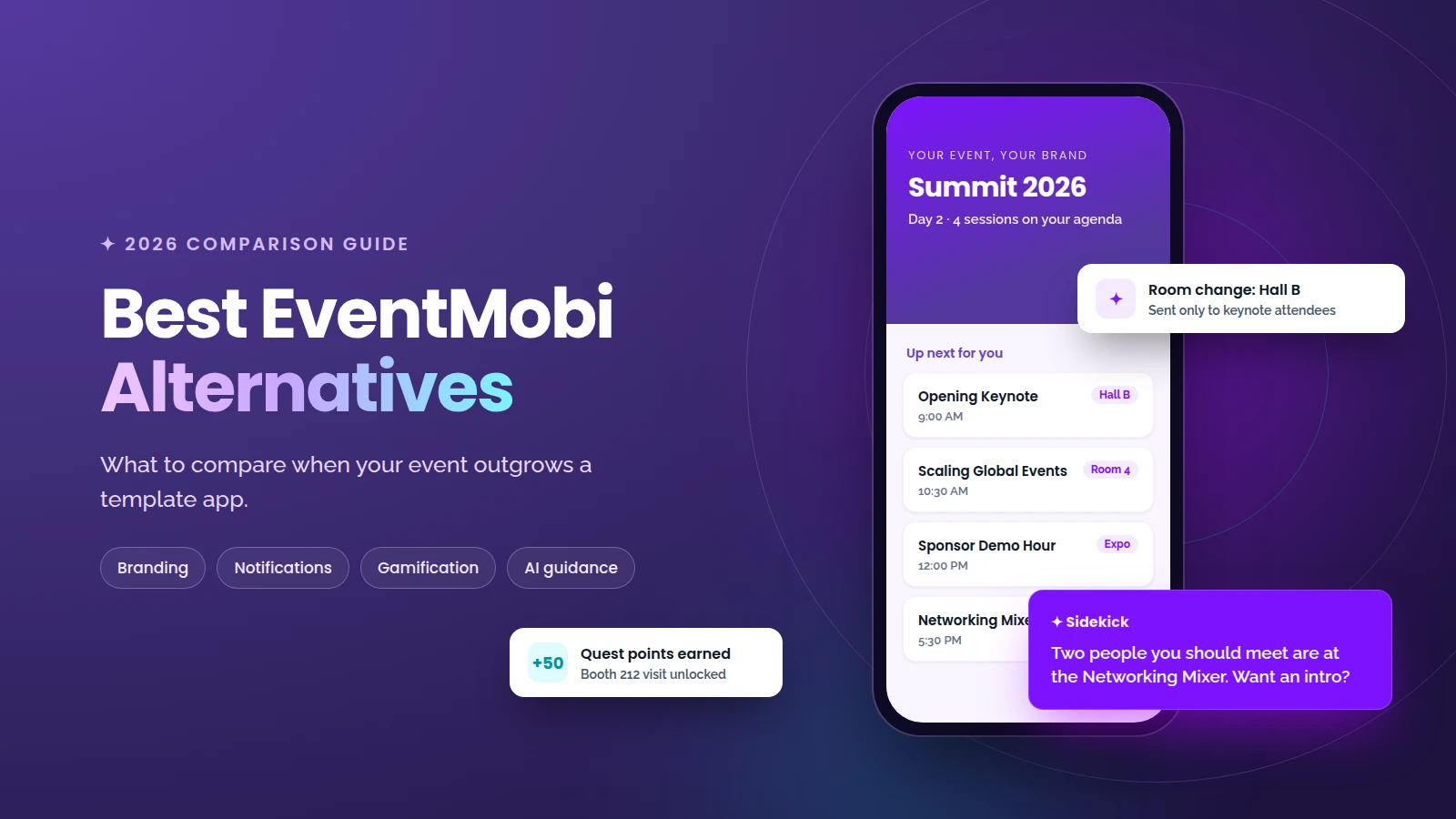
The Amego platform combines a fully branded mobile event app (Amego Classic) with Sidekick, an AI companion that works proactively. Instead of waiting for a question, Sidekick tells an attendee their next session starts in ten minutes, suggests a peer worth meeting, or points out a sponsor demo nearby. Event teams manage content, branding, and analytics in Amego Admin, and Amego Studio, an in-house design team, builds custom screens when a template will not do.
For larger events, Amego is differentiated by targeted notifications, gamification, AI matchmaking, and attendee personalization:
- Targeted notifications let you send push alerts and in-app messages by audience, agenda, and interest, so a room change only reaches the people in that session.
- Quest gamification uses challenges, points, and rewards in passport or leaderboard formats, and it can send attendees to specific sponsor booths.
- Networking includes AI matchmaking, 1:1 meeting booking, messaging, and QR contact sharing.
- Engagement tools cover live polls, Q&A, and timed surveys throughout the event.
Amego also offers lead scanning for sponsors with custom qualifying questions, and it integrates with Cvent, RainFocus, Swoogo, Braindate, and other enterprise systems. Cloudflare evaluated five event apps before choosing Amego and reached 98% app adoption across its global events. Atlassian runs 20+ events a year on Amego, and Palo Alto Networks uses it to scale its global events without losing brand consistency.
Where Amego is not the right fit: Amego does not do registration or badge printing. It connects to the system that does. If you want one vendor for every step from ticket sale to badge, EventMobi or another all-in-one platform is simpler.
Best for: enterprise conferences, user events, and global programs where brand, attendee guidance, and sponsor ROI all matter.
2. Whova: Best for academic conferences and community-driven events
Whova is an all-in-one platform with a well-liked attendee app. Reviewers praise its community board and how quickly attendees get comfortable with it, which makes it popular for academic and association events. The app is custom-quoted per event.
Watch out for: branding happens inside Whova's own app rather than a white-labeled one, and some reviewers mention heavy notification volume. For a deeper comparison, see our guide to Whova alternatives.
Best for: associations and academic conferences where attendee community matters more than brand control.
3. Cvent Attendee Hub: Best for teams already standardized on Cvent
Cvent Attendee Hub is the attendee app layer of Cvent's platform, built to work with Cvent Registration as the system of record. The University of Washington's published Cvent rates list Attendee Hub plus the event app at $7 per registrant, per event, plus a $4.25 per-registrant platform fee.
Watch out for: reviewers mention a steep setup curve and limited layout customization. At least one EventMobi customer on Capterra said they moved to EventMobi from Cvent because Cvent felt hard to use, so for some teams this is a lateral move.
Best for: organizations that already run registration and logistics in Cvent and want everything under one contract.
4. Guidebook: Best for simple guides, training programs, and campus events
Guidebook is a no-code app builder for events, training, and campus guides. You can publish a guide inside the shared Guidebook app or buy a fully branded app, and attendees get offline access to schedules, maps, and documents, which helps when venue Wi-Fi gives out. It integrates with Cvent, Eventbrite, and Stova.
Watch out for: it is built for information delivery more than deep engagement, and some reviewers on tighter budgets found pricing hard to justify for large training groups.
Best for: universities, training programs, and events that mainly need a reliable digital program.
5. Swapcard: Best for trade shows built around exhibitor meetings
Swapcard focuses on AI matchmaking between attendees, exhibitors, and sponsors, and large exhibition organizers like Informa and Clarion use it. Capterra lists its engagement platform from $610 per user per year, with registration priced separately.
Watch out for: subscriptions are annual, and some users report setup complexity for multi-track agendas.
Best for: exhibition organizers whose revenue depends on buyer and exhibitor meetings.
6. Bizzabo: Best for B2B marketing teams that want one system
Bizzabo combines registration, event websites, a mobile app, networking, onsite tools, and Klik smart badges. Capterra lists a starting price of $17,999 per year with a three-user minimum.
Watch out for: reviewers describe a learning curve and add-on costs for features like SSO. It is a much bigger investment than EventMobi.
Best for: B2B event marketing teams that want registration, app, and marketing data in one place and have the budget for it.
7. Stova: Best for high-volume, repeatable event programs
Stova is the combined company formed from Aventri, MeetingPlay, and eventcore. It offers end-to-end event management, including registration, agendas, badges, reporting, and an event app known for its design.
Watch out for: reviewers mention a significant setup learning curve and a higher subscription cost, and some long-time Aventri customers have questioned support quality since the merger.
Best for: organizations running many repeatable events that want one end-to-end system.
If you are weighing the wider market, our roundup of the best event apps of 2026 covers more options, and our guide to the best white label event apps for large conferences goes deeper on branding. For the AI side, see event chatbots vs. agentic AI event apps.
Want to see what your event looks like in a fully branded app with Sidekick? Book a demo and we will walk through it using your own agenda.
Frequently Asked Questions
What are the best EventMobi alternatives?
The most common EventMobi alternatives are Amego, Whova, Cvent Attendee Hub, Guidebook, Swapcard, Bizzabo, and Stova. Amego fits enterprise events that need a fully branded app and an AI companion. Whova and Guidebook fit smaller academic, training, and association events. Swapcard fits exhibitor-driven trade shows.
How much does EventMobi cost?
EventMobi's pricing page lists per-event pricing starting at $3,000 and annual pricing starting at $8,900 per year with unlimited events. Integrations, streaming, and hardware rentals cost extra. EventMobi does not charge registration fees on tickets.
What apps are like EventMobi?
Apps like EventMobi include Whova, Guidebook, Cvent Attendee Hub, and Stova, which all combine an attendee app with event management tools. Amego and Swapcard focus more deeply on the attendee and exhibitor experience and integrate with separate registration systems.
Is EventMobi good for large conferences?
EventMobi can support large conferences, but teams with more complex branding, personalization, integrations, sponsor programs, or attendee guidance requirements often compare it with enterprise-focused event app platforms. For smaller association and member events that want registration, badges, and the app in one system, it remains a strong fit.
What is the best EventMobi alternative for large conferences?
For large and enterprise conferences, Amego is built for the job: it supports events of 100,000+ attendees, offers fully branded apps, and includes Sidekick, an AI companion that guides each attendee in real time. Cvent Attendee Hub and Stova are options for teams that want registration in the same system.
Does EventMobi have AI features?
Yes. EventMobi's MobiAI includes an AI registration concierge and automation tools. Its AI currently focuses on registration and operations rather than an in-app companion that guides attendees during the event.
Can I keep my registration system and switch event apps?
Yes. Apps like Amego integrate with registration platforms such as Cvent, RainFocus, and Swoogo, so attendee and session data flows into the new app without manual exports.
How should I compare EventMobi vs. competitors?
Compare EventMobi vs. competitors on attendee personalization, targeted notifications, gamification, networking, branding, integrations, AI, and total cost for your event size. Test each vendor with your real agenda and a last-minute change rather than a scripted demo.

Sign up for our newsletter
Get insights delivered to your email.