
Every festival organizer knows the moment. Gates open in an hour, the headliner's team just asked for a different load-in window, and someone is asking where the water refill stations are. For the fourth time.
Festival planning is a different sport from running a conference. Your attendees roam. They cross fields, stages, food rows, and parking lots with spotty signal and a phone at 18%. Nobody is sitting in a room with the schedule printed on the door. Your plan has to hold up when the day doesn't go to plan.
This playbook walks through the full arc, from the first budget conversation to the post-event debrief. It's written for first-time festival organizers and for veterans who want a cleaner system. We'll focus on the spots where teams tend to lose time and money: the timeline, the crowd, the vendors and sponsors, and the information attendees need once they're on site.
Table of Contents:
- What Is a Festival Organizer's Playbook?
- Build a Festival Planning Timeline You Can Follow
- Assemble Your Team and Your Run of Show
- Plan for Crowds, Safety, and Weather
- Vendors, Sponsors, and the Money Side
- Festival Tech: Give Attendees One Place to Look
- Run Show Day Like a Festival Organizer
- After the Gates Close
- Festival Organizer FAQ
- Before You Open the Gates
What Is a Festival Organizer's Playbook?
A festival organizer's playbook is a working document that holds your decisions, timeline, roles, and contingency plans in one place. It answers three questions: who does what, by when, and what happens when something changes.
It is not a binder that lives on a shelf. A good playbook gets updated every week until gates open, then gets used by everyone on site. It's short enough that the stage manager actually reads it.
The festival organizer sits in the middle of talent, vendors, sponsors, city permits, security, volunteers, and a paying public with strong opinions about the food lines. The playbook is how you keep all of those groups pointed the same way.
Build a Festival Planning Timeline You Can Follow
Festival planning runs on lead times. Permits, talent, and vendor contracts all take longer than you want them to. These ranges shift with the size of your event and your local rules, so treat them as a starting point and adjust to your own city.
9–12 months out: lock the foundation
Set the budget, choose dates, and secure the site. Check permit lead times with your city or county right away, since some applications need months of review. Decide how big the festival will be, because capacity drives nearly every cost that follows. Then book your anchor talent or program, because ticket pricing and sponsor interest both depend on who is on the bill.
6–8 months out: open ticketing and sign partners
Announce the lineup and open early-bird tickets. Start vendor and sponsor conversations in earnest. Sponsors will ask how they'll actually show up in front of attendees, so have that story ready before the first call. We'll come back to that in the sponsor section.
3–5 months out: operations and information
Finalize the site map, staffing plan, medical coverage, security, and waste plan. This is also the moment to decide how attendees will get information on site: schedule, maps, vendor details, and announcements. If you're using an app, choose it now so you have time to promote it before gates open.
The final month: rehearse
Run a tabletop exercise with your leads. Walk through a weather hold, a medical incident, a stage running 40 minutes late, and a gate surge. For each one, name a single decision owner and write down how attendees will hear about it.
Assemble Your Team and Your Run of Show
Most festival teams are small for the scale of what they run, so clear ownership matters more than headcount. At minimum, someone needs to own each of these areas:
- Production and stage management
- Vendor coordination and load-in
- Sponsorship and partner delivery
- Safety, medical, and security
- Volunteers and staffing
- Attendee communications
Then build your run of show. This is the minute-by-minute version of the truth, and it needs one master copy. When every stage manager, vendor lead, and volunteer captain works from a slightly different schedule, you don't have a schedule at all.
Agree on a change protocol early. Who can approve a set-time change? Who tells the crowd? How fast? Those answers should be in the playbook before the first act takes the stage.
Plan for Crowds, Safety, and Weather
Crowd flow is a design problem you can solve on paper months ahead. Look at where people will bunch up: entrances, water, restrooms, the stage that everyone wants to see at once. Add shade, seating, and accessible routes on purpose, not as an afterthought. Plan a visible, easy-to-find spot for lost children, lost phones, and first aid.
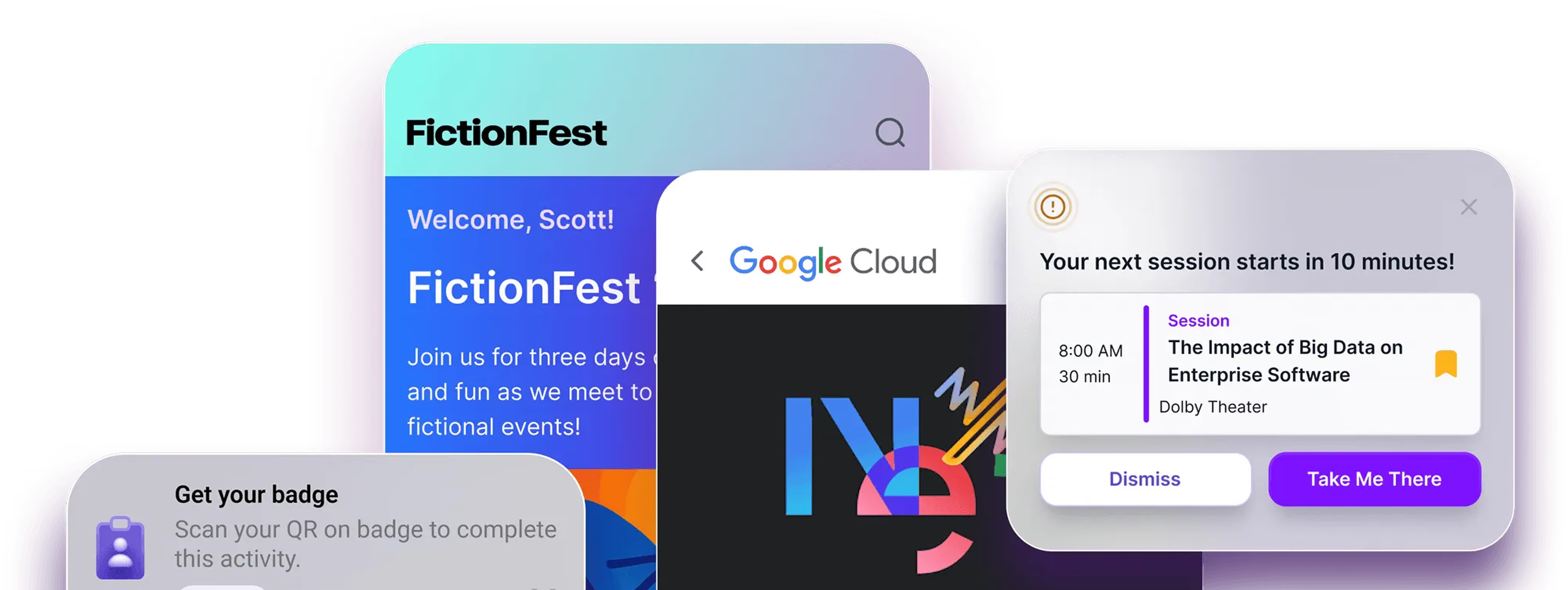
Weather deserves its own page in the playbook. Decide your thresholds before the day: what triggers a hold, who calls it, and what the message says. Then decide how that message reaches thousands of people at once. A tweet is not a plan. Push notifications that you can segment by group are far closer to one, and you can read more about how event app notifications work in practice.
Vendors, Sponsors, and the Money Side
Vendors make a festival feel like a place. Give them clear load-in windows, power and water details, and a single contact for day-of problems. Then help attendees find them. A food truck that nobody can locate is a food truck that goes home with a full cooler.
Sponsors are the other half of the equation. A banner at the gate is table stakes. What sponsors really want to know is who showed up, who engaged, and who they can follow up with. Build the answer into the plan: sponsor placements inside the attendee experience, interactive challenges that send people to a sponsor's activation, and lead scanning where it makes sense. Our page for sponsors and exhibitors goes deeper on how to deliver that value.
On revenue, spread your risk. Tickets, VIP upgrades, vendor fees, and sponsorship each behave differently when weather turns or the lineup changes. A festival that depends on one of them has a thin margin for a bad weekend.
Festival Tech: Give Attendees One Place to Look
At most festivals, information lives in too many places. There's a PDF map, a schedule on the website, updates on social, and a volunteer who may or may not know the answer. Attendees stitch it together on a weak signal, and the stitching fails right when they need it.
The fix is a single source they can trust. Here's what to look for.
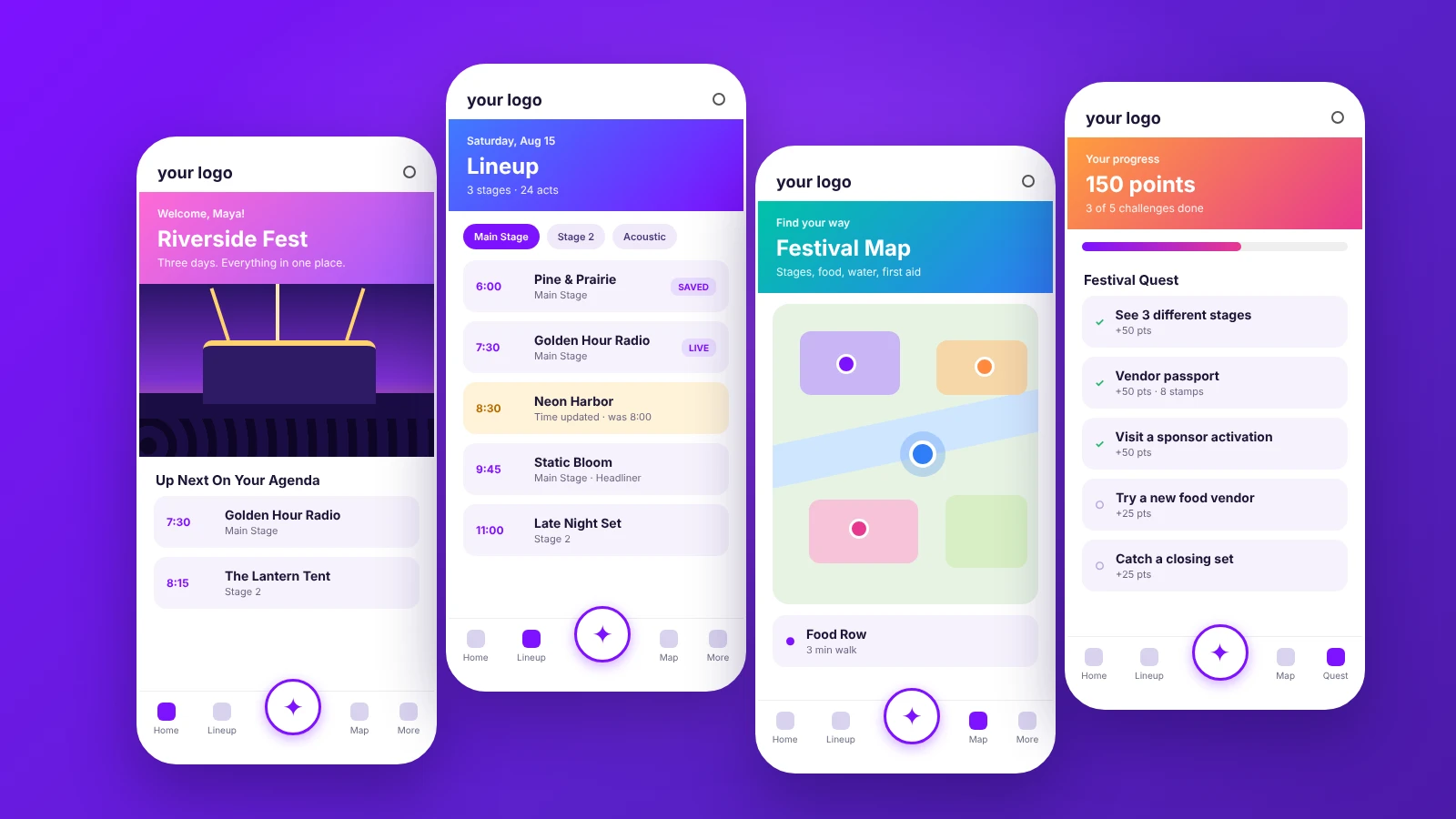
Live schedules and maps that work offline
Set times move. Your attendee experience has to keep up without waiting on an app store update, and it has to keep working when 60,000 phones are fighting for the same tower. Native maps and wayfinding help people get from the main stage to the food rows without asking a stranger.
Notifications that reach the right people
Not every message is for everyone. VIP lounge access, a parking-pass lot change, and a vendor load-out reminder should each go to a different group. Segmented push keeps important messages from drowning in noise.
Recommendations and gamification that move people around
Festivals are about discovery. Sidekick, Amego's AI companion, can suggest artists, food, and activities based on what an attendee has engaged with. Quest gives organizers a way to build stage-hopping challenges and vendor passport cards, which is a friendly way to spread crowds across the site and send traffic to sponsors and vendors who need it.
Check your stack, then check your adoption
None of it works if attendees don't download the thing. Treat the app as part of the festival, not an add-on: promote it in your ticket confirmation, your gate signage, and your lineup announcement. Our event app adoption benchmarks are a useful gut check, and Cloudflare reached 98% adoption across its global events with Amego, which you can read in their case study. If you're not sure what your current setup is missing, start with what tools your event tech stack is missing, and compare options in our roundup of the best event apps of 2026.
If you want to see what this looks like for a festival specifically, take a look at Amego's festivals and gatherings page, or browse the full mobile event app.
Run Show Day Like a Festival Organizer
By show day, the playbook should be doing the thinking for you. Hold a briefing with every lead before gates open. Set up one command post and one radio channel for escalations. Make sure everyone knows the rule: if it's not in the playbook, it goes to the ops lead.
The biggest show-day habit is also the simplest. When something changes, update it once, in one place, and let it flow out. If the schedule changes in your content system but not in the app, the stage signs, and the social post, your crowd is working from three versions of reality. Amego lets you push live schedule changes and announcements to attendees without an app store update, and you manage that content in Amego Admin.
Walk the site yourself, too. No dashboard will tell you that the line at the east entrance is moving at half speed.
After the Gates Close
Teams are tired and the field is still full of cups, so the debrief gets skipped. Don't skip it. Hold it within a week, while the details are fresh, and ask each lead the same three questions: what worked, what broke, and what we should change in the playbook.
Look at the data you collected. Which stages drew the biggest crowds and when? Where did vendor traffic spike or stall? How did attendees engage with sponsor activations? Which messages got opened? Send sponsors their results quickly, since the follow-up that lands in the first week is the one that gets renewed. Then update the playbook while the lessons are still sharp, so next year's team inherits the improvements instead of rediscovering them.
Festival Organizer FAQ
How far in advance should festival planning start?
A year out is a common starting point for a mid-size festival. Larger or first-time events often need longer, mostly because of permits, site availability, and talent booking. Start with the items that have the longest lead times.
What does a festival organizer do?
A festival organizer owns the plan that brings a festival to life. That includes budget, site, permits, talent, vendors, sponsors, safety, staffing, and attendee experience, along with coordinating all the teams that carry those pieces out.
What is the most common mistake first-time festival organizers make?
Planning the lineup in detail and the logistics loosely. Crowd flow, communication, and weather plans are less glamorous than booking talent, but they decide how the day feels to the people who bought tickets.
Does a festival need its own app?
It isn't required, but a branded app gives attendees one reliable source for schedules, maps, and announcements, and gives you a direct channel to reach them on site. It also gives sponsors measurable ways to engage the crowd.
How do you keep sponsors happy at a festival?
Agree on what success looks like before the contract is signed, build activations that bring people to the sponsor, and send a clear results report within a week of the festival ending.
Before You Open the Gates
Festivals are one of the few places where thousands of people choose to be in the same field for the same reason. Your job is to remove the friction between them and the reason they came: the music, the food, the people they're with. The playbook exists so that, when the unexpected happens, your team already knows what to do and your attendees barely notice.
If you're building out your next festival and want to see how Amego fits, you can schedule a demo and talk it through with event people who have been there.

Sign up for our newsletter
Get insights delivered to your email.