
Table of Contents:
- Swapcard Alternatives at a Glance
- What Is Swapcard?
- Amego vs. Swapcard: How G2 Reviewers Score Them
- Why Teams Look for Swapcard Alternatives
- 1. Amego
- 2. Cvent
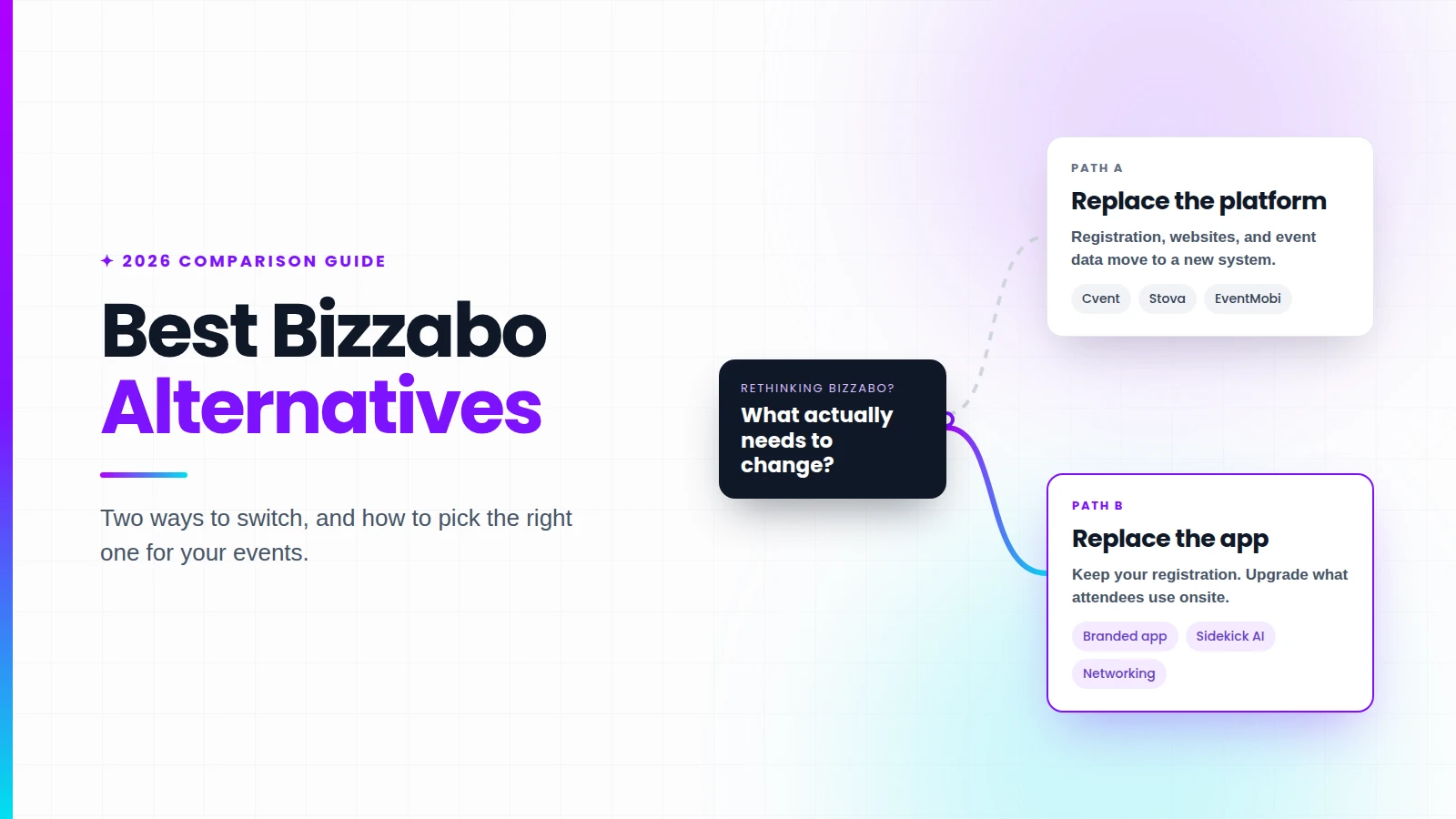
- 3. Bizzabo
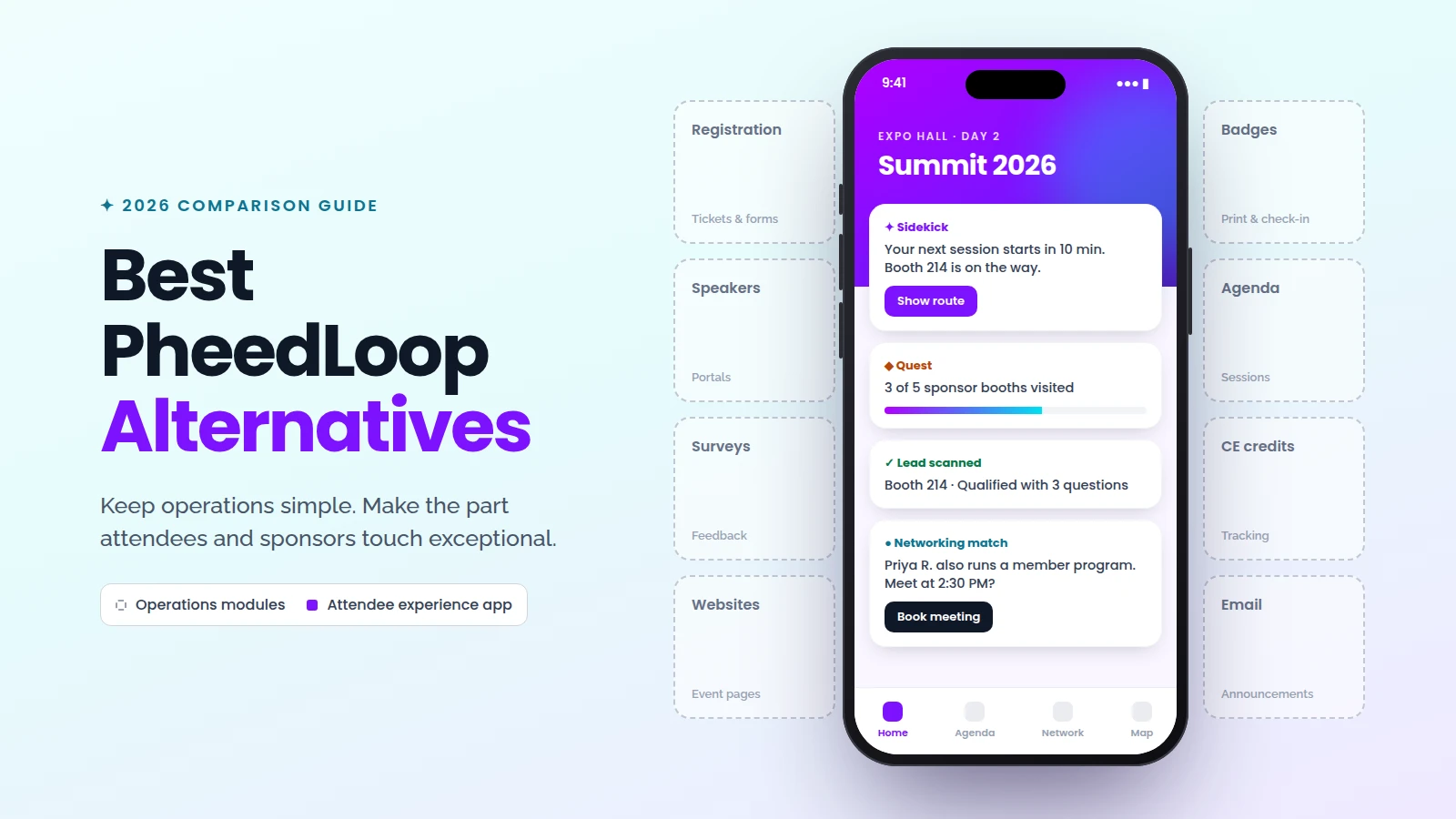
- 4. PheedLoop
- 5. Stova
- 6. EventMobi
- 7. Whova
- Matchmaking Only Works If Attendees Use the App
- Swapcard vs. Competitors: What to Compare
- FAQs About Swapcard Alternatives
Swapcard built its reputation on one idea: trade shows make money when the right buyers meet the right exhibitors. Its AI matchmaking, meeting booking, and lead capture are designed around that, and plenty of exhibition organizers swear by it.
Not every event runs on that model, though. A user conference cares about session flow and the attendee journey as much as booth meetings. A corporate event wants the app to look like the company, not a shared platform. And a team running five shows a year may not love an annual contract with registration priced separately.
This guide compares seven Swapcard alternatives worth evaluating in 2026, what each one does well, where each one falls short, and which kind of event it fits. We are Amego, so we are on the list. Where another platform is the better fit, we say so.
Swapcard Alternatives at a Glance
Pricing reflects vendor pages and review-site listings as of 2026 and changes with attendee counts and negotiated terms. Use the table to build a shortlist, then test each vendor against your real agenda and exhibitor list.
What Is Swapcard?
Swapcard is an event platform built for associations, trade show organizers, media companies, and conference organizers. It describes itself as revenue-first: the platform covers registration, an event web and mobile app, AI-powered matchmaking, meeting booking, interactive floor plans, exhibitor tools, lead capture, and monetization features designed to turn attendees into qualified exhibitor leads. Organizers can request a custom-branded app.
Swapcard's strengths show up clearly in its reviews. G2 reviewers praise its ease of setup, intuitive navigation for attendees, and a support team they describe as very helpful.
How Swapcard is priced
Swapcard sells two plans: an Event Engagement Platform and a Registration and Management Platform. According to Capterra, the Event Engagement Platform starts at $610 per user per year, and registration is priced separately on a custom quote. Subscriptions are annual.
Amego vs. Swapcard: How G2 Reviewers Score Them
Swapcard has strong reviews, so a top-line star rating will not settle the question. The detailed G2 scores give a clearer read: verified reviewers rate Amego higher than Swapcard on all six measures below.
What G2 reviewers say
Rated Higher by the Event Teams Who Use It
Here's how verified G2 reviewers rate Amego and Swapcard on G2.
Average user adoption
vs. 56% for Swapcard
Attendee networking
vs. 81% for Swapcard
Overall relationship score
vs. 79% for Swapcard
Ease of setup
vs. 88% for Swapcard
Meets requirements
vs. 87% for Swapcard
Quality of support
vs. 91% for Swapcard
Source: G2 user satisfaction ratings, 2026. Percentages reflect each product's verified G2 reviews; Amego has fewer reviews than Swapcard.
The biggest gaps are user adoption (76% vs. 56%) and attendee networking (96% vs. 81%). Adoption tells you whether attendees actually open the app once they download it. Networking matters when matchmaking is the whole point of the event. Amego also leads on quality of support (100% vs. 91%) and overall relationship score (91% vs. 79%). G2 named Amego a Leader in its Mobile Event Apps Grid for Summer 2026, with 100% satisfaction scores for performance and reliability and for API and integrations.
Why Teams Look for Swapcard Alternatives
Swapcard reviews are mostly positive, so the reasons teams switch tend to come down to fit rather than failure.
The event is not built around exhibitor meetings
Swapcard's product and positioning center on exhibitor revenue. That is exactly right for a trade show. For a user conference, an internal kickoff, or a customer event where sessions and the overall attendee journey matter most, teams often want a platform built around the attendee first.
Reporting could go deeper
Even happy reviewers mention that advanced analytics and reporting could be more customizable and detailed. Teams that need to prove event ROI to leadership or sponsors feel that gap at wrap-up time.
New admins need ramp-up time
Reviewers describe the platform as easy once it clicks, but mention that the setup can be hard to understand at first and that new users sometimes struggle to navigate it. On a lean team, that ramp-up comes out of event prep time.
Annual contracts and separate registration
Annual-only subscriptions, attendee and exhibitor limits on lower tiers, and registration priced separately can make Swapcard a harder fit for teams with irregular event calendars or budgets that are set event by event.
1. Amego
Best Swapcard alternative for: Events that need strong networking and a branded, AI-guided attendee experience
Amego is an attendee experience platform built by event pros. It supports events from 500 to 100,000+ attendees, and teams at Atlassian, Cloudflare, Google Cloud, ServiceNow, and Palo Alto Networks run their events on it. Where Swapcard starts from exhibitor revenue, the Amego platform starts from the attendee and builds networking, sponsor value, and engagement around that journey.
Networking that goes beyond the directory
Amego's networking tools include AI matchmaking, attendee profiles, messaging, 1:1 meeting booking, and QR contact sharing, so attendees move from browsing names to booking real conversations with the people worth meeting.
Sidekick, the AI companion
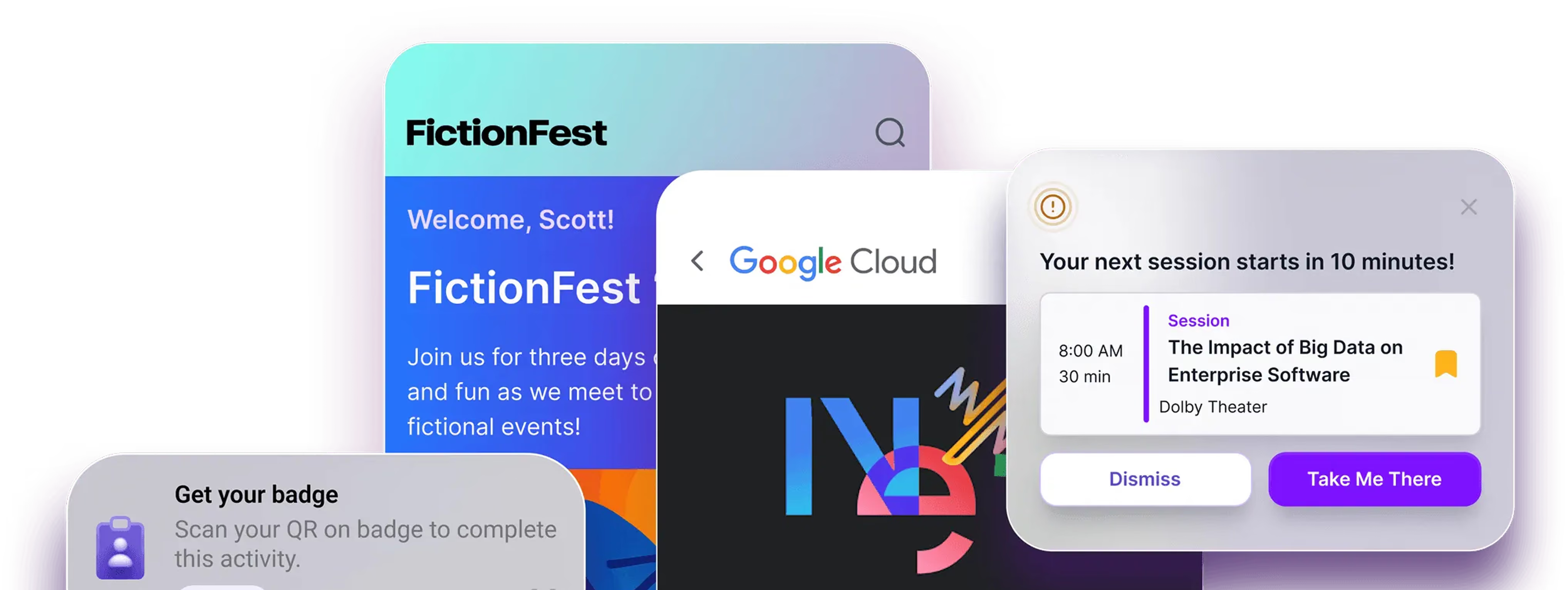
Sidekick is built into the app and works proactively. Instead of waiting for a question, it tells an attendee their next session starts in ten minutes, suggests a peer worth meeting, or points out a sponsor demo nearby. Matchmaking becomes part of the attendee's day instead of a separate tab they have to remember to open.
Sponsor and exhibitor value
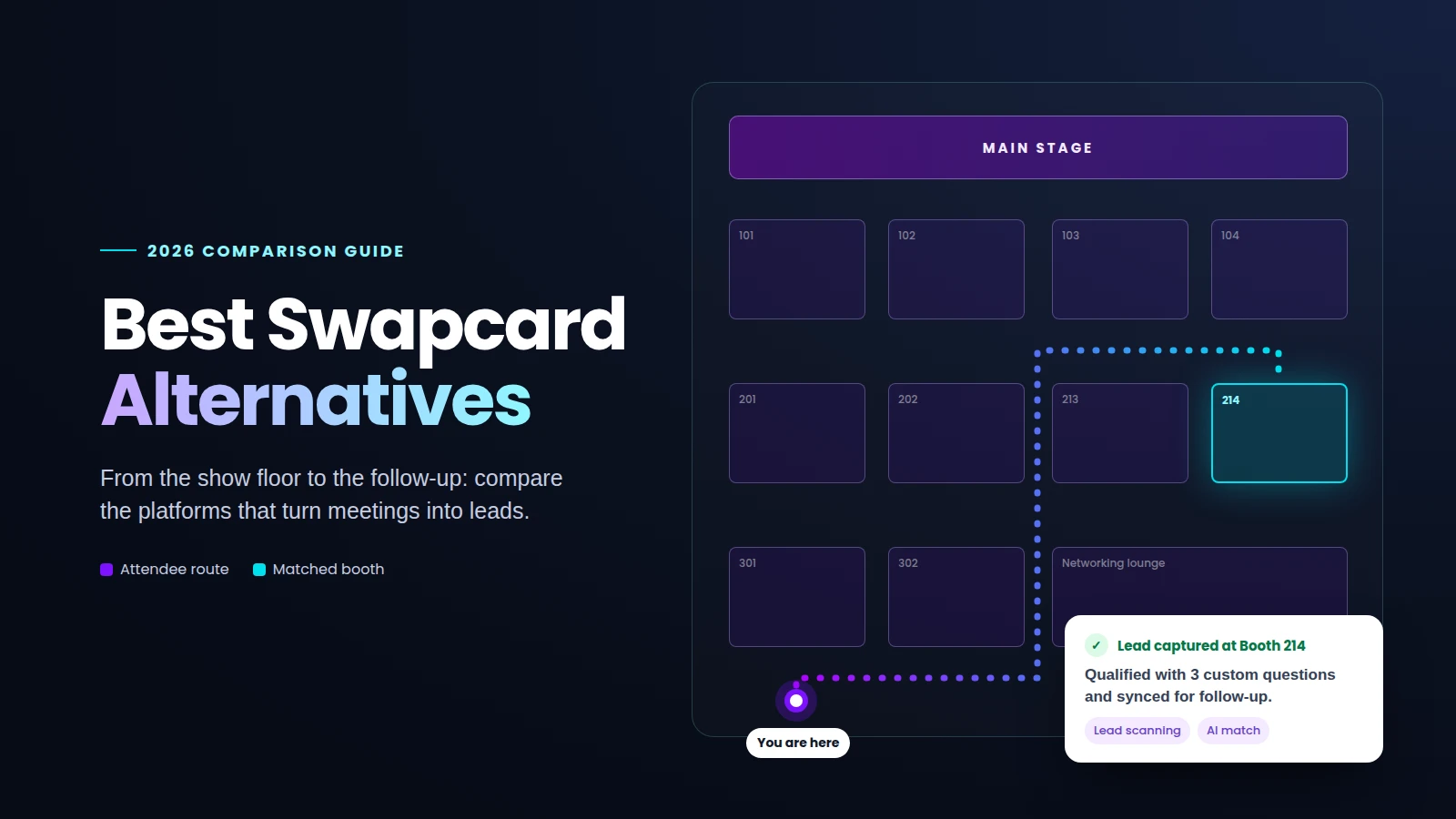
Exhibitors capture leads with Amego's lead scanning, including custom qualifying questions and a quick-scan mode for busy booth hours. Quest gamification can send attendees to specific booths, and engagement tools like live polls, Q&A, and timed surveys keep people active between meetings.
Your brand, your app
Every Amego app runs under your own app store listing with your fonts, colors, and navigation. Event teams manage content and targeted notifications in Amego Admin, and Amego Studio, an in-house design team, builds custom screens when a template will not do. Amego integrates with Cvent, RainFocus, Swoogo, Braindate, ExpoFP, and other enterprise systems.
Proof from real events
Cloudflare evaluated five event apps before choosing Amego and reached 98% app adoption across its global events. Atlassian runs 20+ events a year on Amego and saw 10x more survey responses. Amego is SOC 2 Type II and GDPR compliant, and G2 named it a Leader in its Mobile Event Apps Grid for Summer 2026.
Where Amego is not the right fit: Amego does not do registration or ticketing. It connects to the system that does. If you want one vendor for registration, the app, and exhibitor sales, Swapcard or PheedLoop is simpler.
Best for: enterprise conferences, user events, and conventions, trade shows, and associations that want networking, sponsor ROI, and a fully branded app in one experience.
2. Cvent
Best for: Large programs that want registration, sourcing, and the app in one system
Cvent covers registration, event marketing, venue sourcing, attendee management, and reporting, and its Attendee Hub provides the event app with CventIQ-powered recommendations and AI-assisted networking. The University of Washington's published Cvent rates list Attendee Hub plus the event app at $7 per registrant, per event, on top of a $4.25 per-registrant platform fee.
Watch out for: reviewers describe a steep setup curve and limited layout customization in the attendee app. Our guide to Cvent Attendee Hub alternatives goes deeper.
Best for: organizations running large portfolios of events that want everything under one contract.
3. Bizzabo
Best for: B2B marketing-led conferences
Bizzabo combines registration, event websites, a mobile app, networking, onsite tools, and Klik smart badges that track in-person interactions. It connects event data to marketing tools like HubSpot and Salesforce, which appeals to teams that report events in pipeline terms. Capterra lists a starting price of $17,999 per year with a three-user minimum.
Watch out for: limited customization is the most common complaint theme in its G2 reviews, and reviewers mention a learning curve and add-on costs.
Best for: B2B event marketing teams that want registration, app, and attribution in one platform.
4. PheedLoop
Best for: Budget-conscious trade shows and associations
PheedLoop is an end-to-end platform covering registration, exhibitor and speaker management, badge printing, and a mobile app. It holds a 4.8 out of 5 on G2, and its credit-based pricing at $1.75 per user per module for live and hybrid events makes it one of the more affordable exhibitor-friendly options.
Watch out for: the breadth of features can overwhelm first-time admins, and at least one reviewer noted losing access to reports once the contract expired.
Best for: associations and trade show organizers that want one affordable system for registration through exhibitor management.
5. Stova
Best for: High-volume, repeatable event programs
Stova is the combined company formed from Aventri, MeetingPlay, and eventcore. It offers end-to-end event management with registration, agendas, badges, reporting, and an event app known for its design.
Watch out for: reviewers mention a significant setup learning curve and a higher subscription cost, and some long-time Aventri customers have questioned support quality since the merger.
Best for: organizations running many similar events a year that want one end-to-end system.
6. EventMobi
Best for: Associations and mid-market teams that want published pricing
EventMobi is a modular platform covering registration, check-in and badges, exhibitor lead capture, a mobile app, and virtual events. Its pricing page lists per-event pricing from $3,000 and annual pricing from $8,900 per year with unlimited events.
Watch out for: reviewers mention an interface that can feel dated and agenda management that gets tedious at scale. See our guide to EventMobi alternatives for more.
Best for: associations and smaller teams running several events a year on a predictable budget.
7. Whova
Best for: Academic and association conferences
Whova combines registration with a well-liked attendee app, a community board, and networking tools that attendees pick up quickly. The app is custom-quoted per event.
Watch out for: branding happens inside Whova's own app rather than a white-labeled one. Our guide to Whova alternatives covers the tradeoffs.
Best for: associations and academic conferences where attendee community matters more than brand control.
Matchmaking Only Works If Attendees Use the App
Every platform on this list advertises networking, and most now say AI matchmaking. The feature grid will not tell you which one actually produces meetings, because the deciding factor is something the grid does not show: whether attendees keep opening the app after day one.
A match nobody sees is not a connection. Recommendations live inside the app, so an app attendees open once for the agenda and then forget will produce very few of them, however good the algorithm is. That is why we treat adoption as a networking metric. Cloudflare's 98% adoption matters because every attendee who stays in the app is someone Sidekick can introduce to the right peer or send to the right booth.
When you evaluate event networking platforms like Swapcard, ask three questions:
- What brings attendees back into the app each day? Look for personalized agendas, targeted notifications, and timely nudges rather than a static home screen.
- Does matchmaking show up where attendees already are? Suggestions that appear in the flow of the day get acted on. Suggestions buried in a separate tab mostly do not.
- Can exhibitors prove the meetings happened? Lead scanning with qualifying questions turns a conversation into data a sponsor can take back to their team.
For a broader look at the category, see our guide to the best event apps of 2026.
Swapcard vs. Competitors: What to Compare
When you line up Swapcard vs. competitors, these questions separate the platforms in practice:
- Who is the app built for first? Some platforms start from exhibitor revenue, others from the attendee journey. Match that to how your event makes money and earns loyalty.
- How much of it carries your brand? Ask to see a real customer app running under the customer's own app store listing.
- What does the AI actually do? Find out whether it only recommends contacts, or also guides attendees through sessions, sponsors, and their day.
- What is in the price? Compare total cost, including registration, user limits, add-ons, and contract length.
- How fast is the agenda change test? Move a session 30 minutes before it starts and watch how quickly the right attendees hear about it.
Want to see what networking, lead scanning, and Sidekick look like in your own branded app? Book a demo and we will walk through it using your agenda and exhibitor list.
FAQs About Swapcard Alternatives
What are the best Swapcard alternatives?
The most common Swapcard alternatives are Amego, Cvent, Bizzabo, PheedLoop, Stova, EventMobi, and Whova. Amego fits events that want strong networking plus a fully branded, AI-guided attendee app. Cvent, Bizzabo, and Stova fit teams that want an all-in-one platform. PheedLoop fits budget-conscious trade shows, and EventMobi and Whova fit associations and mid-size conferences.
How much does Swapcard cost?
According to Capterra, Swapcard's Event Engagement Platform starts at $610 per user per year, billed annually. Its Registration and Management Platform is priced separately on a custom quote.
Who are Swapcard's main competitors?
Swapcard's main competitors include Amego, Cvent, Bizzabo, PheedLoop, Stova, EventMobi, and Whova. PheedLoop and Cvent compete most directly for trade shows and exhibitions, while Amego competes on networking, sponsor value, and the overall attendee experience.
What are event networking platforms like Swapcard?
Event networking platforms like Swapcard include Amego, Bizzabo, Cvent Attendee Hub, and Whova. Each offers attendee networking and meeting tools, but they differ in AI matchmaking, branding control, sponsor tools, and whether the AI also guides attendees through sessions and the venue.
What is the best Swapcard alternative for trade shows?
For trade shows, Amego and PheedLoop are strong Swapcard alternatives. Amego offers AI matchmaking, lead scanning with qualifying questions, and Quest challenges that drive booth traffic inside a fully branded app. PheedLoop offers an affordable all-in-one system covering registration, exhibitor management, and badge printing.
How should I compare Swapcard vs. competitors?
Compare Swapcard vs. competitors on who the app is built for, branding control, what the AI actually does, total cost including registration and contract length, and how quickly last-minute agenda changes reach the right attendees. Test each vendor with your real agenda and exhibitor list.

Sign up for our newsletter
Get insights delivered to your email.