
Table of Contents:
- What Event Lead Generation Actually Means in 2026
- Pre-Event Plays (Warm the List Before Anyone Arrives)
- On-Site Plays (Where the Best Leads Get Made)
- Post-Event Plays (The Two Weeks That Decide ROI)
- What Separates a Warm Lead From a Wasted Scan
- How to Choose a Lead Retrieval App for Exhibitors
- Turning Lead Data Into Sponsor ROI
- How Amego Powers Better Event Lead Generation
- FAQs
Event lead generation used to be a lanyard, a fishbowl, and a stack of business cards someone eventually typed into Salesforce. That version still exists at some events. It also produces the leads sponsors quietly refuse to renew for.
The teams driving real pipeline from events in 2026 have replaced the fishbowl with a stack of small, intentional plays that run before, during, and after the event. None of them are magic. Together, they consistently outperform the "scan every badge and sort it out later" approach by a wide margin.
Whether you're an organizer building a sponsorship program, an exhibitor trying to justify the booth, or a sales team working a target account list, here are the 14 event lead generation plays that work, why they work, and how to run each one. We'll also cover how to choose a lead retrieval app and how lead data proves sponsor ROI.
What Event Lead Generation Actually Means in 2026
Event lead generation is the set of tactics that turn attendees, sponsors, and audiences reached before, during, and after an event into qualified pipeline. That's the definition. The important part is the word qualified.
The old scoreboard was volume: 4,000 badge scans, 12,000 emails collected, 800 giveaways handed out. The new scoreboard is quality: how many of those contacts fit the target profile, engaged with a real conversation, and moved into a sales-accepted opportunity. Ten deep conversations with the right buyers is a bigger win than a thousand scanned lanyards.
Every play below is designed to move you in that direction: fewer leads, better fit, tighter follow-up, more revenue. For sponsors and exhibitors, that shift is the difference between a one-year sponsorship and a multi-year partnership.
Pre-Event Plays (Warm the List Before Anyone Arrives)
The best event lead generation starts weeks before the event. By the time attendees walk in, they should already know which sponsors are worth talking to and which meetings they've committed to. Cold introductions at a booth are the fallback, not the plan.
1. ABM-style registrant enrichment
The registration list is your most valuable pre-event asset. Enrich it against your ICP the day it's finalized. Match companies to accounts, flag target buyers, and tag the top 50 to 200 names that matter most. Now your sales and sponsor teams know exactly who to prioritize before anyone shows up.
2. Pre-event 1:1 meeting requests
Give sponsors and internal sales teams a way to request meetings with target accounts before the event opens. A pre-scheduled 15-minute meeting on the calendar is worth more than any amount of hopeful lingering at a booth. This is where structured networking tools in the event app do the heaviest lifting.
3. Content-driven registration drivers
Publish a piece of content (a report, a session preview, a research finding) that the ICP wants and that only registered attendees can access in full. This drives late-cycle registrations from the exact profiles you want to meet, and gives sponsors a topical hook for outreach.
4. Pre-event LinkedIn engagement
Have sponsors, speakers, and internal team members post about their sessions and their booth locations on LinkedIn in the two weeks before the event. Not a company-branded post from marketing. A first-person post from the human who will be at the booth. Engagement on those posts is a strong signal for lead prioritization on-site.
On-Site Plays (Where the Best Leads Get Made)
The event floor is where lead quality is either made or ruined. Every play below is aimed at capturing the intent that's already in the room and turning it into a conversation your team can actually follow up on.
5. Qualified badge scans with a lead retrieval app
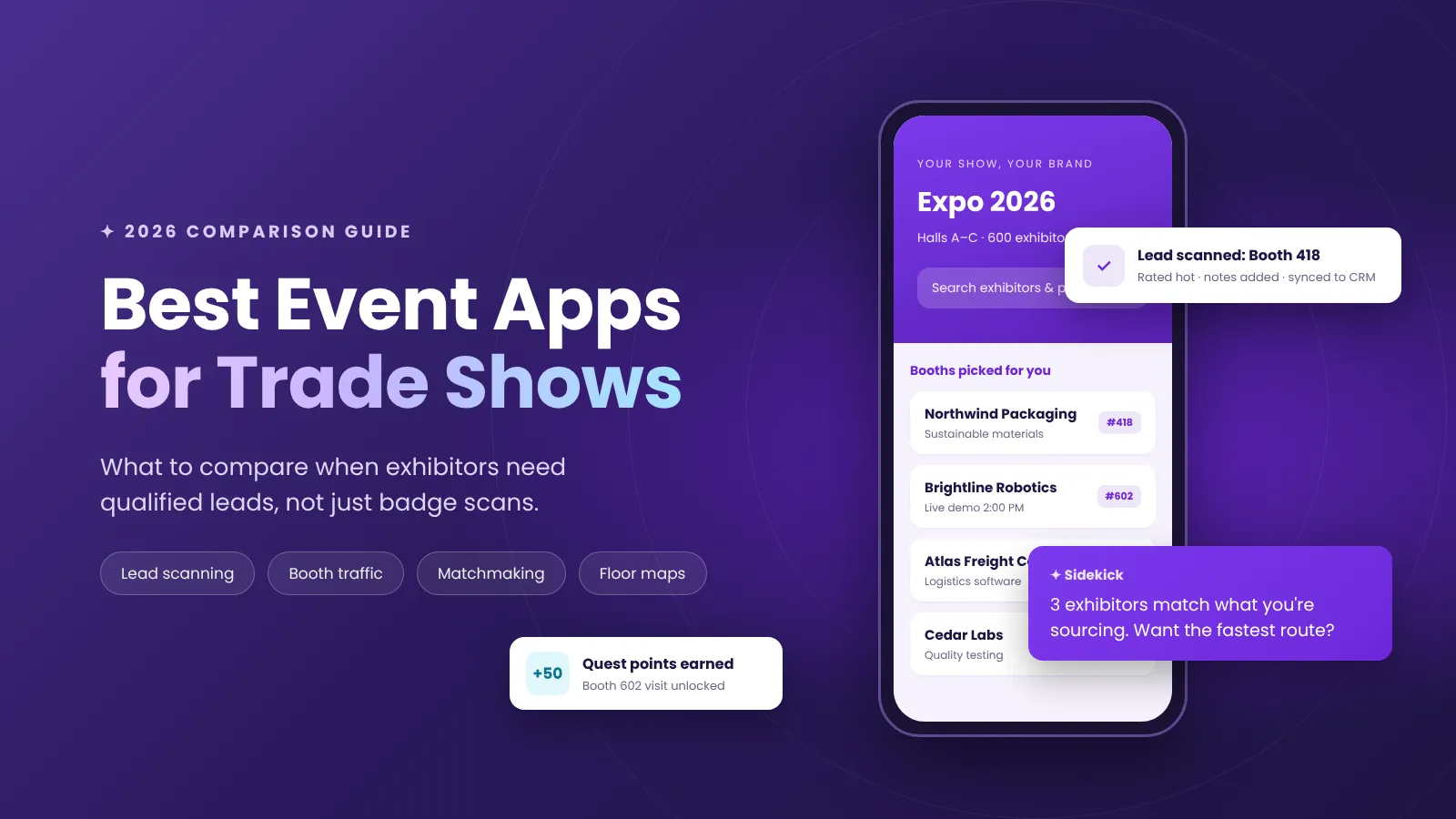
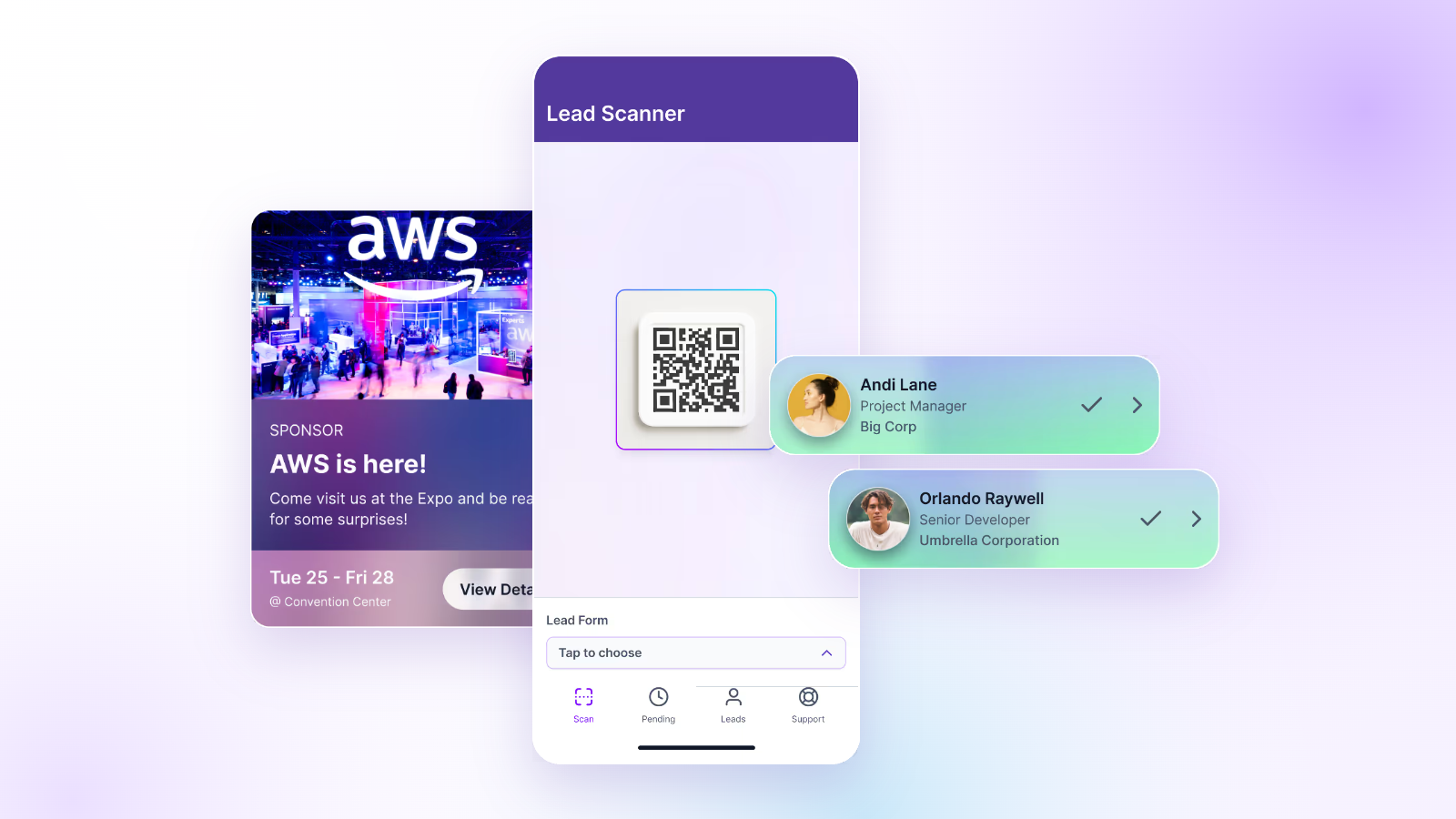
Traditional badge scanning captures name, title, and company. A modern lead retrieval app lets exhibitors add two or three qualifying questions to the scan itself: budget, timeline, use case, current tools. A scan with three qualifying data points is a real lead. A scan without them is a guess. This is the core of good trade show lead capture, and it's the single fastest way to raise lead quality without adding booth staff.
6. Session-based lead capture
When an attendee opts into a sponsor-hosted session, breakout, or workshop, that's an intent signal. Capture it. Session opt-ins are consistently the highest-converting lead source at professional conferences because they self-qualify on topic.
7. AI-matched intro requests
AI matchmaking inside the event app can surface the right sponsor-attendee pairs based on role, interests, and session behavior. When done well, it feels less like a sales pitch and more like a well-informed colleague pointing out someone worth meeting. Amego's Sidekick™ handles this at the attendee level, giving people a reason to open the app and a reason to say yes. Here's a closer look at how conference networking apps handle matchmaking and meetings.
8. Sponsor-hosted breakouts and roundtables
Some of the highest-quality leads at any event never step foot on the expo floor. They come from small-format sessions (a 20-person roundtable, a private breakfast, an invite-only workshop) where attendees self-select in and engage in a real conversation. Give sponsors the ability to host and promote these formats and the ROI on their sponsorship changes shape. It's one of the easiest ways to give sponsors and exhibitors more value than a booth alone can deliver.
9. Gamified engagement tied to sponsor booths
Gamification gets a bad name because most implementations reward meaningless clicks. When it's tied to actions that matter (visiting three target sponsors, attending a specific session, completing a qualification form) it consistently drives adoption of the exact behaviors sponsors are paying for. Amego's Quest is built around this principle.
10. Digital badges and QR contact exchange
Attendees exchanging digital contact info with a QR-scan in the app captures a cleaner, more usable contact record than a business card ever did. It also creates a mutual opt-in signal, which matters for GDPR and CAN-SPAM compliance in the follow-up.
11. Real-time lead alerts to sponsor teams
Sponsors staffing a booth need to know when a target account is engaging. A timely nudge to the sponsor's on-site rep when a matched attendee visits the booth, joins their session, or engages with their content is the fastest, cleanest way to turn intent into conversation. This works best when the event app, the lead retrieval tool, and the sponsor CRM share data.
Post-Event Plays (The Two Weeks That Decide ROI)
A big share of event pipeline is lost in the two weeks after the doors close. Not because the leads weren't there, but because follow-up was slow, generic, or delegated to the wrong person. The post-event window is where average programs and great programs separate, and it's also where sponsors decide whether to renew. Our sponsor ROI guide covers what sponsors expect to see in that post-event report.
12. 48-hour warm follow-up
The first 48 hours are the highest-signal window for follow-up. Attendees still remember the conversation. Their calendars aren't buried in unread email yet. A short, specific, personalized message referencing the actual conversation (not a template) has meaningfully higher response rates than the same message sent seven days later.
13. Session-recording gated re-engagement
Session recordings that require a form submission to view give you a second bite at the apple. Attendees who missed a session (or who want to send the recording to a colleague who missed it) become a warm, self-qualified lead source in the weeks after the event. It works best when sessions are available live and on demand in the same app attendees already use.
14. ABM re-targeting from event engagement data
The people who engaged with your event (attended sessions, visited booths, watched recordings) are the raw material for a post-event ABM campaign. Feed that engagement data into your ad platforms and your outbound tools, and you're marketing to accounts that have already told you they care.
What Separates a Warm Lead From a Wasted Scan
A few things consistently separate the leads that convert from the ones that die in Salesforce.
The lead has qualification data attached. Name, title, and email alone isn't a lead. It's a contact record. Real leads carry at least one qualifying signal: budget, timeline, current tools, or explicit interest in a specific use case.
The follow-up references the actual conversation. "It was great to meet you at the event" is not a follow-up. "You mentioned your team is evaluating replacements for [tool] before Q1" is a follow-up. The specificity has to survive the handoff from on-site to sales.
The lead was captured with consent. Compliance matters, and so does trust. Attendees who explicitly opted in (through a session scan, a booth interaction, or a QR exchange) convert at higher rates than attendees who were passively scanned.
The lead reached sales in under 48 hours. Speed of follow-up is one of the strongest predictors of conversion. Every day of delay compounds against you.
The lead matches the ICP. A room full of the wrong people generates a lot of scans and no revenue. Registration filters and matched-account tagging matter more than any on-site tactic.
How to Choose a Lead Retrieval App for Exhibitors
Plays 5, 6, 10, and 11 all depend on the lead capture tool your exhibitors use on the floor. A lead retrieval app is the tool sponsors and exhibitors use to scan attendee badges, qualify leads, and send that data to their sales team. Here's what to look for.
- Custom qualification per sponsor. Each exhibitor should be able to build its own questions, tags, and rating scales, not share one generic form.
- Offline scanning. Expo hall Wi-Fi fails. Scans should keep working without a connection and sync once the device reconnects.
- Bring your own device. Exhibitors shouldn't need to rent hardware. Scanning should work on the phones booth staff already carry.
- CRM and marketing automation sync. Leads should flow to Salesforce, HubSpot, or the sponsor's system of choice without CSV exports.
- Team controls. Booth managers need to see who on their team scanned whom and edit leads in real time.
- Lead analytics. Sponsors need dashboards during the event and a clean report after it.
Amego's trade show lead capture and lead retrieval app covers each of these, and it's built into the same platform attendees use for the agenda, networking, and engagement. For large exhibitor programs, see how Amego supports conventions, trade shows, and associations.
Turning Lead Data Into Sponsor ROI
Lead generation is only half the job. The other half is proving it worked. Sponsors increasingly report to demand gen teams who expect the same precision they get from digital channels, so an event that can't show lead quality has a harder time holding onto sponsors.
Report quality, not just volume. Share qualified leads, meetings held, and session opt-ins alongside total scans.
Show pipeline at 30 and 90 days. Work with sponsors to track which event leads turned into opportunities. Even an early snapshot makes the renewal conversation easier.
Include in-app visibility. Impressions and clicks on sponsor content in the event app are trackable, unlike a logo on a banner.
For the full framework, see our definitive guide to sponsor ROI at events and our guide to measuring event app ROI.
How Amego Powers Better Event Lead Generation
Amego is built to make every play above easier to run at scale. A few pieces of the platform are worth calling out.
Built-in lead scanning. Amego's lead retrieval app is built for sponsors and exhibitors. Badge scanning on the devices booth staff already carry, sponsor-specific qualifying questions, tags, and ratings, offline scanning that syncs when the connection returns, and lead data that flows to Salesforce or HubSpot. Sponsors get AI-powered lead scoring and engagement data in Amego Admin.
Sidekick™ AI companion and Sponsor Cards. Sidekick™ surfaces relevant sessions, sponsors, and people to each attendee based on their role, interests, and past behavior. Sidekick™ Sponsor Cards place sponsor content in front of attendees based on behavior and context. That translates into higher-quality booth visits and meeting requests without the sponsor having to hard-sell.
Structured networking and 1:1 meeting scheduling. Pre-event, on-site, and post-event, attendees can request and book meetings directly in the app. Sponsors get a way to fill their calendars with the right accounts before the doors open.
Quest gamification. Quest rewards attendees for the behaviors that drive lead generation: visiting target sponsors, attending qualifying sessions, and completing meaningful interactions. It's designed to look like a game and produce like a lead-gen engine.
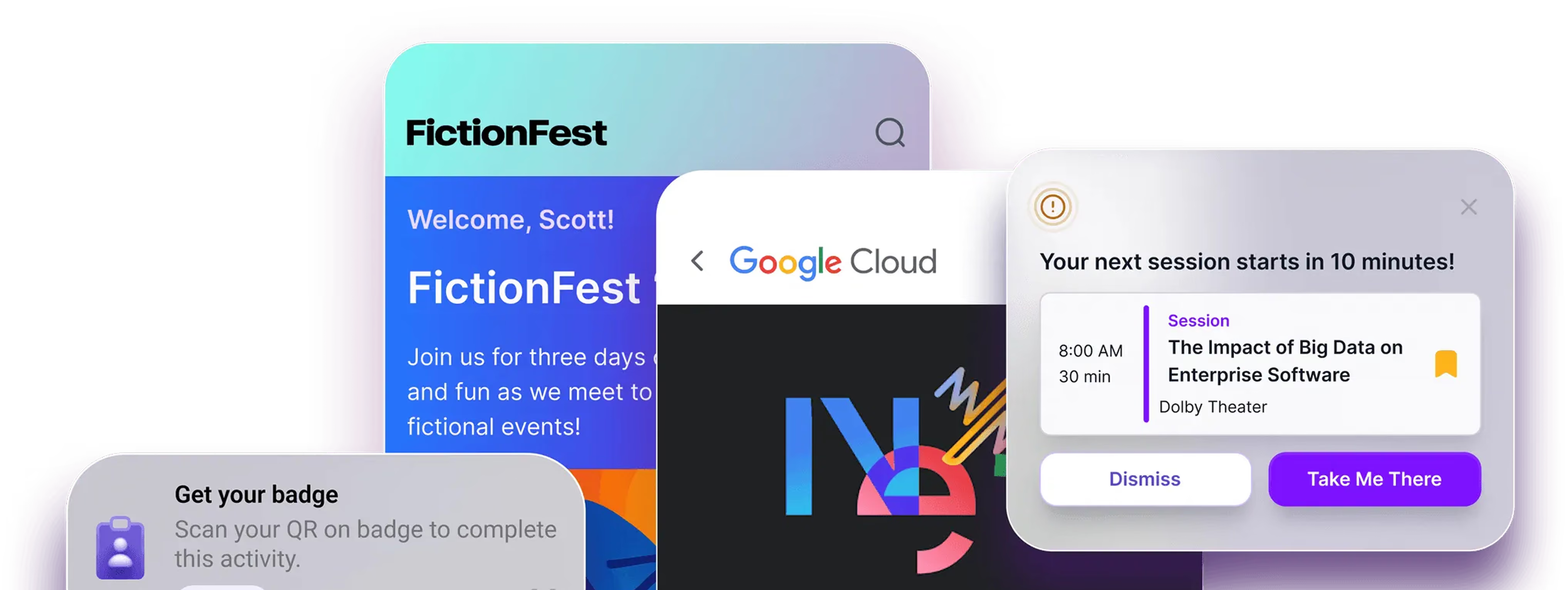
Real-time push notifications. Targeted push notifications sent from Amego Admin let your team reach attendees the moment something is worth acting on: a sponsor session with open seats, a limited-availability roundtable, or a booth activation starting in ten minutes.
Native integrations with the tools you already use. Amego connects with Cvent, RainFocus, Swoogo, and Salesforce, so lead data flows into the CRM and marketing automation platforms your revenue team is already running. No CSV exports, no manual re-typing.
Learn more about Amego for sponsors and exhibitors, or see how enterprise event teams use these tools together in Cloudflare's success story or Atlassian's event app success story.
FAQs
What is event lead generation?
Event lead generation is the set of tactics that turn attendees, sponsors, and audiences reached before, during, and after an event into qualified pipeline for sales. It covers pre-event outreach (registrant enrichment, meeting requests, content-driven registration drivers), on-site capture (badge scans, session opt-ins, gamified engagement, AI-matched intros), and post-event follow-up (warm outreach, gated content, ABM re-targeting).
How do you measure event lead generation ROI?
The most useful metrics are qualified leads generated (contacts with real qualification data attached), pipeline sourced (opportunities created from event contacts), and pipeline influenced (deals that touched event content or attendees at any stage). Vanity metrics like total scans and total registrations matter far less than the percentage of contacts that hit your ICP and moved into sales-accepted opportunities.
What's the difference between event marketing and event lead generation?
Event marketing is the broader discipline of using events to build brand, drive awareness, and engage audiences. Event lead generation is the pipeline-focused subset: turning that engagement into qualified contacts that sales can act on. Every event marketing program should have a lead generation strategy, but they're not the same thing.
How much of event lead generation should be pre-event vs on-site?
For enterprise events with target-account motions, the split is roughly 30% pre-event, 50% on-site, 20% post-event in terms of where the highest-quality leads come from. Pre-event and post-event get less attention than they should because most teams focus their planning cycles on what happens inside the venue.
What is a lead retrieval app?
A lead retrieval app is software that sponsors and exhibitors use to scan attendee badges at an event, add qualifying details like budget, timeline, or use case, and send those leads to their CRM. The best lead retrieval apps work offline, run on booth staff's own phones, and let each exhibitor build custom qualification questions.
What is trade show lead capture?
Trade show lead capture is the process exhibitors use to collect and qualify contact information from attendees who visit their booth or sessions. Modern trade show lead capture replaces business cards and paper forms with badge scanning, digital qualification forms, and automatic CRM sync so leads reach sales within hours instead of weeks.
How do sponsors get better leads at events?
Sponsors get better leads when three things are true: the event has the right audience (fit matters more than volume), sponsors have tools to add qualification data at capture, and follow-up happens fast and personally. Great event platforms make all three easier. Weak platforms leave sponsors with a pile of contacts and no context.
Ready to see how Amego drives better event lead generation and lead capture for your sponsors and exhibitors? Talk to our team.

Sign up for our newsletter
Get insights delivered to your email.