
Every event team has moments when the wheels come off. Someone assumed someone else was owning the speaker gifts. A room got double-booked. The sponsor lead capture never got tested. On-site staff show up to a run of show that got updated three times in the shared doc without anyone telling them.
The teams that produce great events consistently aren't the ones with the fewest crises. They're the ones with the clearest roles, the tightest handoffs, and the shared tools that keep everyone looking at the same version of the truth. That's what "collaboration" actually means in event management. It's not a soft skill. It's an operating system.
Nowhere is that clearer than in event schedule management. The agenda touches every function on the team, and it changes constantly right up to the moment doors open. Here's how professional event teams are structuring, communicating, and tooling themselves in 2026, including how they handle conference agenda management without losing control of the schedule, and what breaks down when they don't.
Why Event Teams Break Down
Most breakdowns look like people problems and are actually structure problems. A few of the patterns that repeat across event teams of every size:
Unclear ownership. Two people think they own the sponsor deck. Neither does it. Or one person thinks they own it and the other quietly does it in parallel. Both versions cost you.
Information lives in someone's head. The speaker's dietary restriction is only known to the person who onboarded them. The change to the registration flow only lives in a Slack DM. When that person is unreachable at 7am on show day, the information may as well not exist.
Version confusion in the run of show. The doc lives in seven places. Marketing has one version. Ops has another. On-site staff printed a third yesterday. Speakers are getting emails referencing a fourth. The same thing happens to the agenda: a session moves rooms, the change lands in one spreadsheet, and attendees find out when they walk into the wrong room.
Late escalation. Something goes sideways at 10am. The person closest to it tries to fix it themselves for four hours. By 2pm it's a fire nobody can put out. The pattern usually isn't stubbornness, it's that the escalation path was never clearly defined.
Silos between marketing, ops, and sales. Registration data lives with marketing. Attendee experience lives with ops. Sponsor delivery lives with sales. When those three don't talk in a structured cadence, the seams show up in the attendee experience.
The Roles That Belong on a Modern Event Team
Team sizes vary. A team of three running a 500-person conference wears every hat. An enterprise team running a 15,000-person flagship might have a dedicated person for every function below. Regardless of size, the responsibilities still need to live somewhere on the team.
Program lead or event director
The single owner for the whole program. Sets goals, arbitrates trade-offs, owns the timeline, and holds the cross-functional standups together. Great program leads are unusually good at making decisions quickly and defending them clearly. When there's no program lead, decisions stall by committee.
Marketing and comms
Owns pre-event demand generation, registration comms, on-site brand experience, and post-event promotion. Marketing usually holds the registration platform and the email tool. When marketing and ops aren't tightly integrated, attendees get contradictory information from different channels.
Operations and logistics
Owns venue, F&B, production, staffing, transportation, and the run of show. Ops is the function that makes the event actually happen physically. In-house ops teams often carry more institutional knowledge than any other function, so keeping that knowledge documented (not just in people's heads) matters.
Content and speaker experience
Owns session design, speaker recruitment, agenda development, rehearsals, and content quality. On most teams, this function also owns conference agenda management: building the tracks, locking session times and rooms, and approving changes once the schedule is live. This role also owns speaker communications, which is a bigger job than most teams initially budget for.
Sponsor and partner management
Owns sponsor sales, sponsor delivery, and sponsor renewal conversations. The most important handoff on any event team is between sponsor sales (who closes the deal) and sponsor delivery (who executes it). When those are the same person, keep them. When they're different people, invest in the handoff.
On-site staffing and volunteer coordination
Owns registration, wayfinding, session support, and attendee assistance during the event. This role is often under-resourced relative to how much of the attendee experience it shapes. Great on-site staff are the difference between an event that runs and an event that shines.
Technology and platform lead
Owns the event management platform, the event app, integrations, and any custom tech (badge printing, session capture, live streaming). At larger events, this is a dedicated role. At smaller events, it's shared between marketing and ops. Either way, someone needs to be the accountable owner or the tech stack rots.
Analytics and reporting
Owns instrumentation, dashboards, and the post-event report. This role is often skipped and then wished for at the end. Even a single person spending 20% of their time on analytics across the lifecycle materially improves the quality of every program-level decision.
The Handoffs That Determine Everything
The moments where work moves from one function to another are where events succeed or fail. Five handoffs deserve explicit attention.
Marketing to ops (registration to on-site). The registration list, session preferences, dietary needs, accessibility requirements, and VIP tags all need to reach ops cleanly. A weekly sync in the final month, and a shared source of truth for the registration data, prevent 80% of on-site confusion.
Sponsor sales to sponsor delivery. Every sponsor commitment closed by sales needs to be documented in a place that the delivery team can execute against. A "sponsor commitments log" (booth size, session slot, brand placement, meeting quota, lead capture setup) shared between sales and delivery is one of the highest-ROI docs an event team can maintain.
Content team to speakers. Speakers need to know their room, their tech, their rehearsal time, their run of show, and their point of contact. Speaker experience is a leading indicator of session quality, and session quality drives NPS. Underinvesting here shows up in attendee feedback three weeks later.
Agenda owner to everyone else. Every schedule change affects someone downstream. Ops needs to know about room swaps, marketing needs to know before promoting a session, sponsors need to know if their slot moved, and attendees need to know before they walk to the wrong hall. Agree in advance on who can change the agenda and how each change gets communicated. Most of the event fails a schedule builder could have prevented start as a broken handoff, not a bad schedule.
On-site to post-event. Everything that happens on-site needs to feed the post-event report and the next event's plan. This is the handoff that's easiest to skip when the team is exhausted at the end of the event. Building an on-site data capture protocol into the run of show prevents the loss.
Who Owns Event Schedule Management?
The agenda is the most shared artifact an event team has. Content builds it, ops stages it, marketing promotes it, sponsors plan around it, and attendees live by it. That's exactly why event schedule management falls apart when everyone can edit it and nobody owns it.
Name one agenda owner. Usually this sits with the content lead or the program lead. Other functions can request changes, but one person approves them and keeps the master schedule accurate. Shared visibility is good. Shared editing without an owner is how double-booked rooms happen.
Set a change protocol before the agenda goes live. Decide what counts as a minor change (a speaker title fix) versus a major one (a session moving rooms or days), who needs to sign off on each, and which teams get notified. Write it down and share it at kickoff so nobody is inventing the process at 8am on show day.
Plan for multi-track complexity. Conference agenda management gets harder with every track you add. Parallel sessions, room capacity, pre-registered enrollment, and speakers who present twice all create dependencies. Look for an agenda builder with multi-track scheduling, real-time updates, and personalized schedules built in, so the tool handles the conflicts instead of your team catching them by hand.
Publish from one source. The agenda in the event app, on the event website, on digital signage, and in the speaker packet should all come from the same place. With a centralized agenda and content library, one update to a session time, room, or speaker syncs to every attendee instead of starting a scramble to update five copies.
Freeze what you can, communicate what you can't. Many teams set a soft agenda freeze one to two weeks before the event. Changes after that point still happen, but they go through the owner, and attendees hear about them through a targeted push notification rather than discovering them on-site.
Meeting Cadence and Rituals That Actually Work
Meeting cadence for professional event teams doesn't need to be complex. It needs to be consistent. The rhythm that works for most enterprise teams:
Weekly cross-functional standup (30 minutes). Every function gives a two-minute status. What's on track, what's at risk, what needs a decision this week. Attended by program lead, marketing, ops, content, sponsors, and tech. Ruthlessly time-boxed.
Bi-weekly function-specific working sessions (60 minutes each). Deeper work sessions inside each function. Program lead attends the ones with active decisions on the table.
Weekly speaker check-ins in the final month. Content team runs these. Speakers appreciate them. Rehearsals reveal problems while there's still time to fix them.
Daily standup during show week (15 minutes, twice a day). Morning standup at 7am to align on the day's run of show and hot issues. End-of-day debrief at close to capture what happened, what needs to change tomorrow, and what needs escalation.
Post-event retrospective (90 minutes, two to three weeks after). Structured. What worked, what didn't, what would we do differently. Documented, and referenced in the next event's kickoff. Without this ritual, the same problems recur every event.
Shared Tooling Beats Individual Heroics
Great event teams are held together by shared tools that keep everyone looking at the same source of truth. When the tools work, individual heroics become less necessary. When the tools don't, teams paper over the gaps with people, which is expensive and eventually unsustainable.
The shared tools that matter most:
One source of truth for the run of show. Not seven docs. Not a slide deck plus a spreadsheet plus a Notion page. One live document that everyone edits and everyone references, versioned so nobody's working off a printed copy from yesterday.
One source of truth for the agenda. The attendee-facing schedule should live in your event platform, not in a spreadsheet that someone re-keys into the app. When the platform is the master copy, event schedule management becomes a single update instead of a chain of them.
One source of truth for attendee data. Registration data, session preferences, VIP tags, and dietary needs live in one place. Everyone who needs a view has one, and updates propagate. This is where a native integration between the registration platform and the event app makes a real difference.
One shared calendar for the team. Every deadline, every meeting, every ownership handoff visible to the whole team. Nobody surprised by what's due tomorrow.
A shared communication channel with clear norms. Slack, Teams, or the equivalent, with agreed norms about what goes in DMs, what goes in channels, what warrants a mention. During show week, a dedicated on-site ops channel with fast escalation paths.
A shared analytics dashboard. Registration pace, session ratings, app engagement, sponsor leaderboards, and NPS all visible in one place, updated in real time, accessible to the whole team.
If you're not sure where your gaps are, our guide to what every event tech stack needs walks through how to audit it.
How Amego Supports Team Collaboration
Amego is designed to reduce the coordination overhead that eats into event teams. A few pieces of the platform worth calling out.
Amego Admin as the shared source of truth. Sessions, speakers, sponsors, attendees, and content all live in Amego Admin. Marketing, ops, content, and tech leads all work in the same CMS, with role-based permissions. Updates propagate to the app in real time, so there's no "the app version is out of date" moment.
Conference agenda management built for complex programs. Amego's Agenda & Content Library handles multi-day, multi-track schedules, session capacity, enrollment, speakers, and supporting content from one centralized CMS. When your team changes a session time, room, or speaker, the update syncs instantly in the app. Attendees build their own schedule with My Agenda and can sync it to Apple, Google, or Outlook calendars.
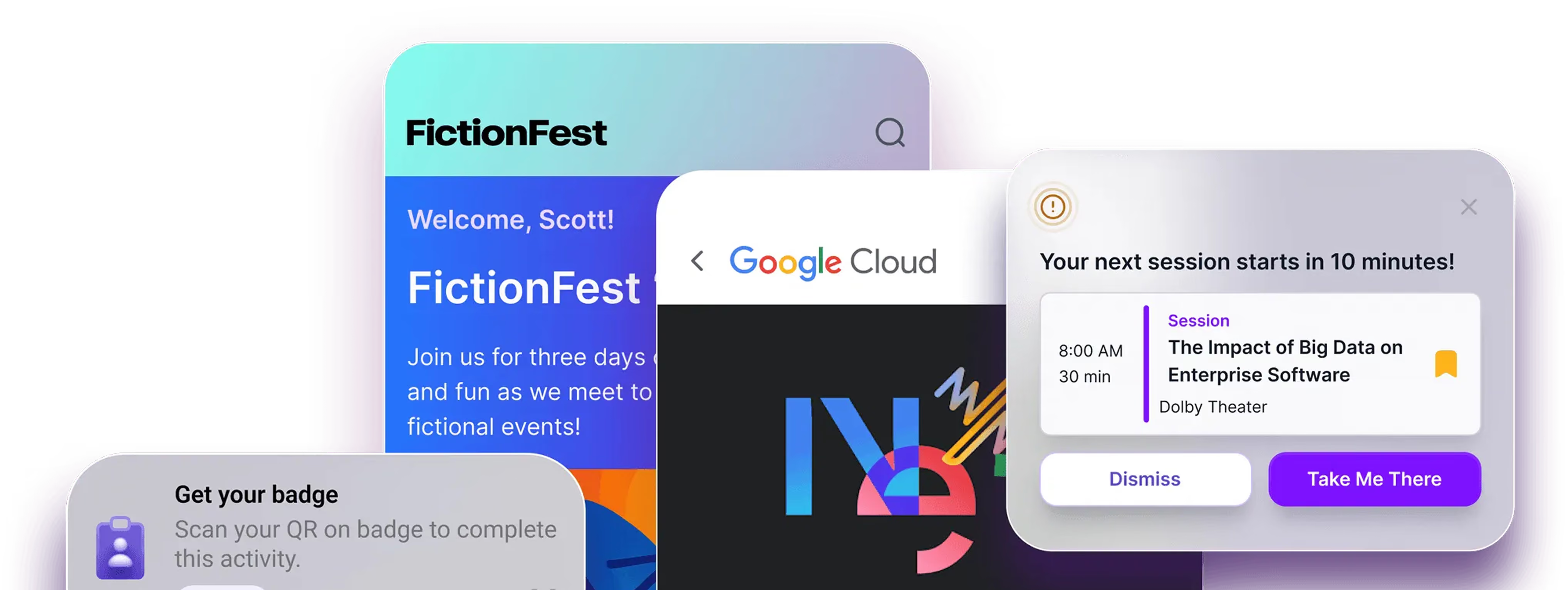
Real-time push notifications for on-site coordination. Your team can push targeted notifications to attendees or subsets of the team without waiting for a developer. When a session moves rooms at 9:30am, the update goes out at 9:31am from a laptop in the back of the room.
Native integrations with your registration and CRM stack. Amego connects with Cvent, RainFocus, Swoogo, and Salesforce. Attendee data flows without CSV exports. Sponsor data flows to sales without manual re-entry. Analytics flow to your BI tools.
Live analytics your whole team can see. Session ratings, app engagement, sponsor leaderboards, and NPS all live in Amego Admin dashboards, updated in real time during the event. Program leads see what's happening, ops sees what to escalate, sponsors see how they're performing.
Built for enterprise event teams. Large programs bring more audiences, denser agendas, and more people touching the schedule. Amego's enterprise events solution adds audience segmentation, enterprise integrations, and security built for high-stakes conferences. For a closer look, see how enterprise events use mobile apps at scale.
White-glove partnership from a team that's been in your seat. Amego is built by event pros, for event pros. When a launch weekend goes sideways, our team picks up. See how Enterprise Events Group has built partnership with Amego or how Cloudflare unifies global event experiences with our team.
FAQs
What roles belong on an event management team?
At minimum: a program lead who owns the whole event, marketing and comms, operations and logistics, content and speaker experience, sponsor and partner management, on-site staffing, technology and platform, and analytics and reporting. Smaller teams combine these roles across fewer people. Larger teams have dedicated owners for each.
How big should an event management team be?
It depends on event size and format, but a rough guide: a 500-person conference can be run by three to five people if they're experienced. A 5,000-person conference typically needs eight to twelve. A 15,000-person flagship event usually involves a core team of fifteen to thirty, supplemented by agencies and on-site staff.
What's the most important collaboration ritual for event teams?
The weekly cross-functional standup, held throughout pre-event. Thirty minutes, every function gives a two-minute status, decisions surface fast, blockers get named. Teams that maintain this ritual consistently avoid most of the coordination breakdowns that cost time on-site.
Where do event teams most often break down?
At the handoffs. The most common breakdowns are between sponsor sales and sponsor delivery, between marketing (registration) and ops (on-site experience), and between on-site data collection and post-event analysis. Investing in explicit handoff processes and shared tools prevents most of these.
Who should own event schedule management on an event team?
One named agenda owner, usually the content lead or program lead. Other functions can request changes, but a single owner approves them, keeps the master schedule accurate, and makes sure every change reaches ops, marketing, sponsors, and attendees.
What is conference agenda management?
Conference agenda management is the process of building, publishing, and updating an event's schedule of sessions, speakers, rooms, and tracks. For multi-track conferences it also covers session capacity, enrollment, and real-time changes, ideally managed from one platform that syncs every update to attendees instantly.
How does the event platform affect team collaboration?
The platform is the shared source of truth for content, attendees, sessions, and analytics. A platform that keeps all functions looking at the same data reduces coordination overhead dramatically. A platform that requires exports and re-entry between tools makes coordination someone's full-time job.
Ready to see how Amego simplifies event schedule management and reduces coordination overhead for enterprise event teams? Talk to our team.

Sign up for our newsletter
Get insights delivered to your email.