
Table of Contents:
- What Is the Event Management Lifecycle?
- Event Planning Timeline: What Happens When
- Pre-Event: Planning, Building, and Preparing
- During the Event: Executing at Showtime
- Post-Event: Analysis, Follow-up, and Reporting
- The Handoffs Between Phases That Break Programs
- How the Lifecycle Changes by Event Type
- How Amego Fits Across the Event Management Lifecycle
- FAQs
Every professional event has three lives. The one people plan for months in advance. The one that plays out on-site over two or three intense days. And the one that quietly determines whether the whole program was worth it, the two weeks after the doors close.
The event management lifecycle is the framework professional teams use to keep all three of those lives connected. When it works, an event feels seamless from the registration email to the post-event report. When it doesn't, something breaks between the phases: a registration list that never made it into the app, a sponsor promise that got lost between planning and on-site, an insight from post-event data that never fed the next event's brief.
Whether you're running a 15,000-person enterprise conference, a trade show, a sales kickoff, or a multi-city roadshow, the event planning process follows the same three phases. Here's what each phase covers, a realistic event planning timeline, how the lifecycle shifts by event type, who owns what, and where the seams most often show.
What Is the Event Management Lifecycle?
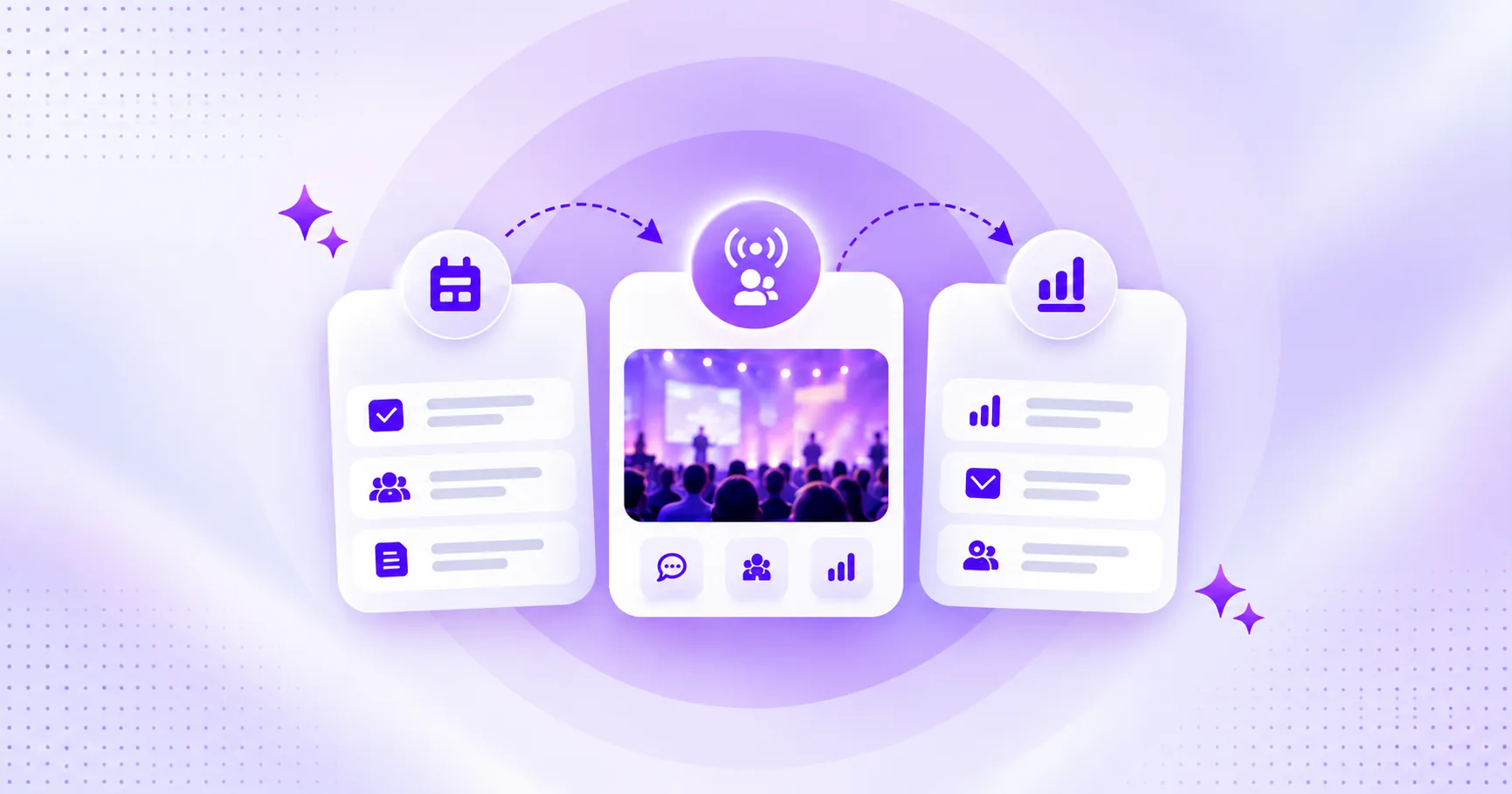
The event management lifecycle is the end-to-end sequence of work that runs from the first strategic decision about an event through the final post-event report. It has three phases: pre-event (planning and preparation), during-event (execution and delivery), and post-event (analysis and follow-up). You'll also see it called the event planning process or the phases of event management. The labels differ, but the structure is the same.
Most teams instinctively focus on the middle phase because it's the most visible. The event is either happening or it isn't. But the leverage sits at the seams. Pre-event decisions determine what's possible on-site. Post-event work determines what gets repeated, improved, or scrapped for next time. Teams that treat all three phases as one continuous program consistently produce better events than teams that treat each event as a standalone project.
Event Planning Timeline: What Happens When
Every program is different, but most professional conferences and corporate events follow a similar event planning timeline. Use this as a starting point and compress it for smaller events.
- 9–12 months out: Set goals, budget, and success metrics. Shortlist venues and lock dates. Open sponsorship sales.
- 6–9 months out: Sign the venue. Choose your event tech stack, including registration and the event app. Issue the call for speakers.
- 4–6 months out: Open registration. Build the first version of the agenda. Close anchor sponsors and document every sponsor commitment.
- 2–3 months out: Lock keynotes and most sessions. Start app configuration and branding. Finalize F&B, production, and staffing plans.
- 3–4 weeks out: Launch the event app so attendees can build their schedule and request meetings. Run QA on every app feature and integration.
- Show week: Run check-in, real-time agenda updates, engagement, sponsor delivery, and data collection. Hold twice-daily team standups.
- 0–48 hours after: Send leads to sales and sponsors, send thank-you messages, and open post-event surveys.
- 2–4 weeks after: Deliver the post-event report, run the retrospective, publish session recordings, and start sponsor renewal conversations.
For a structured way to handle the pre-launch testing step, grab our event app QA checklist and issue tracker.
Pre-Event: Planning, Building, and Preparing
Pre-event is the longest phase and the one with the widest surface area. For an enterprise conference, it can run six to twelve months. The work breaks into six threads that usually run in parallel.
Strategy and goals
Every event starts with a set of goals. Pipeline, brand, customer retention, community, product education. The clearer the goals are up front, the more coherent every downstream decision becomes. Vague goals ("engagement" as a single word) produce vague events. Specific goals produce sharper choices about content, format, and measurement.
Budget and procurement
Budget conversations shape the whole program. Venue, F&B, production, technology, staffing, travel, and sponsorship revenue all model against one another. This is where most first-time teams get surprised, and where experienced teams build in the contingency the venue's force majeure clause will eventually eat.
Registration and marketing
Registration opens the funnel. Marketing fills it. This is where the event management platform stack matters most: a registration platform that captures the right data, an email tool that segments it, and a comms plan that reaches attendees in the moments they'll actually read something. If you're still choosing tools, our comparison of the best event registration platforms is a good place to start.
Content and speakers
Sessions, tracks, keynotes, and workshops all get built during pre-event. The content team owns speaker outreach, prep, and rehearsals. Content decisions locked in early become production decisions later, which is why last-minute agenda changes are expensive in a way that early agenda changes are not. Building the agenda in an agenda and content library that syncs directly to the app keeps those late changes from turning into a manual scramble.
Sponsors and exhibitors
Sponsor deals close in pre-event, and sponsor deliverables (booth locations, session slots, brand placements, lead capture setup) all get built out here. This thread often breaks under handoff pressure because the salesperson who closed the deal isn't always the one delivering on it. Our sponsor ROI guide covers what sponsors will expect you to report on, which should shape what you build now.
Tech stack and app build
The event app, the check-in system, the on-site engagement tools, the analytics, and the integrations between them all get configured in pre-event. Content gets loaded. Branding gets applied. Test events get run. The teams that release the app three to four weeks before showtime get meaningfully better adoption than teams that release it in the final week. See our guide to improving event app adoption rates for more on this window. For a category-by-category view, see our guide to the best event planning tools for conferences and corporate events.
During the Event: Executing at Showtime
During-event is the phase everyone associates with the word "event." It's also the phase where months of planning either pay off or unravel in a hurry. There are six pieces of the work happening simultaneously.
Check-in and arrivals
The first attendee touchpoint sets the tone for the rest of the event. Fast, warm, well-staffed check-in with badge printing that actually works signals a professional experience. Slow, confused check-in with a broken printer signals the opposite. Attendees form their opinion of your event in the first ten minutes. Comparing options? Here are the best badge printing platforms for events.
Real-time updates and content management
Rooms change. Speakers cancel. Sessions run long. The team that can update session details, room assignments, and speaker bios from the back of a session room, without waiting for a developer, is the team that keeps attendees oriented. This is what a professional event app and a CMS like Amego Admin give you.
Attendee engagement
Live polling, Q&A, session ratings, gamification, and networking all happen during the event and all need to actually work in the room. Engagement features that require attendees to switch apps or scan an external code lose the moment. Native features inside the event app win it. Here's more on using event apps for live polling, feedback, and engagement.
Sponsor delivery
Sponsors paid for specific outcomes: booth traffic, qualified leads, brand visibility, meetings with target accounts. Delivering on those outcomes is a during-event workstream, not a set-and-forget one. Live sponsor leaderboards, real-time lead alerts, and mid-event check-ins with sponsor teams are the tactics that keep renewals healthy. On the expo floor, a lead retrieval app with custom qualifying questions gives exhibitors leads they can actually act on.
Attendee support
Attendees will get lost. They'll want to reschedule a meeting. They'll need to know where lunch is. Sidekick™, on-site staff, and clear in-app help resources cover this so your team can focus on the higher-value work.
Data collection
Everything that happens on-site is a data point for post-event. Session check-ins, app engagement, networking activity, sponsor visits, poll responses, and NPS scores all get collected in real time. Teams that instrument this well have the material for a strong post-event analysis. Teams that don't spend two weeks after the event manually reconstructing what happened.
Post-Event: Analysis, Follow-up, and Reporting
Post-event is the phase most under-resourced by most teams. It's also the phase that determines whether the event's investment shows up in the business. Five threads matter.
Analytics and reporting
Registration numbers, attendance, session ratings, app engagement, NPS, sponsor performance, and pipeline sourced or influenced all need to be pulled together into a report the business can act on. The best post-event reports link event performance to business outcomes, not just event metrics. Our guide to measuring event app ROI walks through the metrics and formula.
Follow-up and lead handoff
Attendees leave the event with a warm impression that fades fast. The first 48 hours are the highest-signal window for follow-up. Leads captured on-site need to be in sales' hands, with context, before Monday morning. Anything slower and the pipeline conversion drops noticeably.
Content repackaging
Session recordings, keynotes, and workshop content have a second life as post-event marketing assets. Gated recordings drive lead generation. Highlights become social content. Speaker interviews become blog posts. The teams that plan the content-to-marketing pipeline in pre-event get a much better ROI on the content investment. Keeping sessions available live and on demand inside the app extends that second life.
Retrospective and learnings
A structured retrospective (what worked, what didn't, what would we change) two to three weeks after the event captures the operational learnings while they're still fresh. Skipping this step is why the same problems show up at every event.
Renewal and next-event planning
Sponsor renewals, attendee-to-registrant conversion for the next event, and continued audience engagement all sit in post-event. This is where the current event feeds directly into the next one, closing the loop.
The Handoffs Between Phases That Break Programs
The seams between phases are where most events lose value. A few of the common failure modes:
Registration data doesn't reach the event app cleanly. Attendee names, sessions, and preferences captured in registration end up needing manual re-entry into the app. This is the most preventable handoff problem, and it's the one that reliably shows up when the registration platform and the event app aren't natively integrated.
Sponsor promises get lost between sales and delivery. The salesperson who closed the sponsorship deal makes a commitment ("your booth will have prominent stage-side placement, and you'll get 50 pre-scheduled meetings") that the on-site team doesn't know about. Sponsors notice.
On-site engagement data doesn't feed post-event analysis. Session ratings, poll responses, and networking activity are captured on-site and then don't make it into the post-event report. The event feels like it went well, but the team can't say why, or repeat it.
Post-event insights don't feed the next event's brief. The retrospective happens. The learnings get documented. And then the next event starts and nobody reads the doc. This is a process problem, not a tooling problem, but it's often the one with the biggest cumulative cost.
How the Lifecycle Changes by Event Type
The three phases stay the same across every event type. What changes is where the pressure lands. Here's how the event planning process shifts for the formats professional teams run most often.
Enterprise conferences and user summits
Long pre-event cycles, multi-track agendas, heavy sponsor programs, and thousands of attendees. The pressure is on content management and scale: the agenda changes constantly, and the app has to stay accurate for everyone at once. See how Amego supports enterprise events.
Trade shows, conventions, and association meetings
Exhibitors and sponsors are a core revenue line, so sponsor setup in pre-event and lead capture during the event carry more weight than at almost any other format. Hundreds of exhibitors means sponsor delivery becomes its own workstream. Learn more about Amego for conventions, trade shows, and associations.
Internal events, sales kickoffs, and incentive trips
Registration is usually simpler because the audience is known, but personalization matters more. Different roles, regions, and departments need different agendas and communications, and employee data needs tighter security. See how Amego supports internal events, kickoffs, and incentives.
Field events and multi-city tours
The lifecycle repeats many times on a compressed timeline. A roadshow might run the full pre, during, and post cycle a dozen times in a quarter, so reusable templates and consistent reporting across stops matter more than any single event. Explore Amego for field events and global tours.
Festivals and large public gatherings
Huge audiences, less predictable attendee behavior, and more reliance on real-time communication. During-event work dominates: wayfinding, schedule changes, and push notifications carry the experience. See Amego for festivals and gatherings.
How Amego Fits Across the Event Management Lifecycle
Amego is built to reduce the friction at the seams. A few pieces of the platform worth noting for each phase.
Pre-event. Amego integrates natively with Cvent, RainFocus, and Swoogo, so attendee data, sessions, and agenda content flow from registration into the app without manual re-entry. Amego Studio can help teams design and configure the app to match the event's brand, and the app is ready to release three to four weeks out.
During the event. Amego Admin is the real-time CMS your team uses on-site: update sessions, push notifications, adjust rooms, and monitor engagement without waiting for a developer. Sidekick™ helps attendees navigate the event and find the right sessions and people. Quest keeps engagement high across the day. Amego's lead scanning app gives exhibitors badge scanning with custom qualifying questions, even offline.
Post-event. The app stays live and useful for two to four weeks after the event closes, with session recordings, follow-up prompts, and survey requests inside the app rather than buried in email. Analytics flow to Amego Admin so the post-event report writes itself from real data.
Across every phase. The app, the CMS, the AI, the integrations, and the analytics all live in one platform. Data doesn't need to be re-entered between phases. See how enterprise teams have built their lifecycle around Amego in Cloudflare's success story or Atlassian's event app success story.
FAQs
What are the three phases of the event management lifecycle?
The event management lifecycle has three phases: pre-event (planning, registration, marketing, content, sponsor setup, tech stack build), during-event (check-in, real-time content updates, engagement, sponsor delivery, attendee support, data collection), and post-event (analytics, follow-up, content repackaging, retrospective, next-event planning).
What is the event planning process?
The event planning process is the sequence of work that takes an event from idea to final report. It usually runs in three phases: pre-event (goals, budget, venue, registration, content, sponsors, and tech setup), during-event (check-in, real-time updates, engagement, and sponsor delivery), and post-event (analytics, follow-up, and retrospective).
What does a typical event planning timeline look like?
For a professional conference, planning usually starts 9–12 months out with goals, budget, and venue. Registration opens 4–6 months out, the agenda and app configuration come together 2–3 months out, and the event app launches 3–4 weeks before the event. Leads should reach sales within 48 hours after, and the post-event report and retrospective land within 2–4 weeks.
How long is the pre-event phase for a professional conference?
For a professional conference, pre-event typically runs six to twelve months, with the most intense activity in the final two months before the event opens. Larger flagship conferences can start planning eighteen months out.
How does the event planning process differ by event type?
The phases stay the same, but the pressure points move. Enterprise conferences are heavy on content and scale. Trade shows and conventions put more weight on exhibitor setup and lead capture. Internal events and sales kickoffs need more personalization by role or region. Field events and roadshows repeat the full cycle many times on a compressed schedule.
Who owns each phase of the event management lifecycle?
Ownership varies by team size, but the common pattern is: an event director or program lead owns strategy and cross-phase continuity, marketing owns registration and pre-event communications, an event ops or logistics lead owns the on-site execution, and marketing and sales share post-event follow-up and reporting. On smaller teams, one or two people wear all these hats.
What's the most under-resourced phase of the event management lifecycle?
Post-event. Teams tend to spend their planning cycles on pre-event and their energy on during-event, and then arrive at post-event exhausted with only a few days to file a report and move on. Post-event is where insights compound across events, so under-investing here is where programs plateau.
How does an event app fit into the event management lifecycle?
A modern event app is active in all three phases. Pre-event, it drives adoption, meeting scheduling, and content preview. During-event, it's the primary attendee interface for schedule, navigation, engagement, and networking. Post-event, it keeps session recordings and follow-up prompts in front of attendees for two to four weeks. A platform that treats the app as a single-phase tool misses most of the value.
Ready to see how Amego reduces friction across every phase of your event planning process? Talk to our team.

Sign up for our newsletter
Get insights delivered to your email.