Comparisons
Best Zuddl Alternatives
The best Zuddl alternatives, compared for in-person events.
Subscribe for insights on AI- powered event apps, engagement strategies, and to learn more about how event teams are driving measurable results.


The Short Version
Brella is built for structured B2B meetings, so it fits best when matchmaking is the whole point of your event. Teams look elsewhere when networking is one part of a bigger experience and attendees also want help with sessions, sponsors, and the venue. This guide compares six Brella alternatives, including Amego's Sidekick.
Brella built its name on event networking. Its intent-based AI matchmaking, pre-booked 1:1 and group meetings, and table assignments make it a natural pick for events where structured B2B meetings are the main reason people show up. If you're researching alternatives to Brella, though, something about the fit probably isn't quite right.
Maybe networking is one part of the experience you're designing, not the whole thing. Maybe you want attendees to get help with sessions, sponsors, and the venue too, or your sponsors want more than a meeting calendar. Whatever the reason, this guide covers the best Brella alternatives for 2026, including the Brella competitors event teams shortlist most often. For each one, you'll see what it does well, who it fits, and the questions that separate a good match from an expensive mistake.
For a broader view of the category, see our roundup of the best event apps of 2026, and our guide to event networking strategies and technologies if networking is your top priority.
These are the event networking platforms worth a look, from full attendee experience apps to matchmaking-first tools. We've listed Amego first because it's our product, and we'd rather say that up front. The other five are real options, and each one wins in the right situation.
Brella is a focused, capable product, and teams that live and die by scheduled meetings are often happy with it. It does one thing well: it helps attendees decide who to meet and book the time.
The reasons teams start comparing options tend to be practical ones:
None of these make Brella a bad choice. They're the questions to answer before you renew or sign.
Head-to-head G2 data is the most useful tiebreaker when two platforms look similar on paper. Here's how verified G2 reviewers rate Amego and Brella on the measures G2 reports for both.
What G2 reviewers say
Rated Higher on What Matters to Event Teams
Here's how verified G2 reviewers rate Amego and Brella on G2.
Say it's headed in the right direction
vs. 83% for Brella
Attendee surveys satisfaction
vs. 79% for Brella
Likely to recommend
vs. 91% for Brella
Ease of setup
vs. 90% for Brella
Relationship score
vs. 84% for Brella
Quality of support
vs. 95% for Brella
Source: G2 user satisfaction ratings, 2026. Percentages reflect each product's verified G2 reviews.
Amego leads on every measure shown. Reviewers give it 100% on quality of support (vs. 95% for Brella) and on likelihood to recommend (vs. 91%). The widest gap is attendee surveys satisfaction, 98% against 79%, which is the score closest to what attendees actually feel in the app. Amego also leads on ease of setup (97% vs. 90%), relationship score (91% vs. 84%), and the share of reviewers who say the product is headed in the right direction (100% vs. 83%). G2 named Amego a Leader and awarded it Best Support and High Performer badges. Read more about our G2 Summer 2026 recognition.
Best for: Enterprise conferences, trade shows, and corporate events that want networking as part of a complete, guided attendee experience
Amego is an enterprise-grade event platform with a customizable mobile app, an AI companion called Sidekick, and a CMS called Amego Admin. It was founded in 2021 by Scott Owens, who spent years in event tech at large companies and got tired of apps that treated every attendee the same.
A typical event app is a well-organized filing cabinet. Everything is in there, and attendees are on their own to find it. Amego is built to curate the event for each person instead.
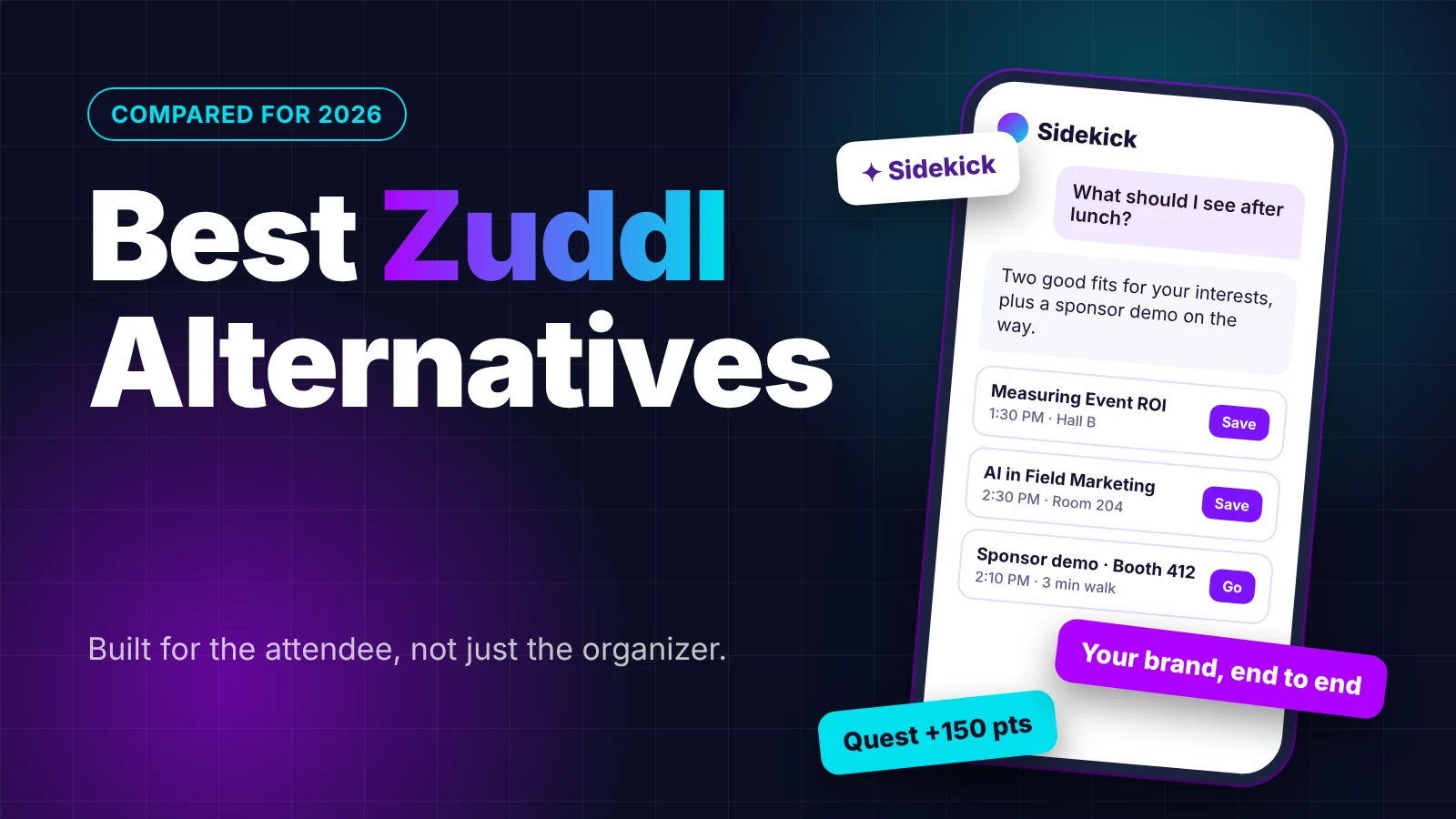
Sidekick surfaces the sessions, people, and sponsors that match what each attendee cares about, and adjusts as the day changes. Room change? Session full? Sidekick points attendees to the next best option before they have to go looking. Enterprise teams can connect their own LLM deployment if their security policy requires it.
Amego's event networking tools let attendees build a networking profile, get personalized recommendations for who to meet, message each other, schedule meetings, and swap contact info by scanning a digital badge QR code. The recommendations draw on shared interests, sessions, and goals, and keep updating as the event unfolds. The goal is to make networking something attendees plan for, not something they hope for. For more on what works, see our guide to event networking strategies and technologies.
The attendee engagement tools cover live polls, surveys, Q&A, and push notifications. Quest is Amego's native event gamification feature. Challenges can reward attendees for visiting sponsor booths, attending key sessions, completing their profile, joining activations, and answering surveys, so "we hope people visit" becomes "people visited." Every challenge also gives you data on what attendees actually did.
Amego treats sponsors as part of the attendee experience, not an interruption to it. Sidekick sponsor cards surface booths and activations at the right moment, Quest challenges send attendees to booths, and lead scanning lets exhibitors scan badges, add qualification notes, and export leads instantly.
Amego gives you control over your colors, layouts, and content across the whole app, and Amego Studio, the design services team, can take the design work off your plate. Amego also connects to registration, CRM, marketing automation, mapping, and analytics tools. Browse the full integrations list.
Sidekick Spark embeds on your event website, so attendees can ask about sessions, speakers, venue, and policies weeks before they download the app. Spark has a free plan, which makes it an easy way to try Amego with no commitment.
Both platforms give attendees an agenda, networking, meeting scheduling, sponsor tools, and lead capture. The difference is the center of gravity. Brella is built around networking, with intent-based AI matchmaking at its core. Amego is built around the whole attendee journey, with AI guidance from Sidekick, Quest gamification, and a fully branded app included in its paid plans. Amego also publishes its pricing and includes unlimited events on every plan. It is SOC 2 Type II and GDPR compliant, and supports events from 500 to more than 100,000 attendees.
Best for: Large expos and trade shows where exhibitor lead generation is the main measure of success
Swapcard is a well-known name in event networking. It offers buyer and exhibitor matchmaking, an exhibitor marketplace with sponsored ads, and year-round community features, with usage-based pricing built from license, volume, and add-ons.
Both lead with matchmaking. Swapcard leans toward exhibitor revenue and marketplace-style discovery, while Brella leans toward structured meetings between attendees. If your event is a trade show where exhibitors need to sell, Swapcard deserves a close look. We go deeper in our Swapcard alternatives guide.
Best for: Meeting-heavy B2B events built around matchmaking
Grip is another matchmaking-first platform, known for AI recommendations and meeting tools aimed at exhibitors and sponsors. Teams comparing Brella with other event matchmaking software usually put Grip on the shortlist.
The two are close cousins, so the decision often comes down to the matching experience, the sponsor tools, and pricing. Ask each vendor for a live demo with your own attendee data and compare what the recommendations look like. Details change often, so confirm current features with each vendor.
Best for: Associations and community-driven events
Whova is a broad event platform with community discussion features, meetups, built-in event management, and a wide set of engagement tools. It's popular with associations and member events where attendee interaction matters as much as the agenda.
Whova spreads across more of the event, from community to organizer tools. Brella concentrates on structured networking. If your attendees want open community conversation more than scheduled meetings, Whova may fit better. For a closer look, read our Whova alternatives guide.
Best for: B2B marketing events that want registration, websites, and the app in one suite
Bizzabo is an all-in-one event suite. It covers registration, event websites, built-in email marketing, and onsite check-in, and it offers Klik smart badges for onsite networking. It's typically sold as a multi-seat annual suite contract, with some features as premium add-ons.
Bizzabo covers more of the event lifecycle, while Brella focuses on networking. If you already have registration handled elsewhere, a focused platform may be the better fit. See our Bizzabo alternatives guide for more.
Best for: Mid-market conferences and corporate events that want one vendor
EventMobi bundles registration, badges, check-in, virtual streaming, and an event app, with onsite badge printing and check-in hardware available. Attendees open a shared app with an event code.
EventMobi suits teams that want one vendor for the logistics and the app. Brella suits teams that want networking to lead. Our EventMobi alternatives guide goes deeper.
The core event app features look similar on both sides. The biggest differences are in AI guidance, gamification, sponsor tools, and pricing flexibility. Based on public information as of October 2026, so confirm details with each vendor.
| Feature | Brella | Amego |
|---|---|---|
| Mobile event app | ✓ | ✓ |
| Personalized agendas | ✓ | ✓ |
| Push notifications | ✓ | ✓ |
| Polls, surveys, and Q&A | ✓ | ✓ |
| Attendee networking | ✓ | ✓ |
| Meeting scheduling | ✓ | ✓ |
| Attendee matchmaking | ✓ Intent-based AI matchmaking at the core | ✓ Personalized recommendations for who to meet |
| Gamification | Not listed | ✓ Quest, built into the platform |
| Sponsor and exhibitor experiences | ✓ Centered on pre-booked meetings and prospecting | ✓ Sidekick sponsor cards, Quest booth traffic, lead scanning |
| Lead capture | ✓ | ✓ |
| White-label branded app | ✓ | ✓ |
| AI companion for attendees | Not listed | ✓ Sidekick |
| Location-aware experiences | Not listed | ✓ |
| AI event guide on your event website | Not listed | ✓ Sidekick Spark |
| Pricing | Quote only | Published pricing |
| Unlimited events on every plan | Quote-based | ✓ |
| Free plan to start | No | ✓ Sidekick Spark |
A comparison post that tells everyone to switch isn't much use, so here's the honest version. Brella may be the better fit if structured B2B networking and pre-booked meetings are the main reason your attendees come. It also tends to suit teams that want intent-based matchmaking at the center, high volumes of pre-scheduled 1:1 meetings, table assignment for meeting areas, and sponsor prospecting tools.
The case for switching gets stronger when networking is one part of a bigger picture. If attendees also need help choosing sessions, finding their way around, and visiting sponsors, an app that guides the whole day gives them more reasons to open it.
Feature checklists make every vendor look the same. When you compare event matchmaking software and event networking platforms, these are the points that tend to change the outcome.
Ask what the recommendation is based on: stated goals, profile fields, sessions attended, or all three. Then ask whether it keeps updating during the event or only runs once before it starts.
A recommendation only matters if it turns into a conversation. Look at messaging, meeting scheduling, group meetings, digital badge swaps, and how connections are saved afterward.
Ask what an attendee sees at 9 a.m. on day two. If the answer is only a list of people to meet, the app won't earn a second open.
Check whether challenges can serve sponsors, attendees, and internal teams at the same time, and whether exhibitors can see booth results.
Sponsors renew when they can prove ROI. Look at lead scanning, qualification fields, booth traffic, and exports, not just meeting counts.
Your brand should carry through every screen. Confirm two-way syncs with your registration and CRM tools, and ask what the AI actually does for an attendee. "AI-powered" on a website tells you nothing.
Enterprise buyers should confirm SOC 2 Type II, GDPR compliance, and what the support model looks like on event day. See Amego's security and compliance page for an example of what to ask for.
After sitting through a lot of vendor demos, we've found three questions that cut through the noise. Ask all of them, and ask your current vendor too.
A long list of matches isn't the same as a useful one. Ask to see how recommendations are ranked and how attendees act on them. The best networking tools shorten the path from "you should meet" to a real conversation.
Plenty of attendees skip scheduled meetings and still want a great event. They need sessions worth attending, a map that works, and reasons to stop at booths. Ask what the app offers them.
An event app collects a lot of useful behavior: sessions attended, people met, booths visited. Ask where that data goes, how it reaches your CRM, and how quickly. For benchmarks on what good looks like, see our guides on event app adoption rates and event app ROI.
Match the platform to the event, not to a feature count.
And if structured meetings are why your attendees come, Brella may still be the right call. The point of an evaluation is to know you've chosen well.
For a wider comparison, our best event apps of 2026 guide covers more platforms side by side. You can also learn what an attendee experience app is and how it differs from a traditional event app.
Enterprise event teams pick Amego for a few consistent reasons: the app carries their brand all the way through, networking sits alongside everything else attendees need, and the experience adapts to each person.
Atlassian described Amego as its "Goldilocks" app, built for agility, engagement, and scale. Read the Atlassian story. Cloudflare brought its global events together on one platform, and put Amego through its full vendor security review along the way. Read the Cloudflare story. Palo Alto Networks uses Amego to run global events with speed and flexible brand execution. Read the Palo Alto Networks story.
Amego is SOC 2 Type II and GDPR compliant, and G2 reviewers have named it a Leader, with badges for Best Support and High Performer. Customers include Atlassian, Docusign, Cloudflare, Palo Alto Networks, ServiceNow, and Twilio, and events run on Amego range from 500 attendees to more than 100,000.
Want to see how Amego compares with your current setup? Schedule a demo and bring your toughest event-day scenario.
Popular Brella alternatives include Amego, Swapcard, Grip, Whova, Bizzabo, and EventMobi. The best fit depends on how central networking is to your event, the size of your program, how much branding control you want, and the systems the app needs to connect to.
It depends on the kind of networking. Swapcard and Grip lean toward matchmaking and exhibitor meetings. Amego offers personalized recommendations for who to meet, messaging, meeting scheduling, and digital badge swaps as part of a guided experience across sessions, sponsors, and the venue.
Brella competitors in 2026 include Amego, Swapcard, Grip, Whova, Bizzabo, and EventMobi. They overlap on agendas, attendee profiles, and networking, but differ on matchmaking depth, AI, gamification, sponsor tools, and pricing.
Apps like Brella include Swapcard and Grip, which are also matchmaking-first, and Amego, Whova, and Bizzabo, which offer networking alongside a broader event app. Compare them on the parts of the attendee experience that matter most to your event.
Both offer event apps with agendas, networking, meeting scheduling, and sponsor tools. Brella is networking-first, built around intent-based AI matchmaking. Amego is built around the full attendee journey, with Sidekick, Amego's AI event companion, a free AI guide for your event website, Quest gamification, and branded app design included in its paid plans.
Compare Brella vs. competitors on the same criteria: how matching works, what happens after a match, the attendee experience beyond networking, gamification, sponsor value, branding, integrations, AI, security, and support. Then ask each vendor for a live demo with your own event in mind.
Yes. Amego is a Brella alternative for teams that want networking as part of a complete, AI-guided attendee experience, not the only focus.
On G2, reviewers rate Amego higher than Brella on product direction (100% vs. 83%), attendee surveys satisfaction (98% vs. 79%), and likelihood to recommend (100% vs. 91%). Amego also leads on ease of setup (97% vs. 90%), relationship score (91% vs. 84%), and quality of support (100% vs. 95%).
For teams running several events, often yes. Brella is priced by quote. Amego includes unlimited events on every plan, branded app design in its paid plans, and a free Sidekick Spark plan to get started.
Brella's AI focuses on matchmaking. Amego's Sidekick guides attendees across sessions, people, sponsors, and the venue, and Sidekick Spark answers attendee questions on your event website.
Yes. Amego's lead scanning app lets exhibitors scan badges, capture attendee details, and qualify leads in real time, then export them instantly. Sidekick also surfaces sponsor content and booths to the right attendees, and Quest challenges can drive booth visits.
Yes. Sidekick Spark embeds directly on your event website, so attendees can ask event-specific questions, explore sessions and speakers, check logistics, and start planning before they ever download the event app. Spark has a free plan.
Yes. Amego is SOC 2 Type II certified and GDPR compliant, and supports events ranging from 500 to more than 100,000 attendees.
New guides, benchmarks, and what we’re seeing on show floors. Written by event people, for ones running showtime.