Comparisons
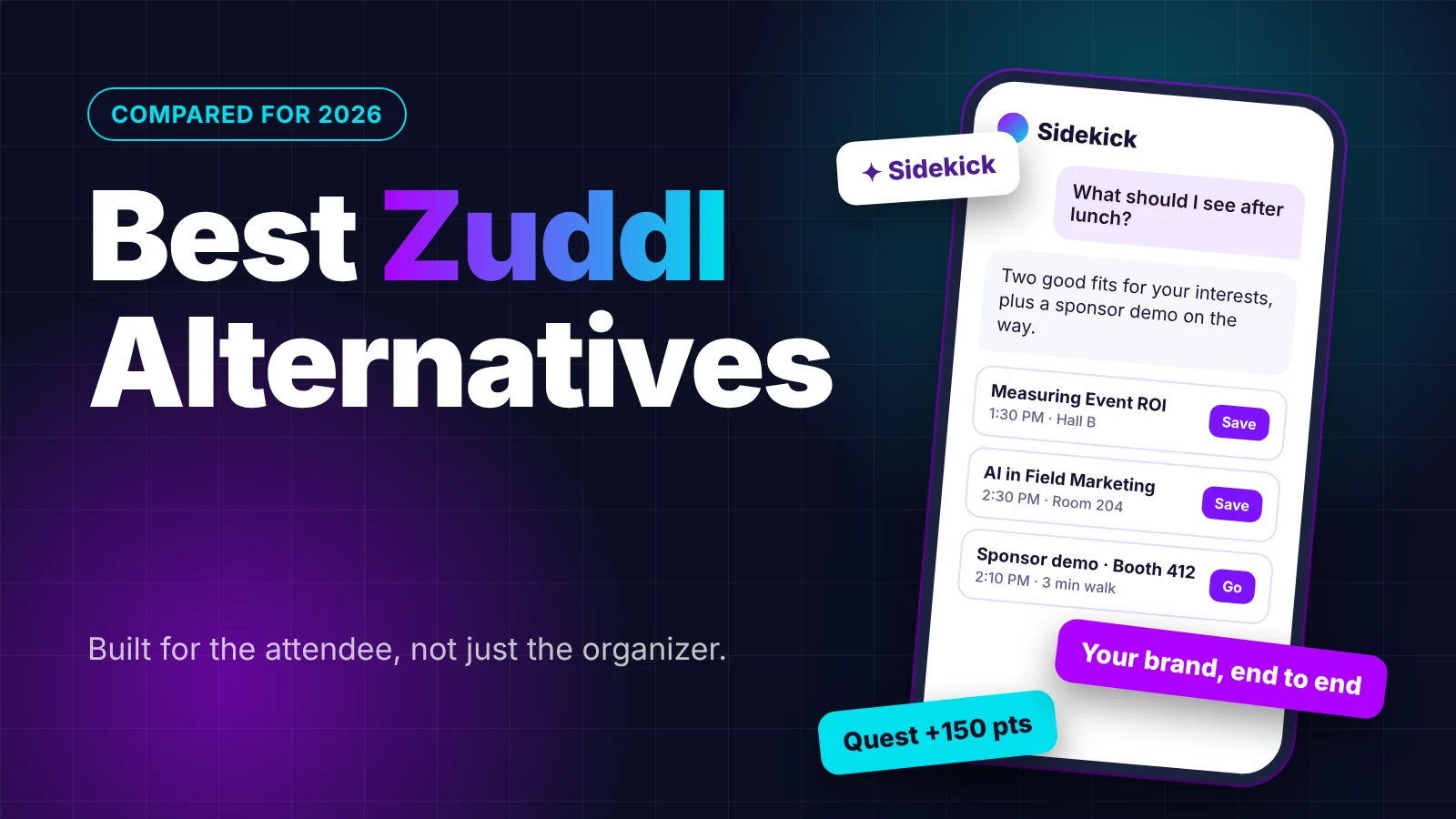
Best Zuddl Alternatives
The best Zuddl alternatives, compared for in-person events.
Subscribe for insights on AI- powered event apps, engagement strategies, and to learn more about how event teams are driving measurable results.


The Short Version
EventBase has a strong enterprise track record, but teams often look elsewhere when they want to make changes without a project ticket, justify the cost across a full event calendar, or add AI that helps attendees in the moment. This guide compares six EventBase alternatives for enterprise conferences, including Amego, Cvent, EventMobi, Whova, Swapcard, and Bizzabo. Amego's Amego Admin is part of that comparison.
EventBase has been building mobile event apps since 2009, and it has a serious enterprise track record. It has built official apps for SXSW, CES, and several Olympic Games, and its customer list includes Salesforce, IBM, Cisco, SAP, and Adobe. If you're researching alternatives to EventBase, though, something about your current setup probably isn't working the way you hoped.
Maybe your team wants to make changes without opening a project ticket. Maybe the cost is hard to justify across a full event calendar, or you want AI that helps attendees in the moment. Whatever the reason, this guide covers the best EventBase alternatives for 2026, including the EventBase competitors enterprise teams shortlist most often. For each one, you'll see what it does well, who it fits, and the questions that separate a good match from an expensive mistake.
For a broader view of the category, see our roundup of the best event apps of 2026.
These are the mobile event app alternatives worth a look. We've listed Amego first because it's our product, and we'd rather say that up front. The other five are real options, and each one wins in the right situation.
EventBase is a capable platform, and plenty of enterprise teams are happy with it. Its customers get a custom-branded app, a personalized first screen, in-session chat and polls, in-app gamification, and 3D Deep Maps on premium licenses. Reviewers on G2 also mention its customer support as a strength.
The reasons teams start comparing options tend to be practical ones:
None of these make EventBase a bad choice. They're the questions to answer before you renew or sign.
EventBase reviews well on G2, especially for support, so this isn't a lopsided matchup. The numbers below show how Amego's verified reviewers rate it against the G2 category average, which is the benchmark we can compare on every measure.
What G2 reviewers say
Above the Category Average Where It Counts
Verified G2 reviewers rate Amego above the category average on support, ease of use, and adoption.
Quality of support
vs. 95% category average
Average user adoption
vs. 68% category average
Ease of use
vs. 91% category average
Usability score
vs. 83% category average
Ease of admin
vs. 91% category average
Meets requirements
vs. 92% category average
Source: G2 user satisfaction ratings, 2026. Percentages reflect Amego's verified G2 reviews compared with the G2 category average.
Quality of support is 100% for Amego against a 95% category average, and average user adoption is 76% against 68%. Adoption is the number worth watching: it's the difference between an app attendees open once for the agenda and one they keep using all day. Reviewers also rate Amego higher on ease of use (98% vs. 91%) and ease of admin (95% vs. 91%), the scores that matter most when a small team is building an app for a big event on a tight timeline. G2 awarded Amego badges for Best Support, Easiest To Do Business With, and Easiest To Use, and named it a Leader in its Mobile Event Apps Grid for Summer 2026.
Best for: Enterprise conferences, trade shows, and corporate events that want a fully branded attendee experience
Amego is an enterprise-grade event platform with a customizable mobile app, an AI companion called Sidekick, and a CMS called Amego Admin. It was founded in 2021 by Scott Owens, who spent years in event tech at large companies and got tired of apps that treated every attendee the same.
Event apps aren't daily tools. People open them when something is unclear: where's the room, who should I meet, what's starting in ten minutes. Amego is built to reduce that uncertainty fast.
Sidekick builds personalized schedules, suggests people, sessions, and sponsors worth meeting, helps with wayfinding, and sends nudges during the event. Enterprise teams can connect their own LLM deployment if their security policy requires it.
On the organizer side, Amego Admin lets your events team update the agenda, rooms, speakers, and content directly. When a session moves at 7 a.m., you don't wait on a vendor.
Amego's event networking tools include attendee profiles, directories, messaging, meeting scheduling, digital connections, and AI-supported matchmaking. The goal is to help the right people find each other, not just to publish a searchable list of names.
The attendee engagement tools cover live polls, surveys, Q&A, push notifications, and news updates, so organizers can reach attendees all day without asking them to hunt through static content.
Quest is Amego's native event gamification feature. Sponsor challenges, attendee challenges, and internal team challenges can run side by side, which helps exhibitors drive and measure booth traffic.
Amego connects to the registration, CRM, and marketing systems enterprise teams already use. Browse the full integrations list. For sponsors, lead scanning includes qualification fields that exhibitors define, with exports they can act on right away.
Sidekick Spark embeds on your event website, so attendees can ask about sessions, speakers, and logistics weeks before they download the app. Spark has a free plan, which makes it an easy way to try Amego with no commitment.
Both platforms deliver branded, enterprise-grade apps with agendas, networking, gamification, sponsor tools, and wayfinding. The differences show up in how the work gets done. EventBase builds custom apps for large flagship events and delivers pieces like its AI assistant and indoor navigation through partners. Amego builds its AI companion, website AI guide, and gamification as its own products, with published pricing and unlimited events on every plan, so a regional summit gets the same experience as the flagship. Amego is also SOC 2 Type II and GDPR compliant, and supports events from 500 to more than 100,000 attendees.
Best for: Teams already running registration in Cvent
Cvent Attendee Hub makes the most sense when Cvent already runs your registration and event management. Keeping everything in one ecosystem simplifies data flow and vendor management, and that can outweigh app-specific differences.
EventBase is a dedicated app vendor, while Attendee Hub is one piece of a much larger suite. If the app is the experience you care most about, compare them side by side. We cover this in more depth in our guide to Cvent Attendee Hub alternatives.
Best for: Mid-market conferences and corporate events
EventMobi is a good fit for teams that want a solid event app without a heavy implementation. It covers the core features organizers expect, and teams running smaller or mid-sized programs often find it easier to get started than with an enterprise platform.
EventBase is positioned for large enterprise portfolios with Fortune 1000 clients. EventMobi tends to suit teams with simpler requirements and tighter budgets. Our EventMobi alternatives guide goes deeper.
Best for: Associations and community-driven events
Whova is known for attendee networking and community features, which makes it popular with associations and member events where connecting people is the main draw.
Whova leans toward community and networking. EventBase leans toward brand-controlled enterprise programs. If your event is built around member connection, Whova belongs on the list. For a closer look, read our Whova alternatives guide.
Best for: Networking-led events and expos
Swapcard puts matchmaking and meeting scheduling at the center of the experience. It's a strong option when the main reason people attend is to meet specific people, such as buyers and sellers at an expo.
Swapcard puts networking first, and EventBase puts the branded app experience first. Pick based on which one your attendees care about more. See our Swapcard alternatives guide for more.
Best for: B2B marketing events
Bizzabo is built around event marketing, with registration, ticketing, and an event app in one platform. It tends to fit marketing teams that want the app to sit inside a wider event marketing workflow.
Bizzabo covers more of the event lifecycle, while EventBase focuses on the mobile app itself. If you already have registration handled elsewhere, a focused app platform may be the better fit.
The core event app features look similar on both sides. The biggest differences are in AI guidance, how much is built in versus delivered through partners, and pricing flexibility. Based on public information as of October 2026, so confirm details with each vendor.
| Feature | EventBase | Amego |
|---|---|---|
| Mobile event app | ✓ | ✓ |
| Personalized agendas | ✓ | ✓ |
| Push notifications | ✓ | ✓ |
| Polls, surveys, and Q&A | ✓ | ✓ |
| Attendee networking | ✓ | ✓ |
| Meeting scheduling | ✓ | ✓ |
| Attendee matchmaking | ✓ | ✓ |
| Gamification | ✓ NFC badge challenges through a partner | ✓ Quest, built into the platform |
| Sponsor and exhibitor experiences | ✓ | ✓ |
| Lead capture | ✓ | ✓ |
| White-label branded app | ✓ | ✓ |
| Contextual attendee recommendations | Through a partner | ✓ |
| Location-aware experiences | Through a partner | ✓ |
| AI event guide on your event website | Not offered | ✓ Sidekick Spark |
| Pricing | Quote only | Published pricing |
| Unlimited events on every plan | Quote-based | ✓ |
| Free plan to start | No | ✓ Sidekick Spark |
A comparison post that tells everyone to switch isn't much use, so here's the honest version. EventBase may be the better fit if you run one very large flagship event and want a fully custom native app build. It also tends to suit teams that need large indoor navigation deployments, have budget for custom enterprise pricing, and are comfortable coordinating several technology partners.
The case for switching gets stronger when the app has to do more than one job. At one flagship event, a custom build can be worth the price. Across a program of regional summits, field events, and internal kickoffs, attendees expect the same polished experience everywhere, and your team needs to launch it without a new project each time.
Feature checklists make every vendor look the same. These are the comparison points that tend to change the outcome.
Ask each vendor what two different attendees see when they open the app. A first-time attendee and a VIP sponsor shouldn't get the same home screen.
A directory isn't networking. Look for recommendations, meeting scheduling, and ways to connect after the event ends.
Check whether challenges can serve sponsors, attendees, and internal teams at the same time, and whether exhibitors can see booth results.
Your brand should carry through every screen, not just the splash page. Ask to see a live customer app, not a template.
Confirm two-way syncs with your registration and CRM tools, and ask who builds and maintains them.
Ask what the AI actually does for an attendee at 9 a.m. on day two. "AI-powered" on a website tells you nothing.
Sponsors renew when they can prove ROI. Look at lead scanning, qualification fields, and exports.
Enterprise buyers should confirm SOC 2 Type II, GDPR compliance, and what the support model looks like on event day. See Amego's security and compliance page for an example of what to ask for.
After sitting through a lot of vendor demos, we've found three questions that cut through the noise. Ask all of them, and ask your current vendor too.
Rooms change. Speakers cancel. If the answer involves a ticket, a project manager, or "we'll get back to you," your attendees will be looking at the wrong schedule for hours. The right answer is "you, in about two minutes."
The first event is always a project. The tenth should be a template. Ask how much setup, design, and vendor time each additional event takes, and what it costs. This is where per-event services add up.
An event app collects a lot of useful behavior: sessions attended, people met, booths visited. Ask where that data goes, how it reaches your CRM, and how quickly. Data stuck in a dashboard doesn't help your sales team. For benchmarks on what good looks like, see our guides on event app adoption rates and event app ROI.
Match the platform to the event, not to a feature count.
And if you love your done-for-you EventBase setup, that's a perfectly good reason to stay. The point of an evaluation is to know you've chosen well.
For a wider comparison, our best event apps of 2026 guide covers more platforms side by side. You can also learn what an attendee experience app is and how it differs from a traditional event app.
Enterprise event teams pick Amego for a few consistent reasons: the app carries their brand all the way through, their own team can run it, and the attendee experience adapts to each person.
Atlassian described Amego as its "Goldilocks" app, built for agility, engagement, and scale. Read the Atlassian story. Cloudflare brought its global events together on one platform, and put Amego through its full vendor security review along the way. Read the Cloudflare story. Palo Alto Networks uses Amego to run global events with speed and flexible brand execution. Read the Palo Alto Networks story.
Amego is SOC 2 Type II and GDPR compliant, and G2 reviewers have named it a Leader and High Performer, with badges for Best Support, Easiest To Do Business With, and Easiest To Use. Customers include Atlassian, Docusign, Cloudflare, Palo Alto Networks, and ServiceNow, and events run on Amego range from 500 attendees to more than 100,000.
Want to see how Amego compares with your current setup? Schedule a demo and bring your toughest event-day scenario.
Popular EventBase alternatives include Amego, Cvent Attendee Hub, EventMobi, Whova, Swapcard, and Bizzabo. The best fit depends on your event size, how much control your team wants over the app, your networking and engagement goals, and the systems the app needs to connect to.
For large conferences, look for a platform your team can update without a vendor ticket, with full brand control, strong integrations, and personalization for different attendee groups. Amego is built around enterprise conference attendee experiences and gives events teams direct control through Amego Admin.
EventBase competitors in 2026 include Amego, Cvent Attendee Hub, EventMobi, Whova, Swapcard, Bizzabo, Guidebook, and Stova. They overlap on agendas, attendee profiles, notifications, and engagement, but differ on customization, AI, networking depth, and how much the vendor does for you versus your team.
Apps like EventBase include Amego, Cvent Attendee Hub, EventMobi, Whova, and Swapcard. Each offers a branded mobile event app with agenda, attendee, and engagement tools, so compare them on the parts of the attendee experience that matter most to your events.
EventBase offers an AI assistant called eventCopilot, built with partner TurnoutNow. Amego includes Sidekick, its own AI companion that builds personalized schedules, suggests people, sessions, and sponsors to meet, helps attendees find their way around, and sends in-event nudges. Sidekick Spark extends that guidance to your event website, and enterprise customers can connect their own LLM deployment.
Compare EventBase vs. competitors on the same criteria: attendee experience, personalization, networking, engagement, branding, integrations, AI, sponsor and exhibitor tools, security, and support. Then ask each vendor to show you how your team would make a change on event day.
Yes. Amego is an EventBase alternative for enterprise conferences, trade shows, and corporate events that want a fully branded mobile event app, an AI companion, and an admin your own team can run.
On G2, Amego scores above the category average on quality of support (100% vs. 95%), average user adoption (76% vs. 68%), ease of use (98% vs. 91%), overall usability (88% vs. 83%), ease of admin (95% vs. 91%), and meeting requirements (96% vs. 92%). Amego also earned G2 badges for Best Support, Easiest To Do Business With, and Easiest To Use.
For most event programs, yes. EventBase is priced as a custom enterprise build, and reviewers note the cost can put it out of reach for smaller events. Amego includes unlimited events on every plan, so your regional and field events get the same experience as your flagship.
Yes. Sidekick Spark embeds directly on your event website, so attendees can ask event-specific questions, explore sessions and speakers, check logistics, and start planning before they download the event app. Spark has a free plan.
Yes. Amego is SOC 2 Type II and GDPR compliant. Details are on the Amego security and compliance page.
New guides, benchmarks, and what we’re seeing on show floors. Written by event people, for ones running showtime.